Incline Dumbbell Press: Proper Form, Step by Step
Learn the proper form for the incline dumbbell press: setup, step-by-step execution, breathing, tempo, common mistakes and fixes for safe, effective chest training.
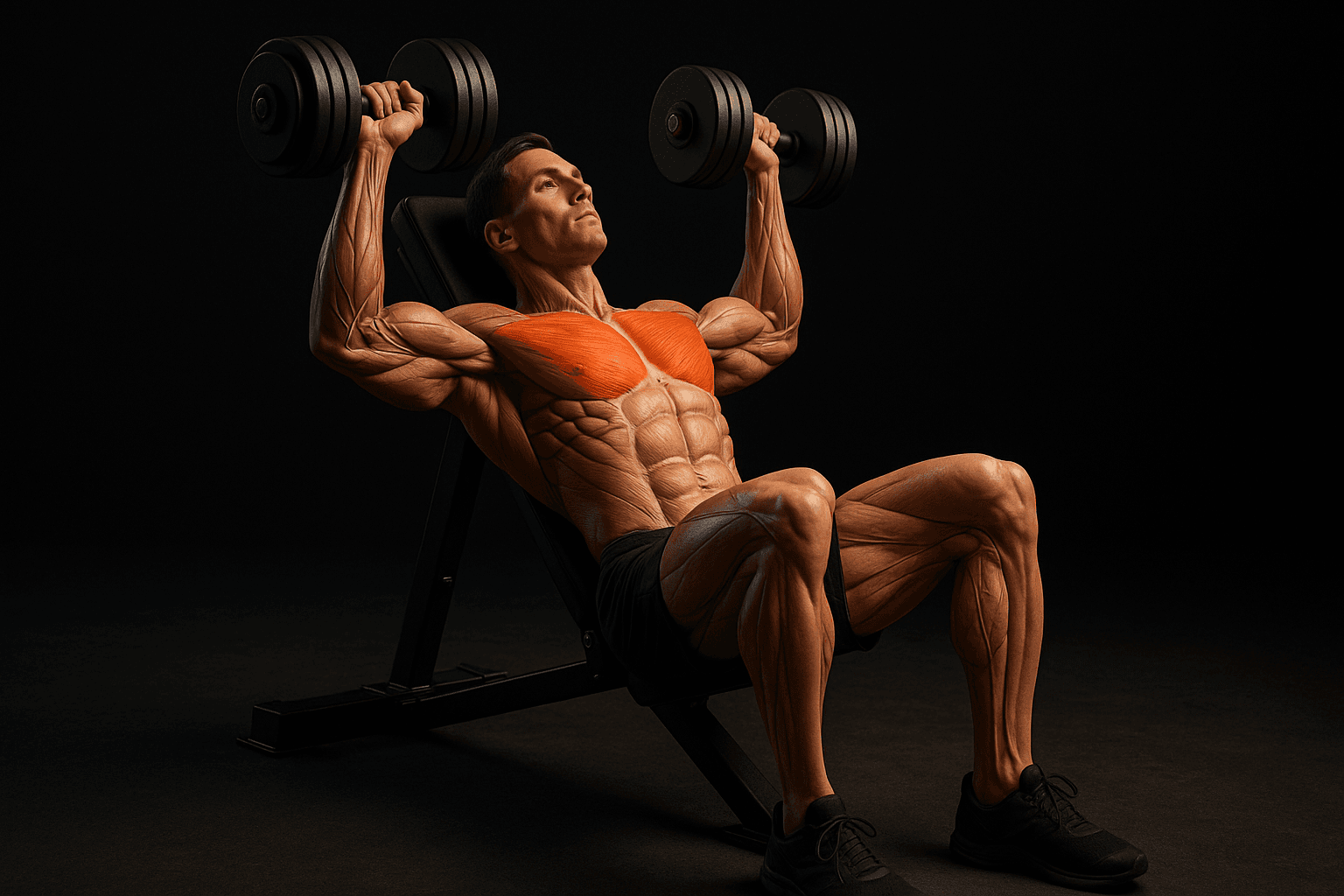
Photo by RepBro.
The proper form for the incline dumbbell press is to lie on an adjustable bench set to 30–45°, feet flat, scapula retracted and braced, press dumbbells from chest level up and slightly together without locking elbows, using a controlled 2s descent and a 1s concentric, breathing in on the descent and out on the press.
What is the incline dumbbell press and why use it?
The incline dumbbell press is a pressing exercise performed on an incline bench that targets the upper portion of the pectoralis major, with secondary loading of the anterior deltoid and triceps. Use it to add upper-chest emphasis and to improve pressing balance between left and right arms because each side works independently.
How should I set up before I touch the dumbbells?
- Bench angle: set 30°–45°. Use ~30° for less shoulder involvement; avoid >45° unless shoulder-dominant pressing is your goal.
- Dumbbell selection: pick a weight you can press for 6–12 clean reps with control.
- Position: sit on the bench with dumbbells on your thighs, feet flat and stable (hips-level or slightly above knees).
- Get the dumbbells up: use your legs to help bring the dumbbells to shoulder level as you lie back—don’t drop into the bench.
- Scapular setup: retract (pinch) and depress shoulder blades; keep this tight throughout the set to protect the shoulder.
- Elbow and wrist alignment: wrists stacked over elbows at the start, forearms vertical. Elbows should be under or slightly in front of dumbbells, not flared straight out.
How do I perform the incline dumbbell press, step by step?
- Start: Dumbbells at chest level with a neutral or slight palms-in rotation (thumbs pointing slightly inward). Upper arms at about 30°–45° from torso.
- Brace: Take a full inhale and brace your core and glutes to create a stable base.
- Lowering (eccentric): Lower both dumbbells in 2 seconds to just below chest level or until upper arm is parallel to the floor. Maintain scapular retraction and a slight arc line — don’t track dumbbells straight up and down like a machine.
- Pause: Brief 0.5–1 second pause at the bottom—no bouncing.
- Pressing (concentric): Exhale and press up in about 1 second, slightly converging the dumbbells at the top without banging them together. Stop short of hyperextending elbows.
- Hips and feet: Keep feet flat and hips down. Don’t overarch the lower back—maintain a natural lumbar curve.
- Reps and sets: Start with 3–4 sets of 6–12 reps for hypertrophy or 3–6 reps for strength with heavier load and longer rest (2–3 minutes). Adjust according to your program.
What tempo and breathing should I use?
- Tempo: 2-1-1 is practical: 2s descent, 1s pause, 1s press. Use slower eccentrics (3s) for emphasis or controlled progressions.
- Breathing: Inhale during the descent, hold briefly while braced at the bottom, exhale through the press. Avoid breath-holding across multiple reps unless using a trained Valsalva for maximal single lifts and under supervision.
What cues help maintain proper form?
- "Chest proud": keep ribs slightly tucked and chest up to emphasize pec engagement.
- "Elbows 30°–45°": avoid flaring elbows perpendicular to the torso to reduce shoulder stress.
- "Back tight, feet grounded": maintain a stable platform.
- "Squeeze, don’t slam": converge dumbbells slightly at the top; think control, not collision.
What are common mistakes and how do I fix them?
-
Mistake: Bench too steep (>45°).
- Fix: Lower to 30°–45° to reduce shoulder overload and increase upper-chest emphasis.
-
Mistake: Flaring elbows to 90°.
- Fix: Tuck elbows so they sit about 30°–45° from your torso; this spreads load across pecs and triceps instead of overloading the shoulder joint.
-
Mistake: Letting shoulders round forward (no scapular retraction).
- Fix: Retract and depress shoulder blades before every rep; practice with lighter weights until it’s consistent.
-
Mistake: Too fast descent or bouncing off the chest.
- Fix: Use a controlled 2–3s descent and a 0.5–1s pause to preserve tension and protect the shoulder.
-
Mistake: Overextending the lower back.
- Fix: Plant feet and brace core; allow a natural small arch but don’t force ribs upward. Use slightly lighter weight if needed.
-
Mistake: Uneven pressing between sides.
- Fix: Pause at bottom to reset each rep and focus on driving evenly; reduce load and prioritize symmetry.
How should I progress and program the incline dumbbell press?
Progress by increasing reps, sets, or load in small steps: add 1–2.5 kg per dumbbell every 1–3 weeks depending on performance. Use it 1–3 times weekly depending on your training split. Track sets, reps, and tempo; if you log workouts, apps like RepBro can help you manage progressive overload and compare variants: https://apps.apple.com/us/app/gym-workout-coach-repbro/id6763749305.
Safety note
Stop any set immediately if you feel sharp or sudden joint pain; consult a qualified professional for persistent pain or an injury. This guide is educational and not a diagnosis.
Quick FAQ
- How heavy should I go? Choose a weight you can control for the target rep range with good form. 6–12 reps is a common starting range.
- Should I touch my chest? Touch lightly or stop just above the chest to maintain tension and avoid shoulder stress—avoid bouncing.
- Dumbbells or barbell? Dumbbells improve range and symmetry; barbell allows heavier loading. Use both depending on goals.
Honest takeaway: Use a 30°–45° bench, keep scapulae packed, control the descent, and press with a steady tempo to make the incline dumbbell press safe and effective.
Frequently asked questions
- What angle should the bench be for the incline dumbbell press?
- Use a bench angle between 30° and 45°. Around 30° emphasizes upper chest with less shoulder strain; above 45° shifts load toward shoulders.
- How should I breathe during the incline dumbbell press?
- Inhale on the controlled descent (eccentric), pause briefly at the bottom, then exhale during the press (concentric). A typical tempo is 2-1-1: 2s down, 1s pause, 1s up.
- Is the incline dumbbell press safer than the barbell version?
- Dumbbells allow more shoulder rotation and individual arm control, which can feel safer for many people; barbell allows heavier loading. For a side-by-side comparison, see this guide: https://www.repbro.app/vs.