How to Progress Weight Lifting as a Beginner: A Simple Session-by-Session System
Not sure when or how much to add weight? This beginner progression system uses rep completion to tell you exactly when to increase load — session by session.
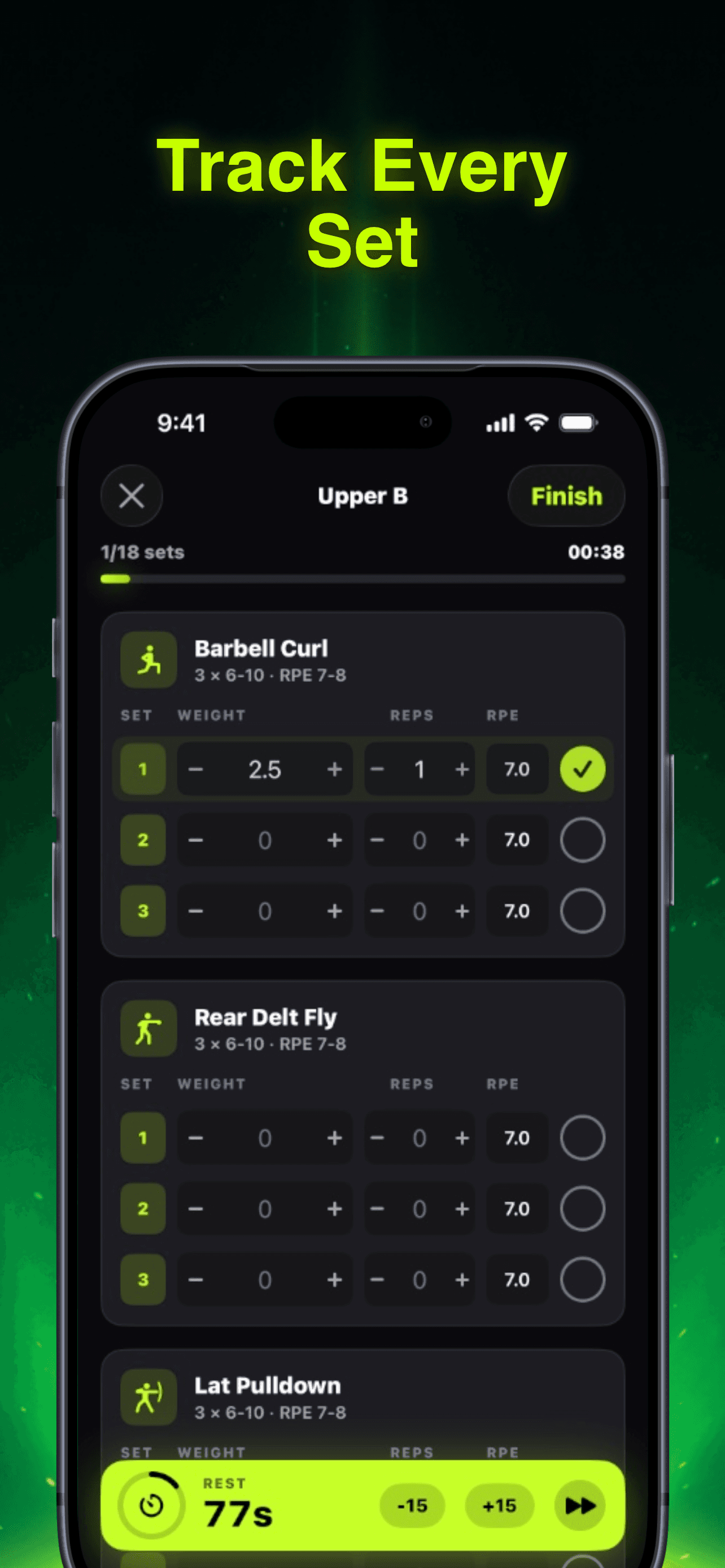
Photo by RepBro.
The One Question Every Beginner Gets Wrong
Most new lifters walk into the gym with a vague plan: lift something, add weight eventually, repeat. The problem is "eventually." Without a rule for when to add weight, you either stall out too early or stay at the same load for months and wonder why nothing is changing.
Here is the short answer: add weight to the bar when you complete all prescribed reps across all sets with acceptable form and at least one rep left in the tank on the last set. That's it. Everything below is the practical system built around that rule.
What Is Linear Progression and Why Does It Work for Beginners?
Linear progression means adding a small, fixed amount of weight every session (or every week). It works for beginners because untrained muscles respond to almost any increase in stimulus. A 2024 study by Chaves et al., reviewed in Stronger By Science, found that untrained individuals gained similar strength and muscle size whether they progressed load or reps — both worked. The takeaway: beginners are so sensitive to new stress that the exact method matters less than the fact that you're consistently pushing forward. Linear progression is just the simplest, most trackable method.
As you get more trained, load progression becomes more important for strength specifically. But for your first 3–6 months, a simple rule-based system will outperform any complicated periodization scheme.
How Much Weight Should You Add Each Session?
This depends on the lift. Bigger compound movements with more muscle mass can absorb larger jumps. Smaller isolation exercises need finer increments.
General guidelines per session:
- Squat: +5 lb (2.5 kg) per session
- Deadlift: +5–10 lb (2.5–5 kg) per session
- Bench press: +2.5–5 lb (1–2.5 kg) per session
- Overhead press: +2.5 lb (1 kg) per session
- Barbell row: +5 lb (2.5 kg) per session
- Dumbbell exercises: +2.5–5 lb (1–2.5 kg) per side, or move to the next dumbbell increment
These are starting points, not commandments. If you're a larger, more athletic beginner, you might handle bigger jumps early on. If 5 lb feels like a wall on bench after two weeks, drop to 2.5 lb micro-plates. Progress is progress.
The Rep Completion Rule: Your Decision Framework
Forget guessing. Here's the system to run every session:
Step 1 — Set a rep target range, not a single number
Instead of "3 sets of 8," use "3 sets of 6–10." The range gives you room to grow without changing the program every week.
Step 2 — Log every set
Write down the weight, reps completed, and how hard it felt (RPE 1–10 works fine — 10 is a true max, 8 means 2 reps left). Don't rely on memory.
Step 3 — Apply the rule at the end of the session
- Hit the top of your range on ALL sets (e.g., all three sets hit 10 reps) → add weight next session
- Hit the bottom of your range on all sets but not the top (e.g., 8, 7, 6 reps) → repeat the same weight
- Miss the bottom of your range (e.g., 5 reps on the last set) → drop weight by 10% and rebuild
That third scenario is called a "reset." It feels like failure. It isn't. It's the system working.
Step 4 — Add the prescribed increment and repeat
Next session, load the new weight and start the cycle again. Most beginners can run this for 3–6 months on the big lifts before needing anything more sophisticated.
A Real Example: 8 Weeks on the Bench Press
Say you start at 95 lb for 3 sets of 6–10.
| Week | Weight | Sets × Reps | Decision |
|---|---|---|---|
| 1 | 95 lb | 8, 7, 6 | Repeat |
| 2 | 95 lb | 10, 9, 8 | Repeat |
| 3 | 95 lb | 10, 10, 10 | Add weight |
| 4 | 100 lb | 7, 6, 5 | Repeat |
| 5 | 100 lb | 9, 8, 7 | Repeat |
| 6 | 100 lb | 10, 10, 9 | Repeat |
| 7 | 100 lb | 10, 10, 10 | Add weight |
| 8 | 105 lb | 8, 7, 6 | Repeat |
Eight weeks in, you've added 10 lb to your bench with zero guesswork. Annualized, that's a 65 lb increase. That's not a typo. Beginners who actually follow a system improve fast.
Common Beginner Mistakes That Kill Progression
Ego loading. Jumping 10–20 lb because last session felt easy. The reps will tell you if you were right. Usually you weren't.
Skipping the log. If you don't write it down, you can't apply the rule. Memory is unreliable. Every set, every session.
Adding weight too early on overhead movements. The overhead press stalls faster than any other barbell lift. Drop to 1.25 lb micro-plates (or 0.5 kg) when 2.5 lb jumps stop working. Most commercial gyms have 1.25 lb plates — ask.
Ignoring RPE. Completing all reps at RPE 10 (grinding, form breaking down) is not the same as completing them at RPE 8. If you're redlining to hit your rep target, the weight is already too heavy. Hold the load, fix your form, then progress.
Switching programs every two weeks. Linear progression only works if you let it run. In my experience, most beginners abandon a program right before it would have started paying off. Pick a system, commit to 8–12 weeks, then evaluate.
When to Stop Using Linear Progression
You'll know it's time to move on when you fail to complete your rep range three sessions in a row — even after a reset. At that point, weekly progression (adding weight once per week instead of every session) is the natural next step. This is sometimes called "intermediate" programming. You're not failing; you've just extracted most of the beginner gains from session-to-session loading.
For most lifters, this transition happens somewhere between 3 and 9 months in, depending on the lift. The deadlift tends to stall last; the overhead press stalls first.
The One Thing to Do in Your Next Session
Bring a log — phone, paper, whatever. Write down the weight and reps for every set. At the end, apply the rep completion rule. If you hit the top of your range on all sets, load the bar heavier next time. That single habit, repeated consistently, is the entire system.
If you want the logging and the decision-making handled automatically — including knowing exactly when to add weight and by how much — RepBro tracks every set and gives you an AI coach that has full context of your plan and your PRs, ready to answer mid-workout.
Frequently asked questions
- How do I know when to increase weight as a beginner?
- Use the rep completion rule: when you complete all reps across all sets at the top of your target range (e.g., 3×10 when your range is 6–10), add weight next session. If you only hit the middle of your range, repeat the same weight. If you miss the bottom, drop 10% and rebuild.
- How much weight should a beginner add to the bar each session?
- For the squat and deadlift, add 5 lb (2.5 kg) per session. For the bench press, add 2.5–5 lb (1–2.5 kg). For the overhead press, add 2.5 lb (1 kg). These are starting points — adjust down if you're failing sets, or up if the jumps feel trivial in the first few weeks.
- What is linear progression for beginners?
- Linear progression means adding a small, fixed amount of weight every session. It works because untrained muscles respond strongly to any new stimulus. Most beginners can run it for 3–6 months on compound lifts before needing a more advanced approach like weekly progression.
- What should I do if I miss my rep target?
- If you miss the bottom of your rep range on any set, repeat the weight next session. If you miss it three sessions in a row, perform a reset: drop the weight by 10% and build back up. Resets are part of the system, not a sign of failure.
- When should beginners stop using linear progression?
- Move on when you fail to complete your rep range three consecutive sessions even after a reset. At that point, switch to weekly progression — adding weight once per week rather than every session. For most lifters this happens 3–9 months in, depending on the lift.