
GZCLP vs Alpha Progression vs Fitbod: Which Program (and Tool) Should You Actually Run?
GZCLP, Alpha Progression, and Fitbod each suit different lifters. This breakdown covers program structure, progression logic, and who each tool is actually built for.
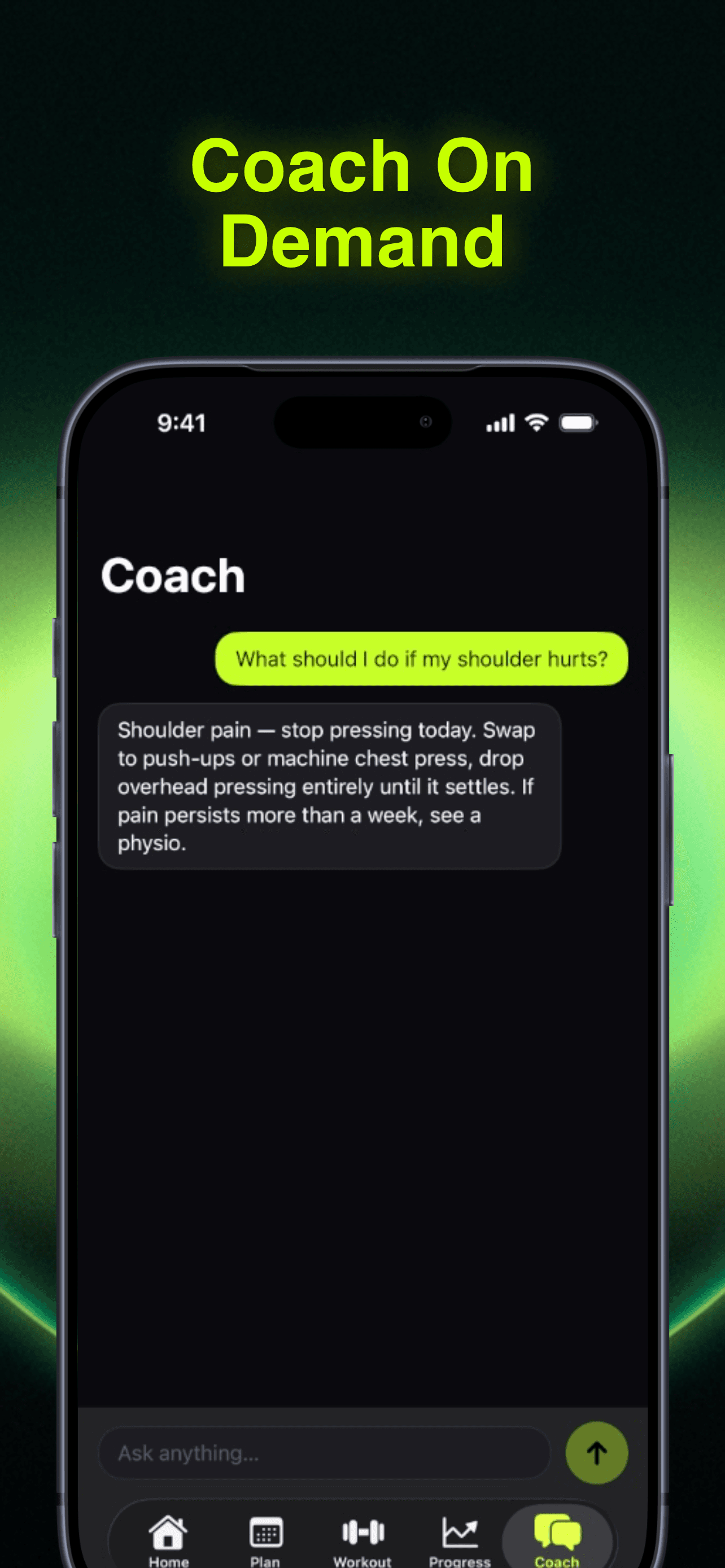
Photo by RepBro.
The Real Question Isn't Just Which Program — It's Which Program for You
Picking a lifting program feels like it should be simple. It isn't. You've got GZCLP sitting on a Reddit wiki, Alpha Progression with its slick app interface, Fitbod with its algorithm-driven workouts, and about forty other options all claiming to be the one you need.
Here's the short answer: GZCLP is the best free, proven linear progression template for raw beginners. Alpha Progression is a solid app for lifters who want structured hypertrophy with minimal guesswork. Fitbod is flexible but trades programming rigor for variety, which can hurt beginners chasing strength. All three have real trade-offs, and none of them adapt in real time to what you just told them in the gym.
That context matters. Let's get into it.
What Is GZCLP?
GZCLP is a linear progression program derived from Cody Lefever's GZCL method. Lefever, a powerlifter who competed in the USPA, published the GZCL framework publicly; GZCLP is a community-adapted beginner template built on top of it.
The program organizes movements into three tiers:
- T1 (Tier 1): Main strength lifts — squat, bench, overhead press, deadlift. Low rep, high intensity. Default: 5 sets × 3 reps at heavy load.
- T2 (Tier 2): Supplemental compounds — front squat, Romanian deadlift, incline press, etc. Moderate rep, moderate intensity. Default: 3 sets × 10 reps.
- T3 (Tier 3): Accessory isolation work — curls, lat pulldowns, tricep work. High rep, low intensity. Default: 3 sets × 15 reps.
Progression logic: Add 5 lb to T1 lifts each session. When you fail to hit the reps, you drop to 6 sets × 1 rep at the same weight, then reset to a lower weight and rebuild. T2 progresses by adding reps until you hit 3 × 15, then adding weight and dropping back to 3 × 10.
This tiered structure is genuinely smart. It keeps intensity high on the main lifts while accumulating volume through supplemental work — a design principle that holds up well in the literature on strength development. A 2017 review in the Journal of Strength and Conditioning Research found a dose-response relationship between weekly sets per muscle group and hypertrophy, and GZCLP hits that target across all three tiers.
Who GZCLP is for: Complete beginners to early intermediates with access to a barbell and a squat rack. It's free, well-documented, and has a large community. The weakness: it's a spreadsheet. You track it manually, there's no coaching, and when something breaks down — a missed rep, an injury, a travel week — you're on your own figuring out the fix.
What Is Alpha Progression?
Alpha Progression is a paid app (subscription-based) that generates hypertrophy-focused training plans based on your experience level, available equipment, and weekly schedule. It uses a volume-progression model: it tracks your sets per muscle per week and nudges volume up over time in line with hypertrophy research, particularly the work popularized by researchers like Brad Schoenfeld.
Strengths:
- Clean exercise library with video demos
- Tracks weekly sets per muscle group automatically
- Deload suggestions built in
- Solid for intermediate lifters focused on muscle growth rather than raw strength numbers
Weaknesses:
- Less emphasis on the big barbell lifts as a foundation
- No real-time coaching — it logs your sets, but it doesn't think about your session
- Progression can feel mechanical; it doesn't know if you were sick last week or if your shoulder is acting up
Alpha Progression is a legitimate tool. For an intermediate lifter who knows the basics and just wants a structured hypertrophy block with good volume tracking, it does the job. It's not built for powerlifting-style strength development, and it won't tell you why your squat is stalling.
What Is Fitbod?
Fitbod takes a different approach. It uses an algorithm to generate each workout based on your logged history, targeting muscles that are "recovered" based on your last session's volume. The idea is to always be training fresh muscle groups.
In practice, this creates a lot of variety — sometimes too much. Beginners need specificity and repetition to learn movement patterns and drive linear progression. Fitbod's algorithm can rotate you through exercises so frequently that you never build a groove on the squat or bench. For a novice, that's a real problem.
Where Fitbod shines: gym-goers who train inconsistently, travel frequently, or have access to unpredictable equipment. Its equipment filters are genuinely good. If you're in a hotel gym with two dumbbells and a cable machine, Fitbod will build you something reasonable.
The trade-off: Fitbod optimizes for recovery-based variety. GZCLP optimizes for progressive overload on a fixed set of movements. For building strength, progressive overload on the same movements wins — full stop.
Head-to-Head: The Three Key Decisions
1. Are you a beginner chasing strength?
Run GZCLP. The tier structure, the linear progression, and the emphasis on barbell compounds will build your strength base faster than either app. Pair it with a simple spreadsheet or a logging app that lets you track T1/T2/T3 sets with weight and RPE.
2. Are you an intermediate focused on hypertrophy?
Alpha Progression is worth a look. Its volume-tracking logic is grounded in real hypertrophy research, and it removes the mental overhead of counting weekly sets per muscle. Just know that you're getting a structured template, not a coach.
3. Do you need maximum flexibility across equipment?
Fitbod handles equipment variability better than either alternative. But if you have a consistent gym setup, that flexibility comes at the cost of programming rigor. Use it as a gap-filler, not a foundation.
What All Three Are Missing
None of these options give you a coach in your pocket. GZCLP is a spreadsheet — when your deadlift stalls, you're Googling. Alpha Progression tracks volume but can't tell you whether to push through a heavy set or back off based on how you described feeling. Fitbod doesn't know your injury history or your actual goals beyond what you clicked at setup.
Real coaching means having context: your current program, your recent PRs, your fatigue, and your question — all at once. That's what separates a training log from a training partner.
For example: say you're three weeks into a GZCLP-style block and your T1 squat just failed for the second session in a row. The right answer isn't always "reset 10%." It depends on whether your technique broke down, whether you've been sleeping, whether your T2 volume is too high. A static app can't make that call.
How to Choose (A Simple Framework)
Work through these in order:
- Experience level — Less than one year of consistent training? Linear progression (GZCLP-style) is almost always the right call.
- Primary goal — Strength or size? Strength demands barbell specificity. Size allows more exercise variety.
- Equipment — Full barbell gym, or mixed/inconsistent? Fitbod handles the latter; GZCLP requires the former.
- Coaching need — Do you have questions mid-session? Do you need swaps when equipment is taken? Do you want someone to push you? A static program or a passive log won't help here.
If you land on needing real-time, context-aware coaching alongside a personalized plan — not just a tracker — that's where an AI coach that knows your full training history changes the outcome.
RepBro generates a personalized split in 90 seconds, tracks every set with RPE, and lets you ask the AI coach mid-workout — "should I swap Romanian deadlifts for something easier on my lower back today?" — and get an answer that actually accounts for your program, your PRs, and your equipment. That's the gap none of the three options above fill.
Try it free for 7 days and see what set-by-set coaching actually feels like.
Frequently asked questions
- What is GZCLP and who is it for?
- GZCLP is a barbell-based linear progression program derived from Cody Lefever's GZCL method. It organizes training into three tiers: heavy low-rep compounds (T1), moderate supplemental lifts (T2), and high-rep accessories (T3). It's best for beginners to early intermediates with access to a barbell and squat rack who want a free, proven strength foundation.
- How does GZCLP progression work?
- T1 lifts (squat, bench, deadlift, OHP) add 5 lb per session. When you fail to complete the target reps, you drop to 6×1 at the same weight, then reset to a lower weight and rebuild. T2 lifts add reps each session until you hit 3×15, then you add weight and reset to 3×10.
- Is Alpha Progression better than Fitbod?
- For structured hypertrophy with consistent equipment, Alpha Progression is the stronger choice — its volume-tracking logic is grounded in research and progression is systematic. Fitbod is better for lifters with inconsistent gym access or equipment, but its variety-first algorithm can slow strength gains for beginners.
- Can I run GZCLP in a gym app?
- Yes. GZCLP is a public, free program, so you can log it in any workout tracking app that lets you record sets, reps, and weight per exercise. Look for an app that also supports RPE logging and lets you ask coaching questions mid-session — that fills the gap GZCLP's spreadsheet format leaves open.
- What's the main weakness of Fitbod for beginners?
- Fitbod rotates exercises frequently based on muscle recovery, which limits the repetition beginners need to build movement patterns and drive linear strength gains. Beginners benefit most from training the same compound lifts consistently — something Fitbod's algorithm isn't optimized for.
- How is RepBro different from Alpha Progression or Fitbod?
- RepBro generates a personalized program like Alpha Progression, tracks every set like Fitbod, and adds a layer neither offers: a mid-workout AI coach with full context of your plan, PRs, and equipment. You can ask it to swap exercises, explain a plateau, or adjust your program — and get a reasoned answer, not a generic suggestion.
