Standing Calf Raise: Proper Form, Step by Step
Definitive standing calf raise form guide: setup, execution cues, breathing, tempo, common mistakes and fixes. Safety-first instructions for pain-free reps.
Photo by RepBro.
Standing calf raise proper form: stand with the balls of your feet on a platform or machine pad, feet about hip-width, load the weight, drive your heels up by plantarflexing the ankle until you feel a firm contraction, pause briefly at the top, then lower under control until you feel a safe stretch in the calf — keep your torso upright and avoid bouncing.
How do I set up the standing calf raise?
- Foot placement: place the balls of your feet on a raised block or the machine footplate so your heels can lower below the forefoot. Position feet about hip-width apart, toes pointing forward or slightly out (0–10°).
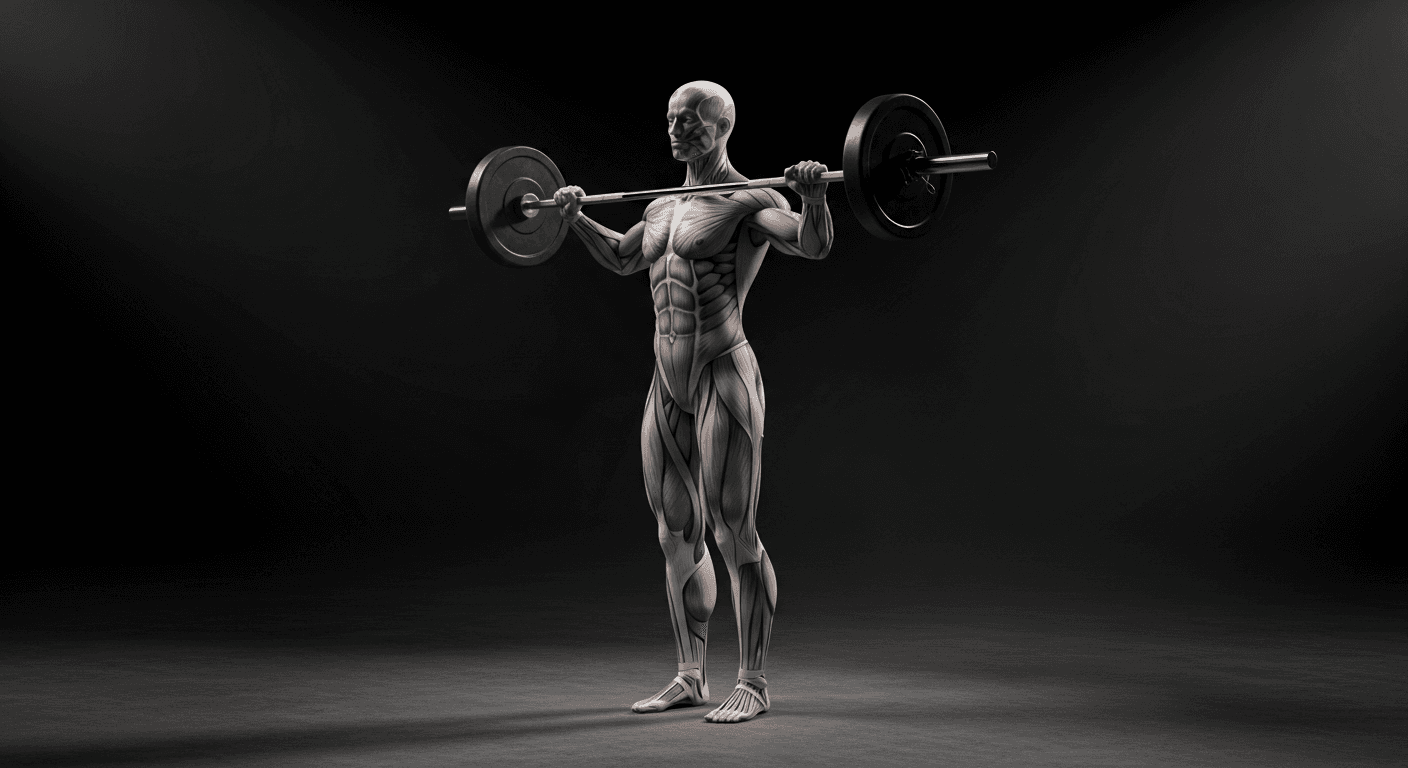
- Load and balance: if using a machine, adjust the shoulder pads to sit comfortably on your traps. If using a barbell, place it across your upper traps or use a trap bar; hold a dumbbell in one hand for single-leg work. Keep weight centered over the midfoot.
- Knee position: keep a soft but mostly extended knee — avoid full lockout/hyperextension. A small bend (~5–10°) protects the joint and keeps emphasis on the calves.
- Spine and head: stand tall, chest up, neutral spine. Look forward, not up or down.
How to perform the movement (step-by-step)
- Unrack or step into the start position with a full—comfortable—dorsiflexion: heels lowered until you feel a controlled stretch across the calves.
- Drive through the balls of the feet and press your heels upward by plantarflexing the ankle. Keep the motion driven from the ankle, not from rising onto the toes via hip extension.
- Reach near-full plantarflexion. Aim for a firm contraction; you do not need to force an excessive ankle inversion or toe point to get a better contraction.
- Pause 0.5–1 second at the top to remove elastic bounce and ensure time under tension.
- Lower slowly and under control back to the start position until you again feel a measured stretch in the calf.
- Repeat for the prescribed reps. Reset form between sets if you start to use momentum.
Breathing and tempo
- Breathing: exhale during the concentric (raising) phase, inhale during the eccentric (lowering) phase. So: exhale as you rise, inhale as you lower.
- Tempo: use a controlled tempo to maximize muscle tension. Recommended tempo for most goals: 1s concentric (rise), 0–1s pause at top, 2–3s eccentric (lower). Example notation: 1-1-3. For strength use slightly slower eccentrics (2–3s); for higher rep endurance you can use 1-2s eccentrics but maintain control.
- Reps and sets (practical guide): 3–4 sets of 8–15 reps for general strength/hypertrophy; calves often tolerate higher volume, so 12–20 reps can work too. For single-leg variations 3 sets of 8–12 per leg is reasonable.
Common mistakes and how to fix them
-
Using momentum/bouncing
- Fix: Slow the eccentric to 2–3s, add a 0.5–1s pause at the top, and reduce the load until you can move deliberately.
-
Rising with hips or back instead of ankles
- Fix: Focus on driving through the balls of the feet and keeping the torso static. Lighten load, and use a mirror or partner to watch for hip rise.
-
Locking or hyperextending the knees
- Fix: Soften the knees slightly (5–10°). Think 'tall spine, soft knees' to take pressure off the joint.
-
Not using full range of motion
- Fix: Lower until you feel a controlled stretch and rise until you reach near-full plantarflexion. Reduce weight if range of motion is limited under load.
-
Holding breath or breathing inconsistently
- Fix: Use an intentional breath pattern: exhale on the rise, inhale on the lower. Do this every rep.
Progressions and variations
- Weighted bilateral machine/barbell standing calf raise: best for heavier loads and progressive overload.
- Single-leg standing calf raise: removes bilateral deficits and increases time under tension per calf; use bodyweight or dumbbell as needed.
- Pause reps: add a 2s isometric hold at the top to increase time under tension.
- Tempo eccentric focus: use a 3–4s lowering phase for additional stimulus; reduce load accordingly.
If you want to compare how this stacks up against seated calf raises or other calf work, see the comparison notes at https://www.repbro.app/vs. For planning and tracking sets/weights precisely you can use the RepBro app.
Safety note
Stop immediately if you feel sharp or shooting pain in the Achilles, ankle, or calf. If pain persists, consult a qualified professional before continuing — this guide is not a diagnosis. Start light, progress gradually, and prioritize controlled range over heavy weight.
Quick troubleshooting
- Weak top-end contraction: try a 1s pause at the top and visualize pulling your heels down into the ground to better activate the gastrocnemius.
- Limited dorsiflexion (can't reach a deep stretch): work on ankle mobility, shorten stance on the block, and reduce load until mobility improves.
Short FAQ
Q: How often should I train calves? A: 2–3 times per week is a practical starting point, allowing 48–72 hours between focused sessions for recovery.
Q: Are full-range reps necessary every set? A: Yes, when safe. Full range promotes balanced development. Use modified ROM only if you have mobility limitations or are rehabbing.
Q: Can I do single-leg calf raises every session? A: You can, but monitor volume. Single-leg work is more demanding; start with 2–3 sets per leg and scale up based on recovery.
One-sentence takeaway: Master the standing calf raise by prioritizing full controlled range, a 1-3s tempo, soft knees, and stop for pain — progress weight only when technique is clean.
Frequently asked questions
- Should my knees be locked during standing calf raises?
- No. Keep the knees softly extended (not hyperextended). A slight bend of 5-10° reduces joint stress and keeps the work on the calves.
- Is it better to do seated or standing calf raises?
- Both are useful: standing calf raises bias the gastrocnemius (two-joint muscle), seated calf raises bias the soleus. Use both or compare results—see how they differ at https://www.repbro.app/vs.
- How much weight should I use?
- Use a load that allows the prescribed tempo and full range of motion for your target reps. Start light to master form and increase 2.5-10% once you can hit all sets with clean technique.