Reverse Pec Deck Alternatives at Home (Minimal Equipment)
Practical, evidence-aware at-home substitutes for the reverse pec deck using dumbbells, bands, and bodyweight. What each option preserves and when to head back to the gym.
Photo by RepBro.
If you don’t have a reverse pec deck, you can reliably target rear delts and upper back at home with 4–5 options: dumbbell chest-supported or standing rear flyes, band face-pulls and band flyes, prone T/Y/I raises, and single-arm bent-over rows with external rotation. Each trades machine isolation for more stability demand.
What exactly does the reverse pec deck do that I should try to match?
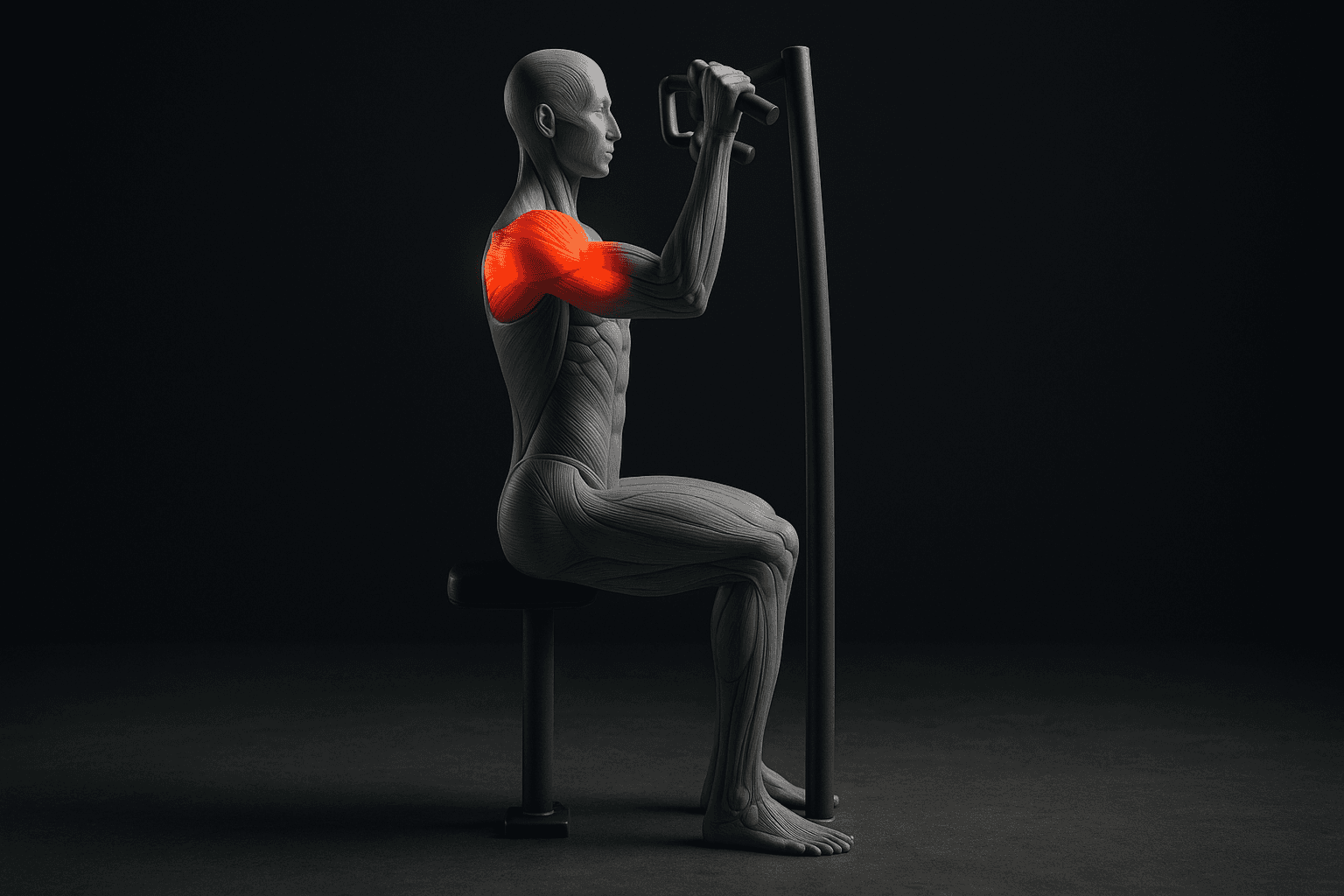
A reverse pec deck primarily loads the posterior deltoid and upper back through horizontal shoulder abduction and external rotation, with a fixed arc and consistent tension while the torso is supported. The machine reduces stabilizer demand and makes loading and tempo easy to control. When choosing an at-home alternative, ask: can it target the same movement plane, provide progressive overload, and keep the shoulder safe?
Which at-home movements most closely match the reverse pec deck?
Below are 5 practical substitutes using minimal equipment. For each I note what it preserves versus what you lose compared with the machine.
- Dumbbell chest-supported reverse fly (on an incline bench or angled couch)
- What it preserves: chest support reduces low-back demand; good isolation of rear delts and rhomboids; simple loading progression with heavier dumbbells.
- What it loses: less constant horizontal tension across the arc unless you control tempo; requires an incline setup.
- When to use: when you have an adjustable bench or a sturdy angled surface and want machine-like isolation.
- Band face-pulls (high anchor)
- What it preserves: excellent external rotation cue and scapular retraction; consistent tension across range if band angle is suited.
- What it loses: variable resistance (light at start, stronger at end) and harder to quantify load precisely compared with plates.
- When to use: for shoulder health, higher-rep work, and when you want to train end-range external rotation.
- Standing or bent-over single-arm dumbbell rear fly with external rotation
- What it preserves: good single-leg/single-arm balance allows focus on movement quality and unilateral correction; straightforward load progression.
- What it loses: more stabilizer demand can reduce isolation; gravity’s effect is fixed (less constant tension through entire arc compared to machine).
- When to use: when you have limited space and want to correct side-to-side strength imbalances.
- Prone T, Y, I raises on floor or bench (bodyweight or light weights)
- What it preserves: excellent scapular control and distal-rear-delt activation; useful for motor-patterning and endurance.
- What it loses: limited loading potential with bodyweight; progression requires small increments (light plates, micro-weights, or bands).
- When to use: for technique, scapular stability, and higher-rep endurance work.
- Band-resisted reverse fly (dual-anchored bands or looped around a sturdy post)
- What it preserves: continuous tension and easy angle adjustments to match the pec deck’s arc; quick progression by using thicker bands or doubling up.
- What it loses: loading precision is approximate; anchor position affects the line of pull so setup matters.
- When to use: for a close simulation of machine tension when you lack a bench or many dumbbells.
How do these alternatives compare at a glance?
| Movement | Primary equipment | Preserves | Loses |
|---|---|---|---|
| Chest-supported DB reverse fly | Dumbbells + bench/couch | Support, isolation, simple loading | Slightly different tension curve |
| Band face-pull | Band + anchor | External rotation focus, scapular retraction | Variable load, anchor-dependent |
| Single-arm bent-over DB fly + ER | Dumbbell | Unilateral work, easy progression | More stabilizer demand, less isolation |
| Prone T/Y/I raises | Bodyweight or light DBs | Scapular control, motor pattern | Limited loading for strength |
| Band reverse fly | Bands | Continuous tension, adjustable angle | Approximate load quantification |
How should I program these at home for progress?
- Frequency: train rear delts 2–3 times per week as part of a pulling or shoulder day. This aligns with common recommendations to train a muscle more than once weekly for hypertrophy and strength.
- Volume: aim for moderate weekly volume appropriate for a small muscle group. Many coaches use a range rather than a fixed number; choose a level that lets you progress while recovering.
- Sets/Reps: use 2–5 sets per exercise and 6–20 reps depending on load and goal (lower reps for heavier DBs/bands, higher reps for face-pulls and T/Y/I).
- Progression: increase band resistance or dumbbell load, add sets, tighten tempo control, or reduce rest. Track load and reps so weekly progress is objective.
When is it time to go back to a gym machine?
Use home substitutions for most general strength, hypertrophy, posture, and conditioning goals. Consider gym access when you need very heavy, precise isolation under high absolute loads, or when rehabilitation protocols require graded machine-based loading and professional monitoring.
Safety note
Stop any exercise that causes sharp or unusual pain. Use controlled tempo, avoid excessive momentum on rear-delt movements, and prioritize scapular control. This article is educational and not a medical diagnosis—consult a qualified clinician for injuries.
Limitations — what apps or AI cannot do for your form and rehab
No app or AI tool can reliably see and correct every aspect of your bilateral joint mechanics or diagnose tissue damage. If you have an injury, persistent pain, or a complex rehab need, work with a qualified clinician. Also remember: a plan only works if you consistently follow it.
If you want an easy way to log and track at-home variants and progression, RepBro can track sets, reps, and load across sessions.
If you need help choosing which substitute to prioritize, tell me what equipment you have and your main goal (strength, size, posture, or rehab) and I’ll suggest a focused routine.
Frequently asked questions
- What are simple home alternatives to the reverse pec deck?
- If you don’t have a reverse pec deck, you can reliably target rear delts and upper back at home with 4–5 options: dumbbell chest-supported or standing rear flyes, band face-pulls and band flyes, prone T/Y/I raises, and single-arm bent-over rows with external rotation. Each trades machine isolation for more stability demand.
- When is a home substitute adequate versus needing gym equipment?
- Home substitutes are adequate for general strength, hypertrophy, and posture work when you can create progressive overload. If you need very heavy isolation, precise constant tension, or rehab-controlled loading, returning to a gym machine or working with a clinician is appropriate.
- How should I program rear-delt work at home for results?
- Train rear delts 2–3 times per week, aiming for 6–20 reps depending on load and goal. Target weekly volume in the middle of commonly recommended ranges for small muscles; progress by adding resistance, sets, or improving technique before adding volume.