How Many Sets and Reps for the Overhead Tricep Extension?
Clear, evidence-aware set, rep, and frequency ranges for the overhead tricep extension by goal; how to progress week-to-week and when to add weight or reps.
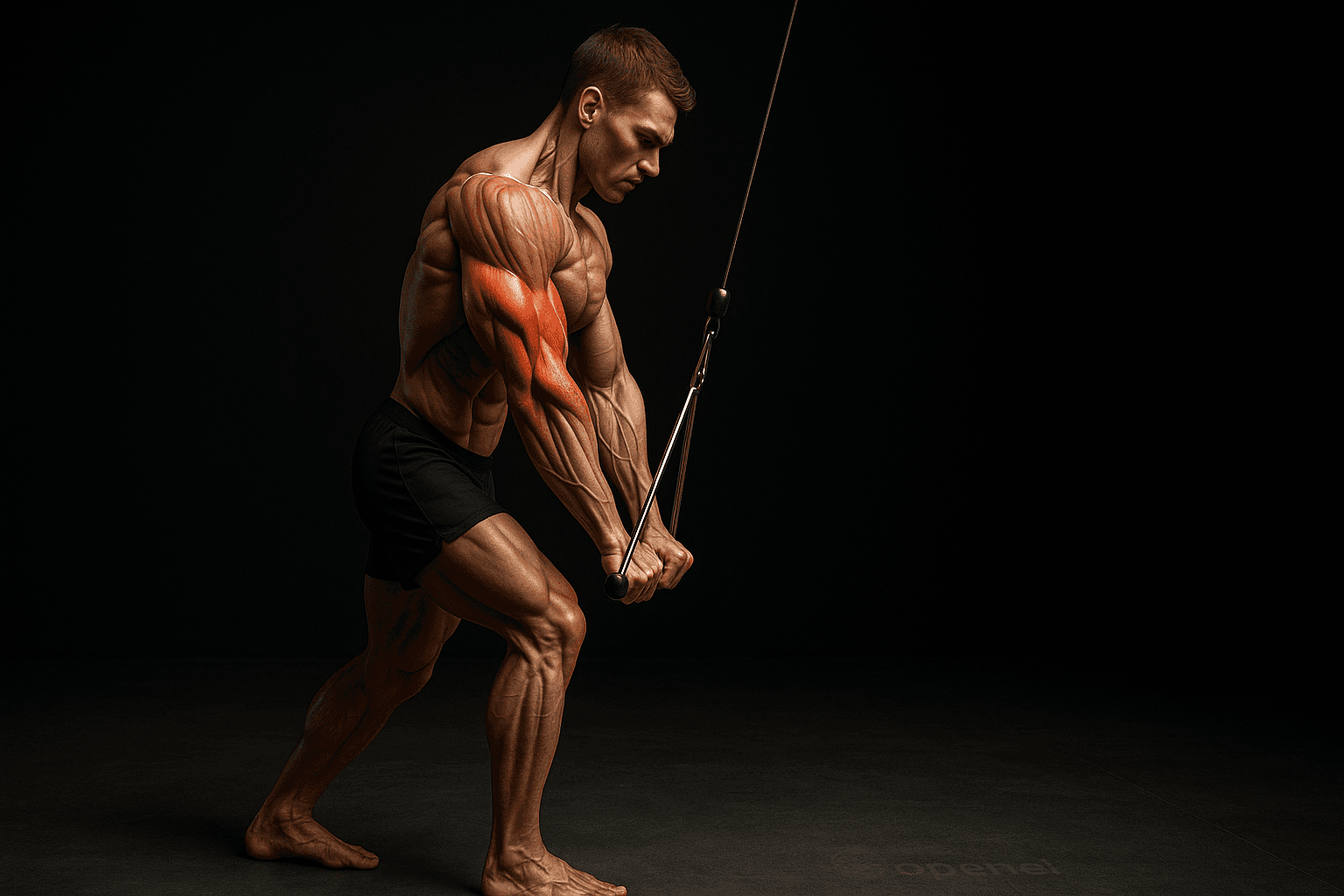
Photo by RepBro.
Aim sets and reps to match your goal. For strength do ~3–6 sets of 3–6 reps; for hypertrophy 3–5 sets of 6–12 reps; for muscular endurance 2–4 sets of 15–25 reps. Train the overhead tricep extension 2–3 times per week and progress by raising reps then load.
What exactly does the overhead tricep extension target and why does that matter for sets and reps?
The overhead tricep extension places the shoulder in flexion, lengthening the long head of the triceps and making it the primary target. Because it’s an isolation movement with less systemic load than multi-joint presses, you can use it for higher local volume and slightly more frequent practice without the same systemic fatigue as big compound lifts.
That means you can (and should) choose set/rep schemes that serve your goal rather than overloading to near-max strength every session. Use it to accumulate targeted triceps stimulus alongside compound pressing work.
How many sets and reps should I do for strength, hypertrophy, and endurance?
Below are practical, evidence-aligned ranges adapted to a single accessory movement. Consider these per-session numbers and pair them with total weekly triceps volume guidance.
- Strength: 3–6 sets of 3–6 reps. Use heavier loads and longer rests (2–3 minutes). Overhead extensions are supplemental for strength—prioritize compound pressing for maximal strength gains.
- Hypertrophy: 3–5 sets of 6–12 reps. Rest 60–90 seconds. Aim to reach close to technical failure by the last few reps of each set (RPE 7–9).
- Endurance / metabolic conditioning: 2–4 sets of 15–25 reps. Shorter rests (30–60 seconds) and controlled tempo.
Weekly volume guidance (per muscle group): aim for roughly 10–20 total weekly sets for hypertrophy, with beginners at the lower end and more advanced lifters toward the higher end. Because the triceps are small, you can distribute those sets across 2–3 sessions. Strength-focused lifters typically keep weekly sets lower but with heavier load and lower reps.
How should I structure rest, tempo, and frequency for overhead extensions?
- Rest between sets: strength 2–3 minutes; hypertrophy 60–90 seconds; endurance 30–60 seconds.
- Tempo: control the eccentric (lowering) phase—about 1–3 seconds—and avoid uncontrolled bouncing at the bottom.
- Frequency: 2–3 times per week for most lifters. This allows you to spread volume and recover while maintaining frequent practice of the movement pattern.
How do I progress week to week on the overhead tricep extension?
Progress using a predictable, low-risk hierarchy:
- Add reps within the target range first. Aim to increase total reps per set or across sets each week.
- Once you can complete the top of the rep range for all prescribed sets in two successive workouts with good form, add a small weight increment.
- After adding weight, drop reps back toward the lower end of the range and repeat.
Example: If your program calls for 4 sets of 8–12 reps, try to add one rep per set week-to-week until you hit 12 reps across all sets. On the next session where you hit 12 across all sets twice in a row, increase the weight by the smallest practical increment.
Use proximity-to-failure (RPE) as a guide: for hypertrophy aim for sets that finish around RPE 7–9. For strength, keep closer to RPE 8–9 on key sets.
When should I add weight versus add reps? What signals tell me to change?
Add reps when:
- You hit the lower end of the rep range and can complete extra reps without form breakdown.
- Your RPE is relatively low (you have 2+ reps in reserve).
Add weight when:
- You complete the top of the rep range across all sets for two consecutive sessions.
- Form remains strict, you feel under control through the full shoulder range, and there’s no joint pain.
Stay with the same weight (or reduce) when:
- You’re missing target reps regularly.
- You experience systemic fatigue or poor recovery.
Practical rule: prefer adding reps first, then increase load by small steps (small plates or minimal cable adjustments) to maintain consistent progression.
How does the overhead extension compare with other triceps exercises?
| Goal | Overhead Extension | Close-Grip Press / Dips | Pushdowns / Pressdowns |
|---|---|---|---|
| Primary emphasis | Long head, stretch at shoulder | Overall triceps + compound strength | Lateral/medial heads, high rep capacity |
| Best for | Targeting long head, accessory volume | Strength and pressing transfer | Volume-friendly, low shoulder strain |
| Typical sets/reps | 3–5 x 6–12 (hypertrophy) | 3–6 x 3–6 (strength) | 3–5 x 8–20 (volume/endurance) |
Use overhead extensions as part of a balanced triceps plan, not necessarily the single cornerstone.
Are there any safety considerations or technique tips?
Safety note: stop if you feel sharp or joint pain. Keep a controlled tempo, stable core, and avoid extreme shoulder hyperextension at the top. Choose a ROM and load you can control—heavier weights increase risk of shoulder strain. If you have a history of shoulder problems, consult a qualified professional before adding heavy overhead work.
Technique tips: keep upper arms vertical and stationary (minimal elbow drift), breathe out on the concentric (press) phase, and picture pulling the weight back up with your triceps rather than driving with the shoulders.
What limitations should I be aware of?
No app, algorithm, or article can replace an in-person coach for form correction or a clinician for injury diagnosis. Apps can help track sets, reps, and progression, but they can’t see your bar path, shoulder position, or pain signals—so consider occasional coaching check-ins. Rehabilitation and exercise prescription for painful shoulders require a qualified healthcare professional. Finally, even the perfect plan needs consistent sessions to produce results.
If you track workouts, tools like RepBro can help log sets, reps, and progression, but pair tracking with honest form checks.
Summary: match overhead tricep extension sets/reps to your goal (strength 3–6 x 3–6; hypertrophy 3–5 x 6–12; endurance 2–4 x 15–25), train 2–3 times weekly, progress by adding reps first then small weight increments, and rely on consistent tracking plus conservative loading to reduce injury risk.
Frequently asked questions
- How many sets and reps of overhead tricep extensions should I do for muscle growth?
- Aim for 3–5 sets of 6–12 reps per session for hypertrophy, with total weekly triceps volume around 10–20 sets. Train the movement 2–3 times per week and progress by adding reps then small weight increments once you hit the top of the rep range consistently.
- Should I do heavy low reps or high reps with overhead triceps for strength?
- For strength, prioritize lower reps and heavier loads: about 3–6 sets of 3–6 reps per session. Overhead extensions are an isolation movement—use them to target the long head and to supplement heavier pressing work rather than as your primary strength driver.
- How do I know when to increase weight on the overhead extension?
- If you complete the top of the target rep range across all sets for two consecutive sessions with good form and without excessive strain, add a small weight increment. If you miss reps, stay or reduce weight and focus on technique and gradual rep progression.