The Most Common Overhead Tricep Extension Mistakes (and How to Fix Them)
Fix the 6 most common overhead tricep extension mistakes—elbow flare, heavy loads, lumbar arch, short ROM, moving the arm, and bent wrists—with clear corrective cues.
Photo by RepBro.
The Most Common Overhead Tricep Extension Mistakes (and How to Fix Them)
If you search "overhead tricep extension mistakes," the short answer is: elbows flaring, too much weight/momentum, lumbar arching, moving the upper arm instead of the forearm, cutting range of motion, and bent wrists are the most common technique errors—each reduces triceps stimulus or raises injury risk, and each has a single, concrete fix you can use immediately.
Why do people let their elbows flare, and what does it cost?
Why does it happen? Because the brain shortcuts: flaring the elbows creates a wider path for the weight to travel, feels more comfortable short-term, and often reduces shoulder stretch. What it costs: reduced long-head triceps tension and more shoulder involvement, plus a higher chance of impingement. Fix: keep the elbows pointed forward. Cue: tuck the elbows to about 0–10° out from the sagittal plane (i.e., largely inline with the ears). If you can’t hold that, switch to single-arm overhead extensions or place the working elbow lightly against your temple to learn the feel.
Why do people use too much weight, and what should you do instead?
Why does it happen? Ego or a belief that heavier = better. What it costs: cheating with shoulder and torso momentum, less time under tension, and shorter range of motion. Fix: reduce load by 20–40% and aim for 8–15 controlled reps at a tempo of 2–3s eccentric and 1–2s concentric. If you can’t complete the set without swinging, the weight’s too heavy.
Why does the lower back arch, and how much does it matter?
Why does it happen? The lumbopelvic region extends to help lift a heavy load when shoulder mobility or arm position is limited. What it costs: extra lumbar stress and loss of isolation for the triceps. Fix: brace your core and maintain a neutral spine—think "ribs down." If you still arch, do the seated variation with back support or reduce load by 20–30% until you can keep the spine neutral.
Why do people move their upper arm instead of the forearm, and what’s the fix?
Why does it happen? Poor cueing and weak shoulder stabilizers lead to the humerus swinging, which turns the exercise into a shoulder–triceps hybrid. What it costs: lower triceps activation and wasted effort. Fix: lock the upper arm in place. Practice isometric holds at the halfway point for 10–20 seconds, or perform the single-arm version with the triceps-side upper arm resting against your head/bench to prevent the humerus from drifting.
Why do reps often cut the range of motion, and how do you restore it safely?
Why does it happen? Pain, limited shoulder mobility, or heavy loads cause short, half-reps. What it costs: reduced long-head development because the muscle isn’t stretched under load. Fix: regain safe ROM progressively—use lighter weight and lower the forearm until it’s roughly parallel to the floor behind your head (or until you feel a mild stretch, not pain). Add 1–2 mobility drills per session (90/90 shoulder stretch or doorway pec stretch) and aim for full-range sets within 4–6 weeks.
Why do wrists bend during the movement, and what's the simple correction?
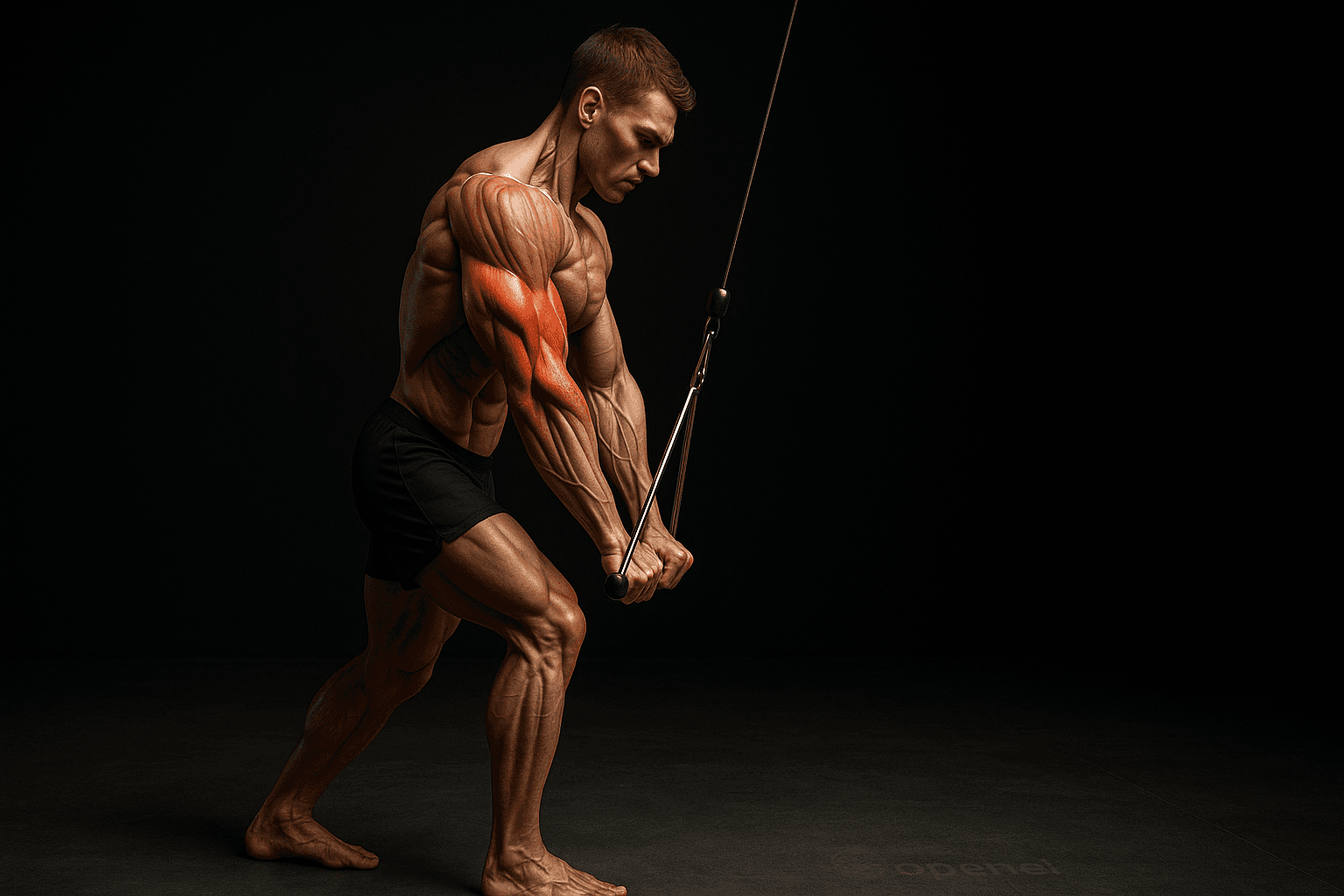
Why does it happen? Grip and forearm fatigue or an awkward handle cause wrist flexion/extension. What it costs: wrist pain, loss of force transfer, and poor control of the weight. Fix: keep wrists neutral. Use an EZ-bar, rope attachment on a cable, or a dumbbell with a thicker handle. Squeeze the weight and align the knuckles so the wrist is in line with the forearm.
Which variations or drills help reinforce good overhead extension form?
Why does this help? Variations reduce compensations and teach stability. Try: seated single-arm dumbbell overhead extension (sits upright with back support), cable overhead extensions with a rope (better wrist position), and French press with light weight to practice upper-arm stability. If you track sets, reps and tempo, tools like RepBro make it easier to see when form deteriorates and which loads consistently cause breakdown. If you’re comparing equipment choices, see a tool comparison at https://www.repbro.app/vs.
Quick safety note — what should stop you immediately?
Stop the set if you feel sharp joint pain, sudden popping, or numbness. This guide gives technique fixes, not diagnoses—if pain persists, consult a qualified clinician or coach.
How to implement these fixes in a single session
- Warm up the shoulders 3–5 minutes (band pull-aparts, scapular wall slides). 2) Test a working weight where you can complete 8–12 reps with strict form; if you fail, lower by 25%. 3) Use a 2–3s lowering phase and a controlled 1–2s lift. 4) Choose the seated or single-arm variation for the first 2–4 weeks if you’re learning. 5) Track sets and note when form breaks—if breakdown occurs on set 3, reduce load or volume next session.
What gains do these fixes produce?
Correcting the six errors above increases the proportion of load that the triceps—particularly the long head—actually receives, improves time under tension, and lowers compensatory stress on the shoulders and lumbar spine. No exercise can guarantee outcomes, but better form gives you more usable stimulus and less injury risk per rep.
Final takeaway: fix elbow position, reduce cheating, preserve spinal neutrality, lock the upper arm, restore full ROM, and keep wrists neutral—do those six things and your overhead tricep extensions will be safer and more effective.
Frequently asked questions
- How heavy should I go on overhead tricep extensions?
- Use a weight you can control for 8–15 full-range reps with a 2–3s eccentric and 1–2s concentric tempo. If form breaks, cut 20–40% of the load.
- Are seated and standing overhead extensions different for form?
- Seated with back support reduces lumbar compensation and helps keep the torso stable; standing forces core activation but increases risk of arching under heavy loads.
- How do I stop my elbows from flaring?
- Pin the elbows by imagining the upper arm is a hinge; practice single-arm versions or use a vertical surface to lightly contact the elbow while training.