Cable Fly Alternatives at Home (Minimal Equipment)
Practical at-home substitutes for the cable fly using bands, dumbbells, and bodyweight. What each option preserves, what it loses, and when to train at the gym.
Photo by RepBro.
You can replace cable flys at home with a handful of single-joint horizontal-adduction options—resistance bands, dumbbell fly variations, floor or incline press-fly hybrids, and bodyweight push-up variants—that preserve the pec horizontal-adduction stimulus. Each loses some aspect of a cable's constant, adjustable line of pull; choose by equipment and goals.
What exactly does a cable fly provide that I’m trying to replicate?
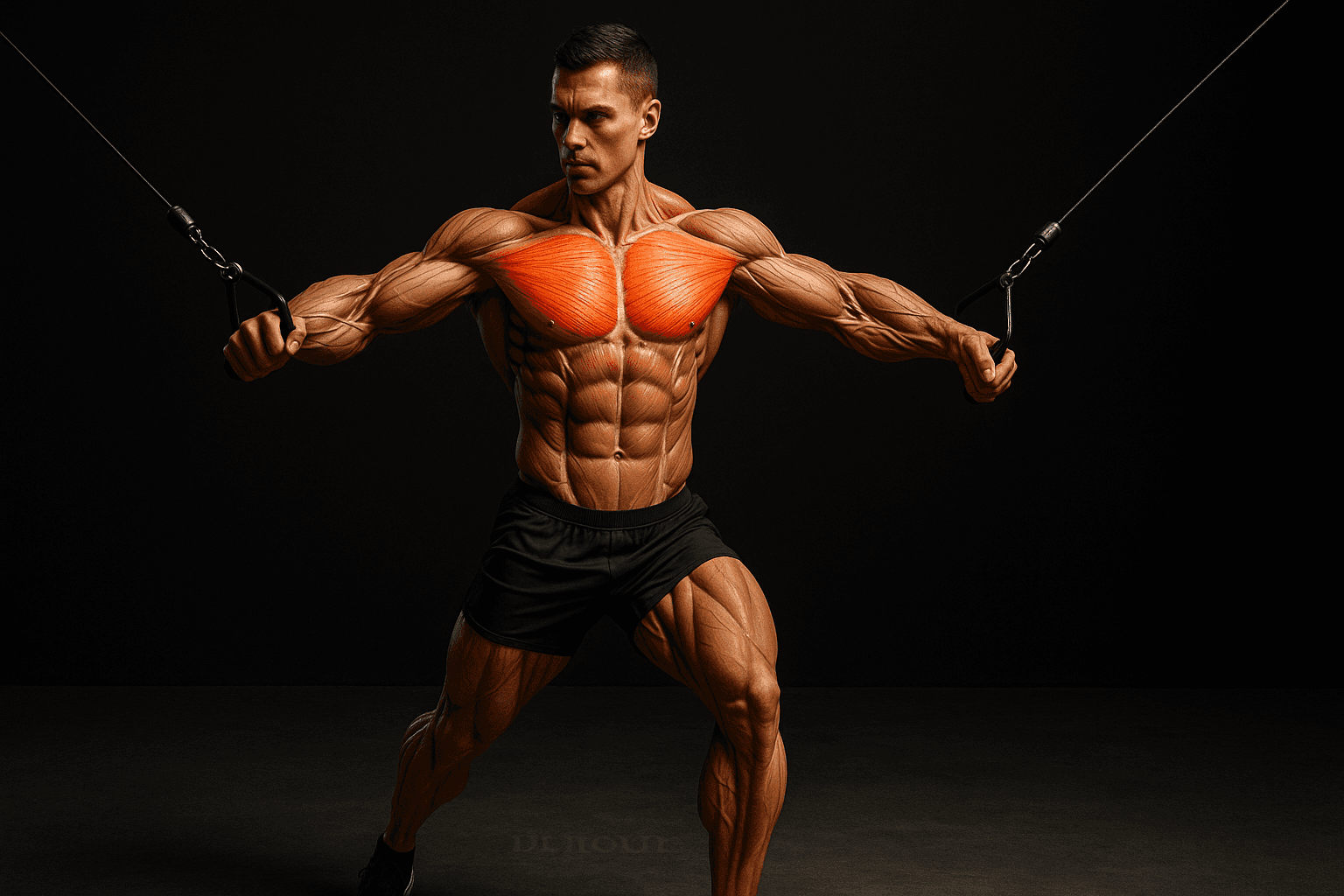
Cable flys provide a mostly pure horizontal-adduction movement with a near-constant tension throughout the range of motion and an easy way to alter the line of pull (high, mid, low). They emphasize pec stretch at the bottom and controlled adduction at the top while being relatively joint-friendly when performed with good scapular control.
Key qualities to replicate: constant tension, adjustable angle, controlled eccentric, and an isolated horizontal-adduction cue.
Which at-home alternatives work and what does each preserve or lose?
Below are 5 practical alternatives using minimal equipment. For each I note what it preserves from the cable fly and what it gives up.
- Resistance-band flies (standing or anchored)
- What it preserves: continuous tension through the range, easy angle adjustments, and good horizontal-adduction specificity.
- What it loses: bands increase tension towards the end range (different curve than some cable stacks), and very-heavy absolute loads can be limited by band capacity and anchor quality.
- When to use: primary substitute at home if you have good bands and a secure anchor point. Great for progressive overload by adding thicker bands or changing attachment distance.
- Dumbbell fly (flat, incline, or single-arm)
- What it preserves: stretch at the bottom, controlled eccentric, and clear horizontal-adduction mechanics.
- What it loses: there is a brief bottom dead spot where tension is reduced (especially lying on a flat bench), and gravity changes the loading direction compared with a cable’s line of pull.
- When to use: solid for time-under-tension and hypertrophy when bands aren’t available. Single-arm DB flyes add stability demand and let you manipulate range.
- Floor dumbbell fly (lying on the floor)
- What it preserves: safer bottom range for people with shoulder mobility limits because the floor prevents excessive stretch.
- What it loses: reduced range of motion vs bench, and therefore less peak stretch stimulus.
- When to use: good if you have shoulder history or no bench. Use for moderate loads and control.
- Push-up variations (wide push-up, archer push-up, decline/incline)
- What it preserves: horizontal-adduction under load, high time-under-tension, and practical overload progression with tempo and incline/decline adjustments.
- What it loses: push-ups are a press pattern (triple-joint) rather than pure single-joint adduction, so they recruit triceps and anterior deltoid more, making them less isolated for the pecs.
- When to use: when you want a compound option that also builds pressing strength and can be done anywhere without equipment.
- Dumbbell press–fly hybrids (press to fly, or pauses at mid-range)
- What it preserves: trains both pressing strength and fly-style adduction, increases load capacity over pure fly while keeping a horizontal-adduction emphasis.
- What it loses: less isolation and somewhat different motor pattern than pure fly. Useful when you need heavier loading without cables.
- When to use: when increasing absolute load matters but you want to keep a fly-like feel.
How do these alternatives compare at a glance?
| Alternative | Constant tension | Adjustable angle | Isolation (single-joint) | Max load potential | Equipment needed |
|---|---|---|---|---|---|
| Resistance-band fly | Yes (variable curve) | Yes | High | Moderate–High (with bands) | Bands + anchor |
| Dumbbell fly (bench) | No (gravity-dependent) | Limited (bench angle) | High | High | |
| Floor dumbbell fly | No | Limited | Moderate | Moderate | |
| Push-up variants | No (bodyweight curve) | Yes (incline/decline) | Low–Moderate | Low–Moderate (add weight) | None or weight vest |
| Press–fly hybrid | Partially | Limited | Moderate | High | Dumbbells |
How should I load and progress these alternatives?
- Frequency: train chest horizontal-adduction work about twice per week, spreading total weekly sets across compound presses and isolation work.
- Volume: aim for roughly 10–20 sets per muscle group per week depending on training age and recovery; begin on the lower end if you’re newer and increase gradually.
- Reps and intensity: 6–8 reps for strength emphasis using heavier presses; 8–15 reps per set is a practical hypertrophy range for fly-style work; use slower eccentrics and full control for isolation.
- Progression: increase reps then load, or increase band tension/anchor distance. For bodyweight variations, add load (weighted vest, backpack) or increase difficulty (archer, single-arm).
These principles reflect common sports-science consensus: progressive overload, adequate frequency (≈2x/week), and gradual volume increases are key for hypertrophy.
When is a home swap adequate, and when should I go back to a gym cable machine?
Adequate at home if:
- You can progressively increase tension/volume reliably with bands, dumbbells, or bodyweight.
- Your goal is general hypertrophy, aesthetic chest development, or maintaining strength.
- You need flexibility in exercise angle and can control scapular motion.
Consider the gym if:
- You require very precise constant tension across the full range for a sport-specific rehab or advanced technique.
- You need very heavy, stable single-joint loading beyond your home gear’s capacity.
- You want seamless angle changes and microloading that a stacked cable machine provides.
What about safety and common mistakes?
Stop immediately on any sharp pain; slight muscle soreness is normal, but joint pain is not. Prioritize scapular control—don’t let the shoulders protract and shrug during flies. Use moderate ranges if you have shoulder history and prefer floor variations. Consult a qualified professional for persistent pain or injury concerns. No text can diagnose or replace in-person assessment.
Limitations: what apps or AI coaching cannot do
- No app or AI can reliably see and correct your form in real time; video feedback from a coach or in-person assessment is superior.
- For injury diagnosis, rehab programming, or post-surgery plans you need a qualified clinician.
- Any written plan only works if you apply it consistently; consistency and progressive overload matter more than the exact app you use.
If you want a simple way to track sets, volume, and progressive increases for these home alternatives, consider using an app like RepBro to log workouts and follow progression over weeks.
Safety note: always stop on sharp pain, warm up the shoulder girdle before single-joint work, and seek professional help for persistent pain or complex injury history. This article is educational and not medical advice.
References and further reading: look for consensus position statements and meta-analyses on resistance training frequency and volume for hypertrophy, and resources on scapular mechanics for shoulder safety.
Frequently asked questions
- Can I get the same pec stimulus at home without cables?
- Yes—you can approximate the cable fly stimulus using resistance bands, dumbbell fly variants, and push-up variations. Each option preserves horizontal adduction and pec stretch but differs in tension curve, peak load, and stability demands. Progressively overload and vary angle to approach the cable-equivalent stimulus.
- How often should I include fly-style work in my routine?
- Aim to train chest/ horizontal-adduction work about twice per week, distributing 10–20 sets per week across compound presses and isolation fly variations depending on recovery and training history. Adjust volume down during deloads and increase gradually over weeks for hypertrophy.
- When should I return to the gym for real cable work?
- Return to the gym if you need precise, high single-joint loading, a strict constant line of pull for rehab or sport-specific reasons, or progressive load beyond your home equipment. Otherwise well‑planned band, dumbbell, and bodyweight work often suffices for most lifters.