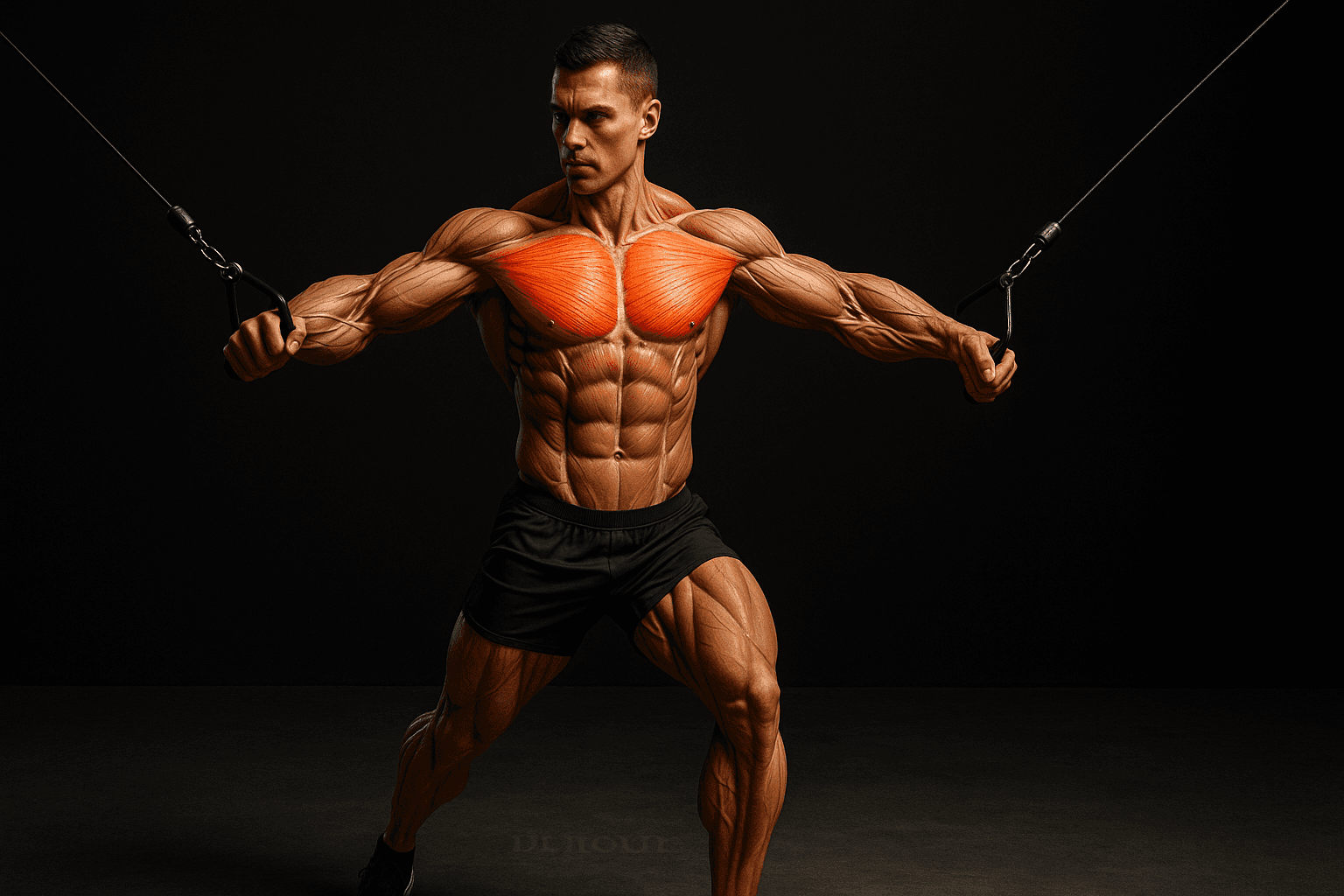
How Many Sets and Reps for the Cable Fly?
Clear, evidence-informed sets, reps and frequency ranges for cable flys by goal (strength, hypertrophy, endurance), how to progress week-to-week, and signals to add weight versus reps.
Photo by RepBro.
Direct answer
Do 3–5 sets of cable flys per session with rep ranges matched to your goal: 3–6 for strength-focused accessory work, 6–12 for hypertrophy, and 12–20+ for muscular endurance. Train the movement 2–3 times per week and progress by adding reps first, then small weight jumps.
What is the purpose of the cable fly in a program?
Cable flys are an accessory isolation exercise that places continuous tension on the pecs across the range of motion. They are useful for increasing muscle tension, improving chest shape, and adding volume without the same joint compressive loads as heavy barbell pressing. Use them to add targeted volume to a chest-focused plan.
How many sets and reps should I do for strength, hypertrophy, and endurance?
Below are practical, evidence-aligned ranges used by coaches and sports-science consensus for accessory exercises. Adjust within ranges by training age and recovery.
-
Strength (accessory role): 3–5 sets of 3–6 reps. Use heavier loads, longer rest (2–3 minutes), and make technique strict. Note: barbell/dumbbell presses remain the primary strength stimulus for bench press progress.
-
Hypertrophy: 3–5 sets of 6–12 reps. Focus on time under tension (controlled eccentrics), full but safe range of motion, and 60–90 seconds rest. Combine with pressing variants to reach recommended weekly chest volume.
-
Muscular endurance / metabolic work: 2–4 sets of 12–20+ reps. Shorter rest (30–60 seconds), higher tempo useful for conditioning or finisher work.
How much chest volume should cable flys contribute each week?
Sports-science guidance for muscle growth emphasizes weekly volume per muscle group (total sets across exercises). For chest, aim for roughly 10–20 effective sets per week. Cable flys can supply 3–10 of those sets depending on your program (e.g., 3 sets twice a week = 6 sets). Balance with compound pressing sets.
How should I progress cable flys week-to-week?
Progression principles are the same as for other resistance exercises: progressive overload and autoregulation.
A simple, practical progression plan:
- Choose a target rep range (e.g., 8–12 for hypertrophy) and a weight you can control across all sets.
- Increase reps first: Aim to add 1–2 reps per set each week while maintaining form until you reach the top of the range.
- When you can perform the top reps for all sets with good form, increase load by a small increment (e.g., 2.5–10% or the next cable pin/plate). Drop back to the lower end of the rep range and repeat.
- If you’re using high-rep work, you can raise the total number of sets before increasing load.
Example: Week 1 — 3x8; Week 2 — 3x9; Week 3 — 3x10; Week 4 — increase weight, 3x8.
What are clear signals to add weight versus add reps?
Add reps when:
- You can complete all prescribed sets with the top-range tempo and no technical breakdown.
- RPE (rate of perceived exertion) drops and the set feels easier across the board.
Add weight when:
- You can perform the top rep target for every set with proper form and controlled tempo.
- You’re no longer progressing by adding reps and prefer to keep reps in a specified zone for that training block.
If increasing weight causes form to degrade or joint discomfort, revert to the previous weight and try microloading (smaller weight jumps) or additional reps.
How often should I perform cable flys per week for best results?
For most lifters, 2 sessions per week with 3–5 sets per session is a practical balance of stimulus and recovery. Advanced lifters can distribute the same weekly volume across 3 sessions for better performance and technique; beginners may start with 1–2 sessions and fewer total sets.
Comparison: sets, reps and frequency at a glance
| Goal | Sets per session | Reps | Frequency per week |
|---|---|---|---|
| Strength (accessory) | 3–5 | 3–6 | 2–3 |
| Hypertrophy | 3–5 | 6–12 | 2–3 |
| Endurance/conditioning | 2–4 | 12–20+ | 1–3 |
What tempo and rest should I use?
- Tempo: Controlled eccentric (about 1–3 seconds), controlled concentric; avoid bouncing the handles together. Slower eccentrics increase time under tension for hypertrophy.
- Rest: Strength-style sets 2–3 minutes; hypertrophy 60–90 seconds; endurance 30–60 seconds.
Sample session templates
- Hypertrophy-focused chest day: 4x8 cable flys (60–90s rest) after primary compound presses. Total weekly: 8–12 fly sets across two sessions.
- Strength block with accessory flys: 3x5 heavier cable flys as a secondary movement, low volume, long rest. Emphasize compound strength work first.
- Conditioning finisher: 3x15–20 cable flys, short rest, as a metabolic finisher.
Safety and common technique cues
Safety note: stop if you feel sharp joint pain or instability. Keep a slight bend in the elbow, avoid over-stretching the shoulder at long lengths, and pull the handles to chest level without forcefully slamming them together. If you have shoulder issues, consult a qualified professional before using heavy loading.
Limitations — what apps and articles can’t do
No app or article can watch your form in real time or diagnose individual tissue irritations. A written plan cannot substitute for hands-on coaching for technical deficits or a clinician’s diagnosis for pain or injury. Long-term progress requires consistent application; the structure here is a guideline that works only when followed and adjusted for recovery.
If you track sets, reps and progression quantitatively, tools such as RepBro can help log progress, but they don’t replace a qualified coach or physiotherapist when you need one.
Closing practical tips
- Prioritize compound presses for strength and use cable flys to add targeted volume and variety.
- Progress reps first, then weight in small increments. Aim for 2–3 sessions per week if your schedule and recovery allow.
- Watch shoulder comfort and prioritize controlled tempo over heavy, uncontrolled loading.
If you have ongoing shoulder pain or are rehabbing an injury, seek advice from a qualified medical or physical therapy professional before adding or loading cable flys.
Frequently asked questions
- How many sets and reps should I do for cable flys if my goal is hypertrophy?
- For hypertrophy do 3–5 sets of 6–12 reps per cable fly variation per session, targeting controlled tension and a slow eccentric. Aim to accumulate 10–20 effective sets for chest per week across exercises, including presses and flyes, rather than only flys.
- Can cable flys help strength, and what rep ranges should I use?
- Cable flys are primarily an accessory for chest development, not maximal strength. Use 3–5 sets of 3–6 reps if you want heavier, strength-focused accessory work, but prioritize compound presses for true strength. Keep technique strict and use heavier cables or single-arm variations if needed.
- How often should I train cable flys each week?
- Train cable flys 2–3 times per week as an accessory for most lifters, distributing total weekly volume across sessions. For beginners 1–2 sessions may suffice. Recovery and total chest volume determine frequency—avoid daily flys due to shoulder stress.