Cable Fly: Muscles Worked and Best Alternatives
Discover which muscles the cable fly trains (primary and secondary), where it fits in a program, and 4 practical alternatives with when to pick each.
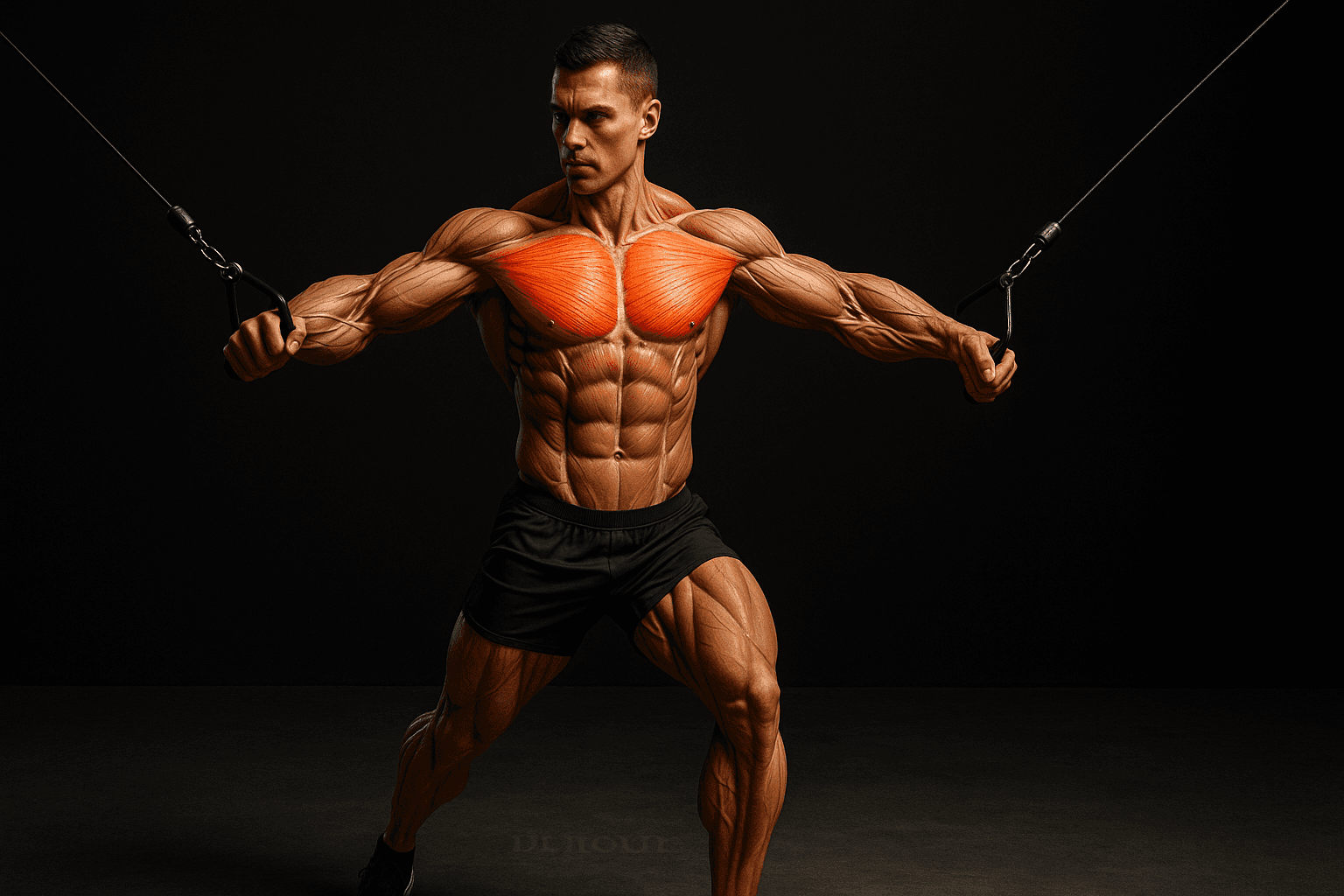
Photo by RepBro.
The cable fly primarily trains the pectoralis major (the chest muscle), with secondary loading of the anterior deltoid (front shoulder), biceps as a stabilizer, and the scapular stabilizers (serratus anterior, rhomboids, traps). Depending on cable height and arm path, you can emphasize the upper (clavicular) or lower (sternal) fibers of the pec.
What exactly does "cable fly muscles worked" mean in practice?
The cable fly is a horizontal adduction movement: you bring the arms across the body against resistance. Primary movers:
- Pectoralis major (sternal head—mid/lower chest; clavicular head—upper chest depending on cable angle)
- Pectoralis minor and serratus anterior assist for scapular control
Secondary/stabilizer muscles:
- Anterior deltoid (assists shoulder horizontal adduction)
- Biceps brachii and coracobrachialis (isometric stabilizers)
- Lower traps and rhomboids (control scapular position)
From an EMG and mechanical perspective, pressing movements (bench press, dumbbell press) load the chest with more total force. The cable fly is an isolation tool that keeps continuous tension across the range, so it's best used for added hypertrophy and shaping, not as your primary strength movement.
When should I use cable flies in a program?
Use cable flies as an accessory movement after compound pressing. Practical guidelines:
- Frequency: 1–3x per week depending on total chest volume.
- Sets & reps: 2–4 sets of 8–15 reps for hypertrophy; 3–5 sets of 6–8 reps if you prefer heavier, lower-rep work with longer rest (90–120s).
- Progression: increase load, increase reps, reduce rest, or add tempo (e.g., 3s eccentric) over time.
- Placement: after bench/incline/pressing work, or on a lighter chest-only day.
Technique cues:
- Slight bend in elbows (15–30°) — don't lock joints.
- Start with hands slightly wider than shoulders and bring handles together in a controlled arc toward midline.
- Maintain neutral spine and retract the scapula slightly; avoid excessive sternum collapse.
- Stop if you feel sharp pain—mild muscle stretch is normal, sudden sharp pain is not.
Safety note: stop on sharp pain or tingling; if you have a shoulder or chest injury, consult a qualified professional before resuming. Avoid overloaded end-range with compromised shoulder mobility.
What are the best alternatives to the cable fly and when to pick each?
Here are four practical alternatives, with clear cues on when to choose them.
- Dumbbell Fly
- Why: Similar horizontal adduction pattern with free-weight stabilization demand.
- When to pick: No cable machine available; you want greater proprioceptive challenge; or you need a heavy, low-tech option.
- Programming: 3 sets of 8–15 reps; control the eccentric, keep elbows slightly bent. Reduce ROM if you have shoulder pain.
- Limitations: Less constant tension at lockout than cables; can stress the shoulder if you go too deep.
- Pec-Deck / Machine Fly
- Why: Fixed path and easy loading make it beginner-friendly and good for isolating the pecs without stabilizer demand.
- When to pick: Rehab-friendly (when cleared by professional), fatigue management days, or when stabilizer weakness limits training volume.
- Programming: 3–4 sets of 10–15 reps with a controlled tempo.
- Limitations: Fixed plane can feel unnatural for some; less carryover to compound pressing strength.
- Push-Up Variations (banded, elevated, or weighted)
- Why: Compound bodyweight pressing that loads the chest and core with scalable difficulty.
- When to pick: No equipment, travel, or when you want compound stimulus instead of isolation (e.g., limited gym access). Banded push-ups mimic continuous tension like cables.
- Programming: 3–5 sets of 8–20 reps depending on variation and load.
- Limitations: Less direct isolation of the pectorals; shoulder position changes can alter stimulus.
- Single-Arm Cable or Single-Arm Dumbbell Fly / Crossover
- Why: Unilateral work reduces compensation, improves mind–muscle connection, and allows subtle angle changes.
- When to pick: Addressing asymmetry or a unilateral shoulder issue; you want to overload one side without shifting the torso.
- Programming: 3–4 sets of 8–12 reps per arm, control the return phase.
- Limitations: Takes longer per session; requires cable or dumbbell.
Bonus alternative for strength: Barbell or Dumbbell Bench Press
- Why: If your goal is overall chest strength and size, heavy presses produce higher total mechanical tension.
- When to pick: You’re plateauing on isolation work and need to reintroduce heavy compound loading for progressive overload.
How to choose between these options if you hit a plateau or have an injury?
- Equipment limits: Push-ups or dumbbell flies are best when cables aren’t available; pec-deck is ideal if you’re short on a spotter and want consistent loading.
- Shoulder pain or impingement: Reduce ROM, favor single-arm or machine options, and prioritize scapular control. Stop any movement that reproduces sharp joint pain.
- Plateau strategies: Change angle (low-to-high or high-to-low cable paths), switch from bilateral to unilateral sets, manipulate tempo (slower eccentrics), or replace isolation with heavier compound pressing for 4–8 weeks to build base strength.
If you want an easy way to compare options side-by-side, RepBro’s comparison features make swapping exercises and tracking substitutions practical: https://www.repbro.app/vs. And if you track workouts, consider using the RepBro app to log progressive overload and angles: https://apps.apple.com/us/app/gym-workout-coach-repbro/id6763749305.
Quick practical sample sequence for a chest session
- Compound press (barbell or dumbbell): 3–5 sets of 4–8 reps
- Secondary incline press: 2–3 sets of 6–10 reps
- Cable fly (or alternative): 3 sets of 10–15 reps with a 2–3s eccentric
- Optional finisher: push-up ladder or drop-set on pec-deck
Safety note: stop on sharp pain, reduce ROM if joints feel uncomfortable, and consult a qualified clinician for persistent issues. Never push through acute shoulder or chest pain.
Takeaway: The cable fly is an effective chest isolation tool (primary: pectoralis major; secondary: anterior deltoid and stabilizers) best used after pressing work, and you can substitute dumbbell flys, pec-deck, push-up variants, or single-arm crossovers depending on equipment, injury status, and training goals.
Frequently asked questions
- Does the cable fly work the whole chest or just the outer pecs?
- The cable fly primarily trains the pectoralis major (both sternal and clavicular regions depending on cable line), with secondary work from the anterior deltoid and scapular stabilizers—it targets the chest across different portions depending on cable angle, not just the 'outer' pec.
- Should I do cable flies before or after pressing movements?
- Do cable flies after compound presses (bench, incline, or push-ups). Use them as an accessory for hypertrophy: 2–4 sets of 8–15 reps once heavier compound work is complete.
- Are cable flies better than dumbbell flies for hypertrophy?
- Neither is strictly superior—cables give consistent tension through the range and easier angle manipulation; dumbbells allow greater stabilization demand. Swap between them to avoid plateaus and target different stimulus.