Back Squat Alternatives at Home (Minimal Equipment)
Practical at-home alternatives to the barbell back squat using bodyweight, dumbbells, or bands. What each preserves and loses, how to program them, and when to return to the gym.
Photo by RepBro.
Direct answer
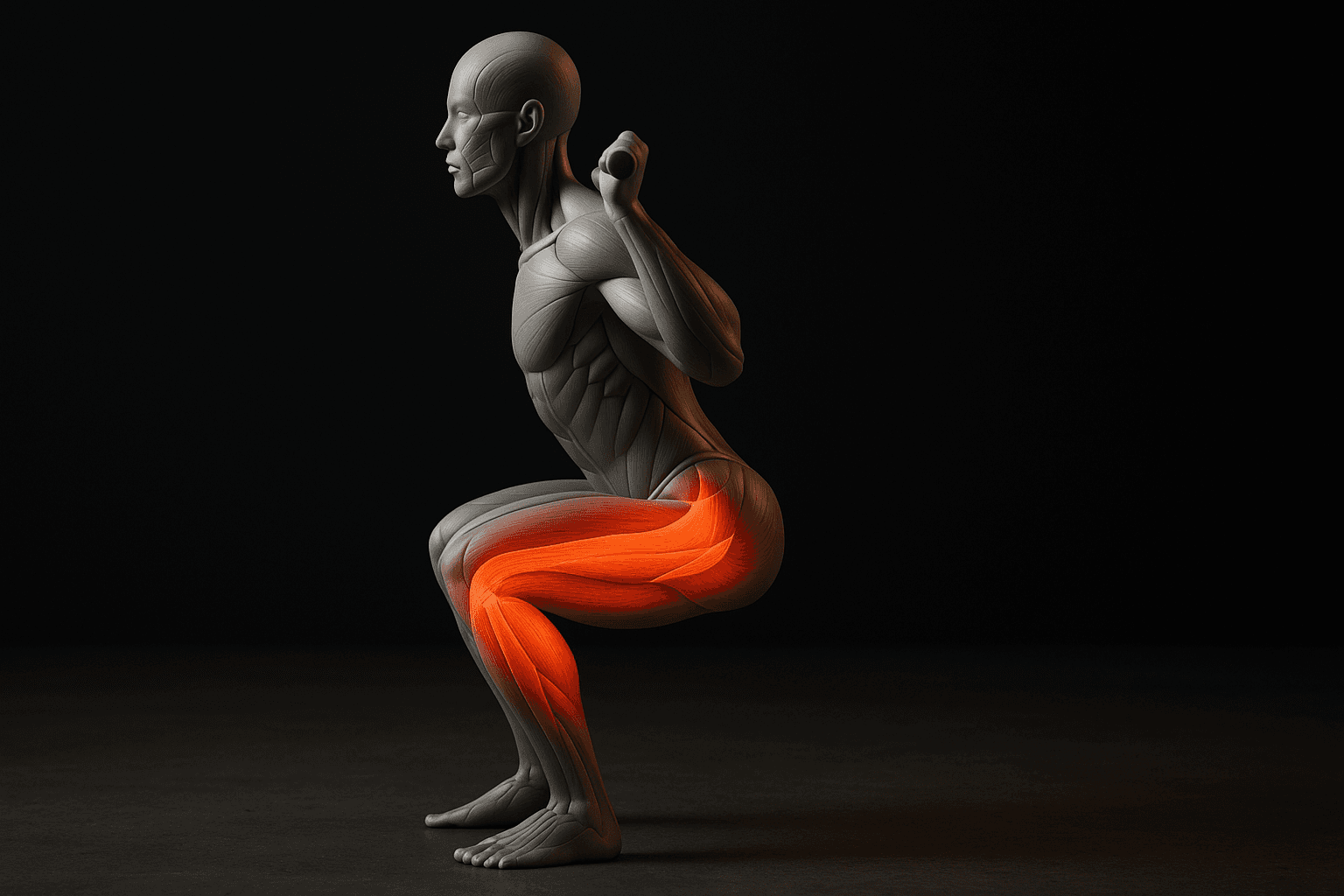
You can maintain and build lower-body strength at home with a small set of alternatives: goblet squats, Bulgarian split squats, Romanian deadlifts, band-resisted squats, and single-leg variations (pistols/step-ups). Each preserves important movement qualities but loses certain barbell-specific loading and technical demands — see below.
What at-home movements most closely replace the back squat?
- Goblet squat (dumbbell or kettlebell)
- Bulgarian split squat (dumbbell or bodyweight)
- Romanian deadlift (two dumbbells)
- Banded squat (loop or long resistance band)
- Single-leg options: pistol progressions or weighted step-ups
Each of these can approximate aspects of the back squat using minimal equipment.
What does each alternative preserve versus what does it lose compared to the barbell back squat?
| Movement | Equipment | What it preserves | What it loses | Use when... |
|---|---|---|---|---|
| Goblet squat | Dumbbell/kettlebell | Vertical torso, quad-dominant knee flexion, core anti-flexion | High absolute load, barbell-specific bar path and upper-back carry | You want a safe, simple bilateral squat with measurable progression |
| Bulgarian split squat | Dumbbell/bodyweight | Unilateral strength, glute/quad balance, mobility | Heavy bilateral loading, symmetric spine loading | You need to fix left-right imbalances or have limited load options |
| Romanian deadlift (RDL) | Dumbbells | Hip-hinge, hamstrings, glute posterior-chain strength | Knee-dominant loading of deep squat, vertical compressive spine load | Focused posterior-chain development and low-equipment hip strength |
| Banded squat | Bands | Progressive resistance through range, top-end lockout strength | Exact load quantification, barbell spine loading, fixed bar position | You want variable resistance and to overload the top of the lift safely |
| Pistol/step-up (single-leg) | Bodyweight/dumbbell | Maximal unilateral strength, balance, mobility | Easy progressive absolute overload without equipment | You lack heavy weights but can handle high relative difficulty |
How should I structure sets, reps, and progression with these alternatives?
Training principles that apply to home swaps are identical to standard practice: progressive overload, sufficient volume, and appropriate frequency. Practical, consensus-style guidelines:
- Frequency: train lower body 2–3 times per week. Distribute heavy and volume sessions across the week.
- Strength emphasis: 3–6 sets of 3–6 reps with heavier load or harder variants (weighted Bulgarian split squat, loaded pistol). Rest 2–4 minutes between heavy sets.
- Hypertrophy emphasis: 3–4 sets of 6–15 reps. Controlled tempo, 60–90 seconds rest; accumulate weekly volume across sessions.
- Progressive overload: increase load, add reps, reduce assistance, or increase range of motion. For bands, increase band tension or add chains/weight.
If you’re using bodyweight-only progressions, increase difficulty by adding tempo (slow eccentrics), pausing at the bottom, or moving to a harder variant (e.g., assisted pistol → full pistol → weighted pistol).
When is the swap adequate and when should I go back to the gym for a barbell?
Adequate at home if:
- Your goal is general strength, hypertrophy, or fitness and you can reliably add load or difficulty.
- You need to limit spinal compression (bands, dumbbells, single-leg work reduce axial load).
- You’re addressing imbalances or mobility alongside strength.
Go back to a gym if:
- You aim for maximal barbell back squat performance (heavy singles or competition).
- You’ve plateaued because you can’t safely or meaningfully increase load at home.
- You need specialist equipment (squat rack, heavy plates, calibrated loading) or coaching access to fix technical faults under heavy load.
What specific sessions can I use at home (example microcycles)?
Option A — Strength focus (2x week):
- Session 1 (heavier): Goblet squat 5x5 (heavy), RDL 3x6, core anti-extension 3x10
- Session 2 (variation): Bulgarian split squat 4x6 each leg (heavier), banded squat 3x8, single-leg calf work
Option B — Hypertrophy focus (3x week):
- One heavier-ish session (4x6), two higher-volume sessions (3x10–15). Prioritize recovery and progressive overload across weeks.
Adjust sets/reps to fit ability to increase load or difficulty over time. Track load, reps, and perceived effort.
What safety steps should I follow?
Stop if you feel sharp or unexpected pain. Use a load you can control and prioritize technique over adding weight. Warm up the hips, knees, and ankles before heavy work. If you have a known condition or injury, consult a qualified professional before changing your program. No text can substitute for hands-on coaching.
What can’t an app or AI do for my squat substitutes?
- See or correct your live movement pattern with certainty.
- Diagnose injuries, prescribe medical rehab, or provide in-person manual adjustments.
- Guarantee adherence — the plan only works if you follow it consistently.
Apps and programs are tools for tracking and guidance; real-time form correction and clinical decisions require a qualified human professional. If you use a training app, choose one that lets you log sets, weights, and notes so you can objectively track progression; for example, trackers such as RepBro can help keep consistent records.
Limitations
This guide highlights practical alternatives but does not replace individualized coaching or medical advice. Remote guidance cannot replace in-person assessment of movement faults, pain sources, or complex rehabilitation plans. If you have an injury, surgery history, or persistent pain, see a licensed clinician or certified strength coach. Consistency and progressive overload matter more than tool choice — missing sessions or poor recovery will limit results regardless of exercise selection.
Safety note: If you experience sharp joint pain, dizziness, or neurological symptoms during exercise, stop immediately and seek professional evaluation. This article is educational and not a medical diagnosis or treatment plan.
Frequently asked questions
- Can I get as strong as with back squats using only dumbbells and bands?
- You can make comparable strength and size progress at home for months or longer, especially with progressive overload and heavy, low-rep work. However, absolute maximal barbell squat strength and the specific spinal loading pattern typically require access to a barbell and progressively heavier loads.
- How often should I train squat alternatives each week?
- Train lower body 2–3 times per week, mixing heavier, lower-rep sessions with higher-rep volume sessions for hypertrophy. That frequency matches common sports-science recommendations for stimulus and recovery while allowing progressive overload with alternatives.
- When is a gym necessary instead of at-home options?
- Consider returning to a gym when you need heavier absolute load for barbell-specific strength, competition preparation, or when you stagnate because you cannot safely add meaningful load at home. Also return if you want supervised barbell coaching for form or rehabilitation needs.