Back Squat Muscles Worked: Complete Activation Guide for Every Rep
The back squat primarily targets quadriceps and glutes as prime movers, with hamstrings, adductors, and core providing secondary support. Learn exact muscle activation patterns.
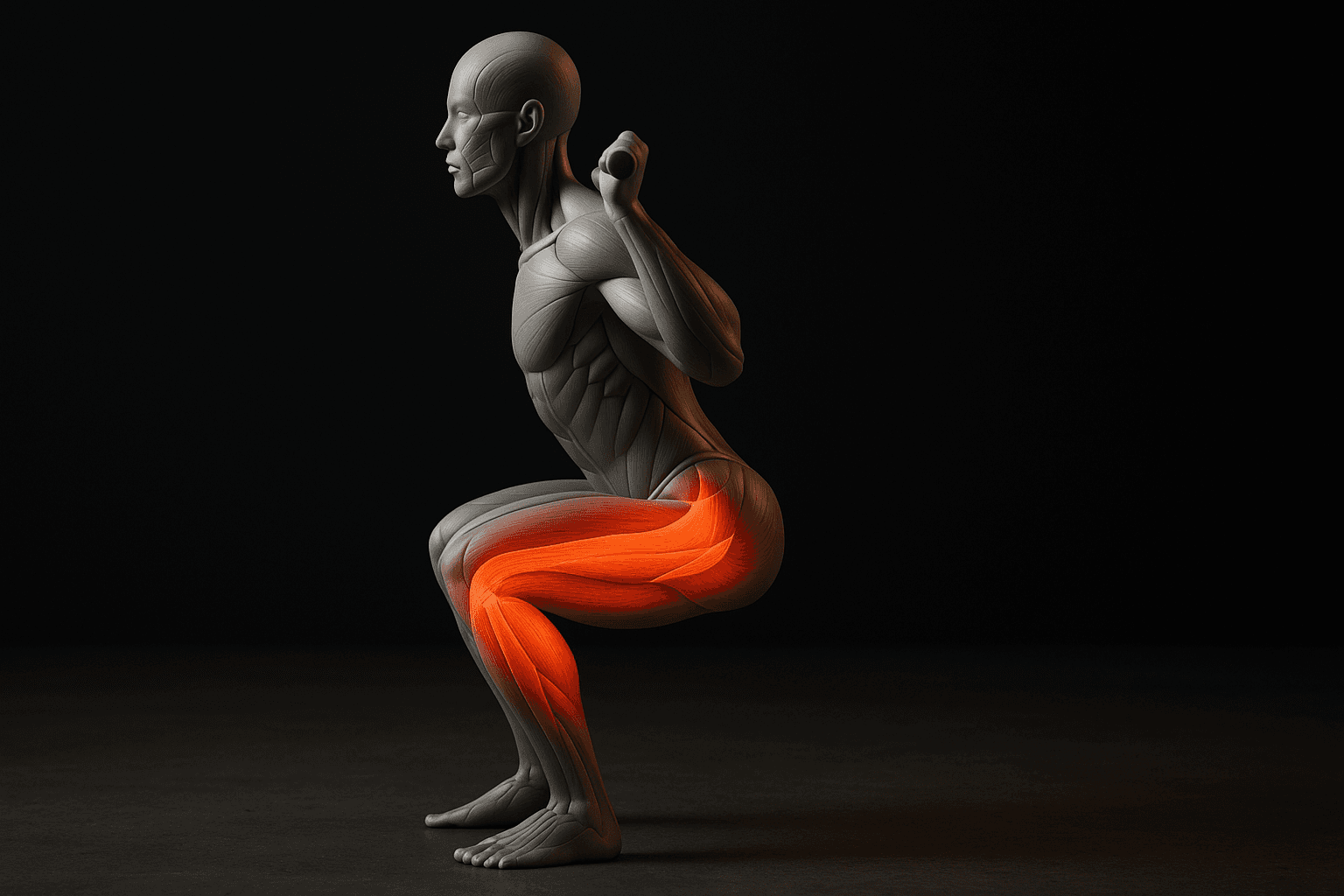
Photo by RepBro.
Which Muscles Does the Back Squat Work?
The back squat muscles worked include the quadriceps and gluteus maximus as primary movers, with the hamstrings, hip adductors, spinal erectors, and core muscles providing crucial secondary support. The quadriceps drive knee extension out of the bottom position, while the glutes power hip extension through the mid-to-top range. This makes the back squat one of the most comprehensive lower-body exercises for building strength and muscle mass across multiple muscle groups simultaneously.
Understanding exactly which muscles fire during each phase of the squat helps you optimize technique, identify weak points, and choose the right variations for your goals.
Primary Back Squat Muscles: The Main Drivers
Quadriceps Complex
The quadriceps group consists of four muscles that work together during the back squat:
- Vastus lateralis (outer quad) — generates the most force during knee extension
- Vastus medialis (inner quad) — stabilizes the kneecap and assists extension
- Vastus intermedius (deep quad) — provides raw extension power
- Rectus femoris (front quad) — crosses both hip and knee joints
The quads are most active during the concentric (rising) phase, especially in the first third of the movement when knee angle changes most dramatically. High-bar positioning increases quadriceps demand compared to low-bar squats.
Gluteus Maximus
Your glutes are the powerhouse of hip extension. The gluteus maximus activates progressively as you rise from the bottom position, reaching peak activation in the final third of the movement. Deeper squats (below parallel) significantly increase glute activation compared to partial range movements.
The glutes work hardest when you:
- Descend below parallel
- Use a wider stance
- Focus on driving through your heels
Secondary Back Squat Muscles: The Support System
Hamstrings
While not prime movers, the hamstrings serve two critical functions:
- Hip extension assistance — working with the glutes to extend the hip
- Knee stabilization — preventing excessive forward knee travel
The hamstrings activate more in low-bar squats due to the increased hip hinge pattern.
Hip Adductors
These inner thigh muscles stabilize the femur and assist with hip extension, especially in wider stance squats. The adductor magnus, in particular, contributes significantly to the movement pattern.
Spinal Erectors
Running along your spine, these muscles work isometrically to maintain neutral spine position under load. They're more active in:
- Low-bar squats (due to forward torso lean)
- Front-loaded variations
- Higher rep ranges where fatigue accumulates
Core Muscles
Your abs, obliques, and deep stabilizers create intra-abdominal pressure to support your spine. This "natural weight belt" effect becomes more important as loads increase.
How Squat Variations Change Muscle Activation
Bar Position Effects
High-bar squats place the barbell on your upper traps, promoting:
- More upright torso position
- Increased quadriceps activation
- Greater knee flexion angles
- Reduced spinal erector demand
Low-bar squats position the bar lower on your rear delts, creating:
- More forward torso lean
- Increased posterior chain activation (glutes, hamstrings, spinal erectors)
- Greater hip hinge pattern
- Ability to handle heavier loads
Stance Width Impact
Narrow stance (shoulder-width or less):
- Emphasizes quadriceps activation
- Requires greater ankle mobility
- Increases knee flexion demands
Wide stance (1.5x shoulder-width or more):
- Increases glute and adductor activation
- Reduces ankle mobility requirements
- Allows for shorter torso position
Depth Considerations
Full depth (hip crease below knee):
- Maximizes glute activation
- Increases quadriceps range of motion
- Requires adequate mobility
Partial squats (above parallel):
- Reduce muscle activation across all groups
- Limit strength and hypertrophy benefits
- Should only be used for specific training purposes
Programming Back Squats for Muscle Development
Frequency and Volume
For optimal muscle development across all squat muscles:
- Frequency: 2-3 times per week
- Sets per week: 8-16 working sets for intermediate lifters
- Rep ranges: 6-12 reps for hypertrophy, 3-6 for strength
Session Placement
Place back squats early in your workout when you're fresh. The complex coordination required and heavy loads demand peak nervous system function.
Progressive Overload Strategies
- Load progression: Add 2.5-5kg per week for beginners
- Volume progression: Increase sets before increasing weight
- Intensity progression: Use RPE 7-9 for most working sets
Common Muscle Imbalances and Solutions
Quad-Dominant Patterns
If you feel squats only in your quads:
- Focus on sitting back initiation
- Try wider stance variations
- Add pause squats to improve glute activation
- Include Romanian deadlifts to strengthen posterior chain
Glute Weakness
Signs include knee cave or forward lean:
- Add glute activation warm-ups
- Practice goblet squats for positioning
- Include single-leg work like Bulgarian split squats
- Focus on driving through heels
Core Instability
If your torso collapses forward:
- Strengthen spinal erectors with good mornings
- Practice front squats for anti-flexion strength
- Add planks and dead bugs for core stability
- Work on thoracic spine mobility
Tracking Your Squat Muscle Development
Monitor these indicators of balanced muscle development:
- Strength ratios: Your squat should be roughly 1.2-1.5x your bench press
- Movement quality: No knee cave, excessive forward lean, or butt wink
- Muscle soreness patterns: Balanced soreness across quads, glutes, and posterior chain
The most effective way to ensure all squat muscles develop properly is consistent tracking of your sets, reps, and weights alongside regular form assessment.
Alternative Exercises for Targeted Muscle Development
When you need to emphasize specific muscle groups:
For more quad emphasis: Front squats, high-bar squats, narrow stance
For more glute emphasis: Low-bar squats, wide stance, box squats
For unilateral strength: Bulgarian split squats, single-leg RDLs
For reduced spinal loading: Goblet squats, trap bar deadlifts
The back squat remains the gold standard for comprehensive lower-body development, training more muscles simultaneously than almost any other exercise. Master the movement pattern, understand which muscles should be working, and you'll build a foundation of strength that carries over to every other lift in your program.
Frequently asked questions
- What are the main muscles worked in a back squat?
- The primary muscles are the quadriceps (knee extension) and gluteus maximus (hip extension). Secondary muscles include hamstrings, hip adductors, spinal erectors, and core muscles for stabilization.
- Do high-bar or low-bar squats work different muscles?
- Yes. High-bar squats emphasize the quadriceps more due to increased knee flexion. Low-bar squats shift more load to the posterior chain (glutes, hamstrings, spinal erectors) due to the forward torso lean.
- How does squat depth affect muscle activation?
- Deeper squats (below parallel) significantly increase glute activation compared to partial squats. Full depth also maximizes quadriceps range of motion for better muscle development.
- Why do I only feel squats in my quads?
- This usually indicates a quad-dominant pattern. Focus on sitting back initiation, try wider stance variations, and strengthen your posterior chain with Romanian deadlifts and glute activation exercises.
- How often should I squat for muscle growth?
- 2-3 times per week with 8-16 total working sets is optimal for most intermediate lifters. Use rep ranges of 6-12 for hypertrophy and ensure adequate recovery between sessions.