Ab Wheel Rollout: Muscles Worked and Best Alternatives
Clear, evidence-aware guide: what muscles the ab wheel rollout trains, where it fits in a program, progressions/regressions, and 4 practical alternatives with when to choose each.
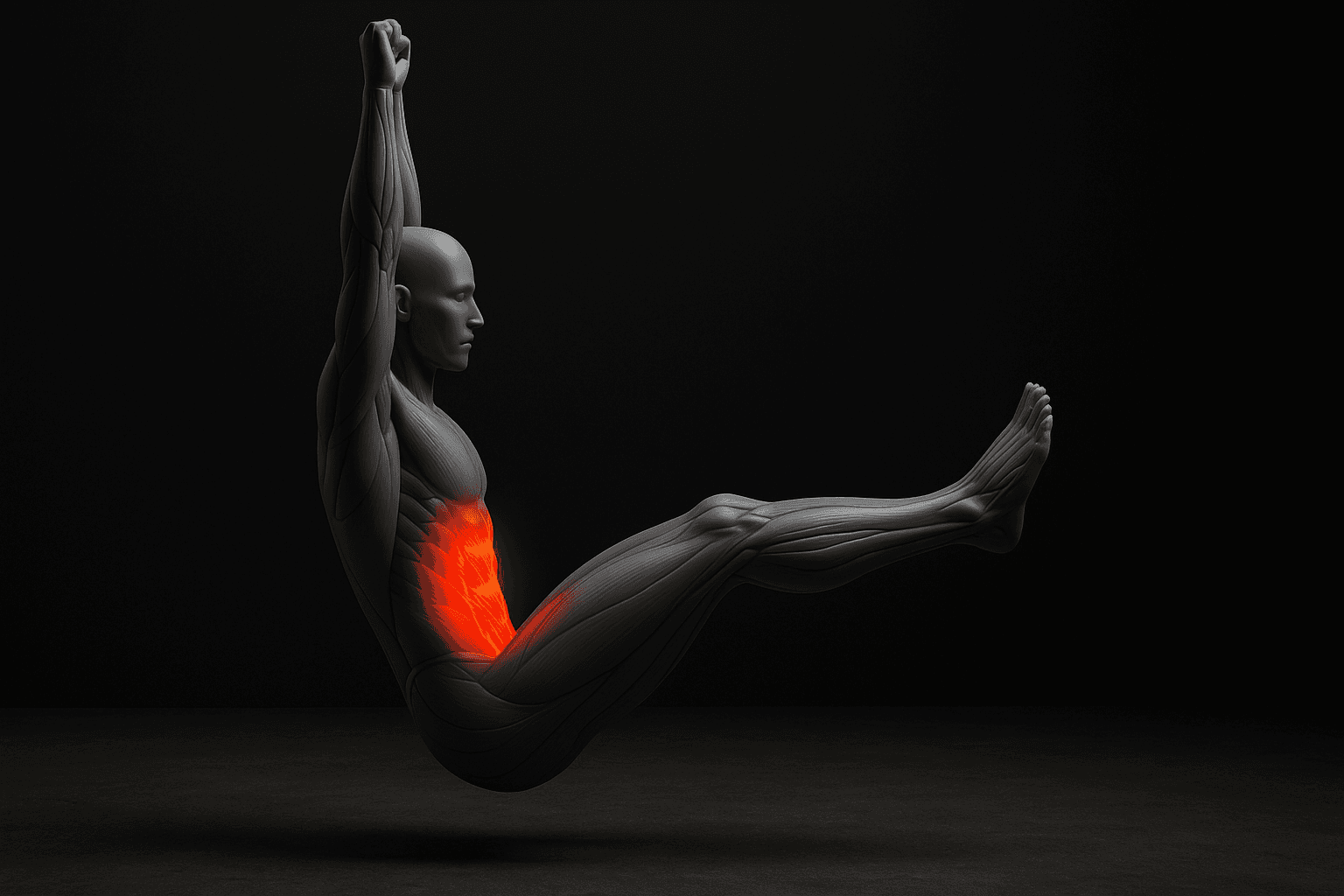
Photo by RepBro.
Answer-first
The ab wheel rollout primarily stresses the core’s anti‑extension system — rectus abdominis, external obliques and transverse abdominis — while secondarily loading the lats, serratus anterior, shoulders and hip extensors. Use it as an advanced accessory 2–3 times per week with clear regressions and progressions.
What muscles does the ab wheel rollout train?
The ab wheel is mainly an anti‑extension exercise. Primary muscles involved:
- Rectus abdominis: resists lumbar extension through the movement and contributes to returning to the start position.
- External obliques (and internal obliques): stabilize the torso and resist unwanted rotation or lateral collapse.
- Transverse abdominis: provides deep compressive stability during the extended position.
Secondary muscles that assist or stabilize:
- Latissimus dorsi and serratus anterior: help control shoulder position as the arms move forward and back.
- Anterior deltoids and pectorals: support the shoulder position under load.
- Glutes and hamstrings: help lock the pelvis and prevent lumbar hyperextension at the bottom.
Mechanically, the ab wheel places a long moment arm on the shoulders and spine, which is why it feels very challenging even with modest added load.
How does the ab wheel work biomechanically—what makes it hard?
Two key demands make rollouts difficult:
- Anti‑extension torque: as the wheel moves forward, the spine wants to extend; the abs must produce torque to prevent collapse.
- Shoulder and scapular control: the shoulders must tolerate a long lever while keeping the scapulae stable.
Because of those demands, the ab wheel combines isometric control (holding neutral spine) with eccentric and concentric length changes — a different stimulus than pure flexion exercises.
When should I include the ab wheel in my program?
Place the ab wheel as an accessory, after heavy compound lifts or after technical core work. Recommended practical guidelines:
- Frequency: 2–3 sessions per week for most lifters.
- Volume: 2–4 sets per session, using a rep range that challenges you while preserving form.
- Progression: increase range of motion, reps, or move from knee rollouts to standing rollouts over weeks or months.
Avoid making maximal, high‑volume rollout sessions the only core work; balance anti‑extension with anti‑rotation and hip control exercises.
How do I progress and regress safely?
Progressions (in order of difficulty):
- Kneeling rollouts with limited range.
- Kneeling full range to near horizontal.
- Eccentric‑emphasized (slow return) kneeling rollouts.
- Standing rollouts or band assisted standing rollouts.
Regressions and alternatives if you lack strength, shoulder stability, or have pain:
- Plank variations (short lever to long lever).
- Deadbugs or bird‑dogs for motor control and pelvic stability.
- Cable/landmine rollouts to control loading and reduce shoulder shear.
Progress only when you can hold perfect bracing and neutral spine through the current variation.
What are solid alternatives and when should I pick each?
Below are four practical choices with when to use them.
-
Plank (and plank progressions): Choose when you need a low‑risk anti‑extension option, when learning bracing, or when rehabbing. Requires no special equipment.
-
Cable or landmine rollouts: Pick when you want incremental loading and smoother resistance. Good if wrists or shoulders dislike the ab wheel’s fixed plane.
-
Pallof press: Use for anti‑rotation emphasis and to build core stiffness without long lever shoulder stress. Excellent when shoulder pain limits axial loading.
-
Deadbug / Bird‑dog: Pick for motor control, beginners, or during rehab phases; these improve coordination of pelvis and ribcage without heavy spinal torque.
Quick comparison table
| Exercise | Primary challenge | Equipment | When to pick it |
|---|---|---|---|
| Ab wheel rollout | Anti‑extension, long lever | Ab wheel | Ready for advanced anti‑extension work and you have shoulder control |
| Plank (progressions) | Anti‑extension, baseline stiffness | None | Beginners, limited equipment, rehabbing shoulders |
| Cable / landmine rollout | Anti‑extension with controllable load | Cable or barbell | Want graded loading or wrist-friendly plane |
| Pallof press | Anti‑rotation, bracing | Cable/band | Shoulder pain, rotation control, program variety |
| Deadbug / Bird‑dog | Motor control, pelvic stability | None | Rehab, teaching bracing, early progressions |
What should my form and breathing look like?
- Start from a braced neutral spine; don’t over‑flex at the hips.
- Keep ribs stacked over pelvis; avoid rib flare.
- Move slowly and control the negative (outward) portion.
- Breathe: inhale to set tension, exhale through the hardest portion while maintaining brace. Avoid breath‑holding for multiple maximal reps.
Safety note: stop on sharp or radiating pain. If you have a history of low back or shoulder injuries, consult a qualified clinician before attempting advanced rollouts. Never diagnose injuries from a description alone.
What can apps and AI coaching not do? (Limitations)
- No app or AI can reliably see and correct your form the way a trained coach in person can; video feedback helps, but it’s not a substitute for hands-on assessment when form or pain is involved.
- Apps cannot diagnose injuries or replace a physical therapist; seek professionals for persistent pain or rehabilitation plans.
- A program only works if you do it consistently; tools help track and plan, but adherence and progressive overload are the human factors that produce change.
If you track progress digitally, tools such as RepBro can log sessions and make progression easier, but they don’t replace form checks or professional advice.
Practical closing recommendations
If you can perform a controlled full‑range kneeling rollout with clean spine alignment, include the ab wheel 2–3 times per week as an accessory and rotate in anti‑rotation work and hip control. If you feel shoulder or low‑back discomfort, step back to regressions (planks, deadbugs) or choose cable/landmine versions. Prioritize slow, controlled progress and recovery.
Safety reminder: stop if you experience sharp pain, and consult a qualified professional for persistent issues. This article is informational and not medical advice.
Frequently asked questions
- Which muscles does the ab wheel rollout work?
- The ab wheel rollout primarily challenges the core’s anti‑extension system — rectus abdominis, external obliques and transverse abdominis — while secondarily loading lats, serratus anterior, anterior deltoids, and the hip extensors for pelvic control. It’s mostly an isometric spinal stabilizer with eccentric/concentric range-of-motion.
- How often should I train rollouts?
- Treat rollouts as an accessory core move: perform them 2–3 times per week, allowing recovery between sessions. Use 2–4 sets per session and progress slowly by increasing range, reps, or challenge. Avoid daily maximal attempts; recovery matters for the spinal stabilizers too.
- What are good alternatives if I can’t do rollouts?
- Solid alternatives include planks (and plank progressions) for anti‑extension, cable/landmine rollouts for controlled loading, Pallof presses for anti‑rotation and shoulder-friendly core work, and deadbugs for beginners or rehab. Pick based on equipment, pain history, and where you’re stuck.