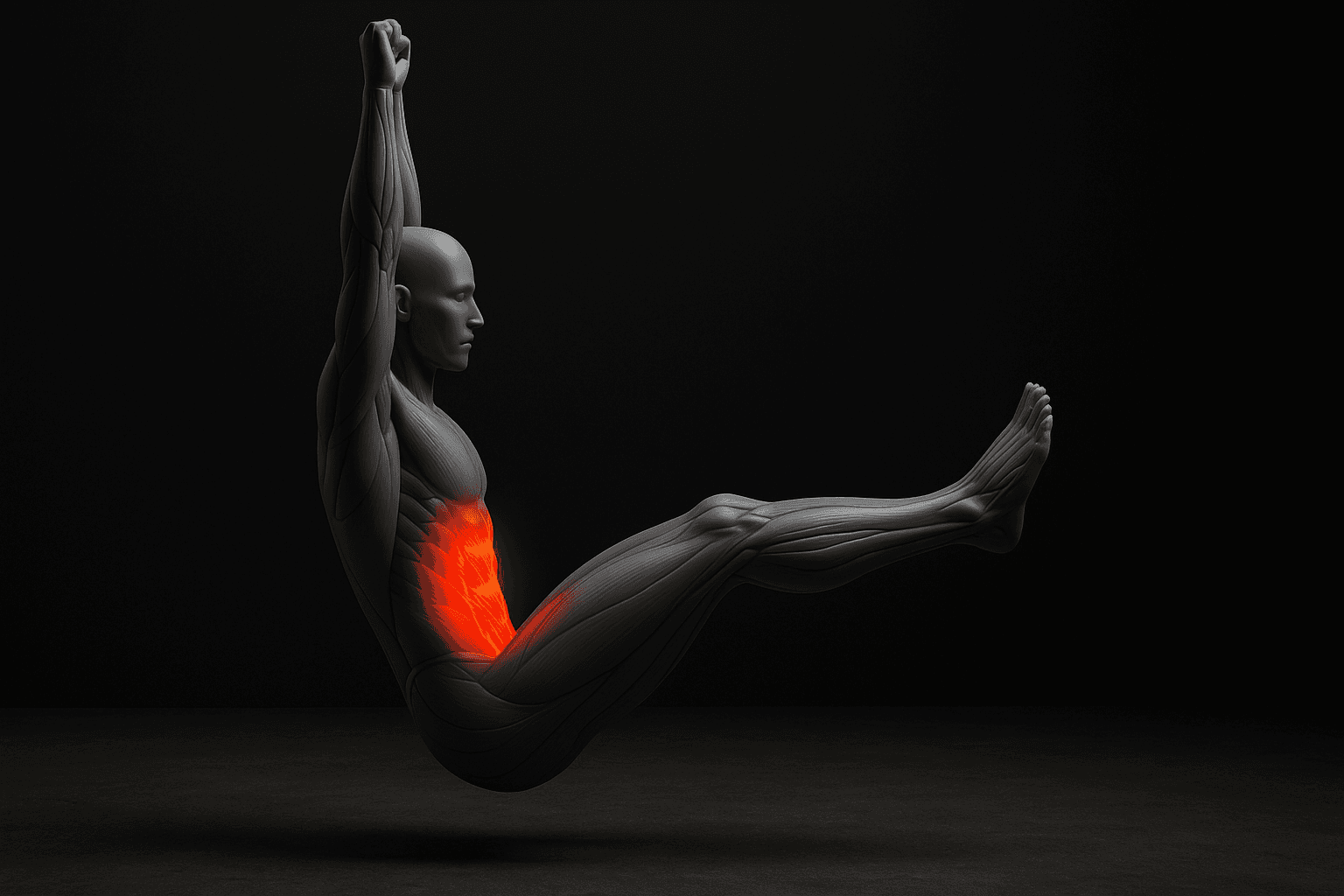
The Most Common Ab Wheel Rollout Mistakes (and How to Fix Them)
Identify the top ab wheel rollout mistakes, why they happen, what they cost (lost gains or injury risk), and one practical fix per mistake to improve technique safely.

Photo by RepBro.
The most common ab wheel mistakes are lumbar sag, hips hiking up, using the shoulders/arms instead of the core, progressing to standing too early, choppy or momentum-driven reps, and poor head/neck position. Each reduces effectiveness and raises injury risk; fix each with a focused cue and a regression.
Why are these mistakes important to fix?
Ab wheel rollouts produce large moments at the spine and require coordinated bracing of the abdominal wall, hips, lats and scapular stabilizers. Small technical errors change force vectors and shift load from the abs to the lumbar spine or shoulders, which reduces training effect and increases injury risk.
Why is my lower back sagging during rollouts?
Why it happens: Sagging (lumbar hyperextension) is usually due to insufficient anti-extension strength in the rectus abdominis/transversus abdominis or poor breathing/bracing. Fatigue and trying to roll too far also cause the spine to collapse.
What it costs: A sagging lumbar spine concentrates shear and compressive loads on the lower back and reduces effective tension on the anterior core, lowering strength gains and increasing low-back strain.
Concrete fix: Learn a bracing cue. Take a diaphragmatic breath, brace as if expecting a punch, then perform small controlled rollouts while keeping a neutral spine. Regress to kneeling partial rollouts and 10–30 second front plank holds until you can maintain neutral alignment under load.
Why do my hips rise (butt goes up) when I roll out?
Why it happens: Hips rising shifts the pivot to the hip joint and reduces abdominal stretch; it often occurs when the lats and anterior core fatigue and the body uses a hip hinge to maintain hand position.
What it costs: Reduced anterior core activation and a shorter, less productive range of motion. That means slower strength carryover and a false impression of progress.
Concrete fix: Cue “knees → shoulders → hips in one line.” Use a mirror or record yourself. Practice slow partial rollouts and a slow eccentric return (3–5 seconds) to expose the tendency and force the abs to control the movement rather than the hips.
Why am I using my shoulders and arms more than my abs?
Why it happens: Rolling with the shoulders (shrugging, protracting, or letting the scapulae move excessively) or straightening through the arms shifts demand to the deltoids, pecs and lats. Weak scapular control and poor lat engagement contribute.
What it costs: Less targeted abdominal overload, increased shoulder strain, and a higher chance of anterior shoulder pain over time.
Concrete fix: Set your shoulders first: retract slightly and depress the scapulae (like holding weight down by your sides). Pull the wheel forward with the torso rather than reaching with the arms; think "lead with the chest" instead of "reach with the hands." Also include lat-engagement drills (e.g., banded scapular pulls) in warm-ups.
Why do I keep trying standing rollouts and failing?
Why it happens: Standing rollouts dramatically increase required torque and require much more anti-extension strength. Many lifters jump to standing variations because they look impressive, not because they've built the intermediate capacity.
What it costs: Rapid progression without adequate capacity raises injury risk—especially to the lumbar spine—and yields poor repetitions that don't build the desired strength.
Concrete fix: Follow a staged progression: kneeling partial → full kneeling → eccentrics from knees → incline/decline rollouts (hands elevated) → rollouts from standing only after many controlled reps at full kneeling. Only progress when you can perform multiple clean sets without form loss.
Why are my reps short, choppy, or powered by momentum?
Why it happens: Choppy reps come from trying to hit a certain distance, poor motor control, fatigue, or using speed to compensate for weakness.
What it costs: Momentum reduces time under tension for the target muscles and hides weaknesses; it also increases uncontrolled spinal loading during the return.
Concrete fix: Slow the tempo. Use a 2–3 second controlled roll-out and a 3–5 second controlled return. If you must use speed, identify the weak phase (outward vs return) and slowly strengthen it with negatives or isometrics.
Does my head/neck position matter during rollouts?
Why it happens: Looking up or jutting the chin forward is an attempt to extend the cervical spine and can accompany compensatory thoracic extension. Tucking excessively can limit breathing and proper bracing.
What it costs: Neck strain and disrupted spinal alignment, which can reduce trunk stiffness and transfer load away from the abs.
Concrete fix: Maintain a neutral cervical spine: eyes a few inches ahead of the wheel, chin slightly tucked. Imagine a straight line from head to tailbone. Combine with the breathing/bracing cue above.
How do kneeling and standing rollouts compare for progressions and risk?
| Variation | Difficulty | Spinal load | Recommended for |
|---|---|---|---|
| Kneeling partial rollout | Low | Low–moderate | Beginners building control and bracing |
| Full kneeling rollout | Moderate | Moderate | Core strength development and motor control |
| Standing rollout | High | High | Advanced lifters with proven core capacity |
Short safety note
Stop if you feel sharp or shooting pain; mild muscle soreness is normal but sharp pain is not. If you have a history of back or shoulder injury, consult a qualified professional before progressing. This article does not diagnose injuries or replace clinical advice.
Limitations: What apps and guides cannot do for you
A written guide or app cannot see your movement and therefore cannot replace an in-person coach for detailed form correction. Apps and videos can give cues and progressions, but they can't assess pain sources, diagnose injuries, or provide individualized rehabilitation. Consistency, patience, and occasional professional input are required for safe progress.
Closing practical checklist (quick):
- Maintain a neutral spine and braced belly; regress if it collapses.
- Keep hips in line — avoid butt-up pivots.
- Set the shoulders and lead with the chest, not the hands.
- Progress via partial, eccentric, and incline regressions before standing.
- Use slow, controlled tempos; stop when form breaks.
If you want a structured progression, record a few sets and compare them to these cues or seek hands-on coaching to refine movement patterns.
Frequently asked questions
- Are ab wheel rollouts safe for my lower back?
- Ab wheel rollouts can be safe if you maintain a neutral spine, progress gradually, and have adequate core control. Pain or a persistent sagging lumbar spine indicates poor control; regress to partial rollouts or plank progressions and consult a professional if pain persists.
- How should I progress rollouts without injuring myself?
- Progress by increasing range of motion and load slowly: start with kneeling partial rollouts, add eccentric (slow) returns, then full kneeling rollouts, and only attempt standing rollouts after consistent control. If form breaks, reduce ROM or return to a previous regression.
- How often should I train the rollout?
- Train rollouts 1–3 times per week as part of a balanced program, allowing recovery between sessions. Prioritize technique and quality over high volume; if form deteriorates within a session, stop and reduce difficulty.