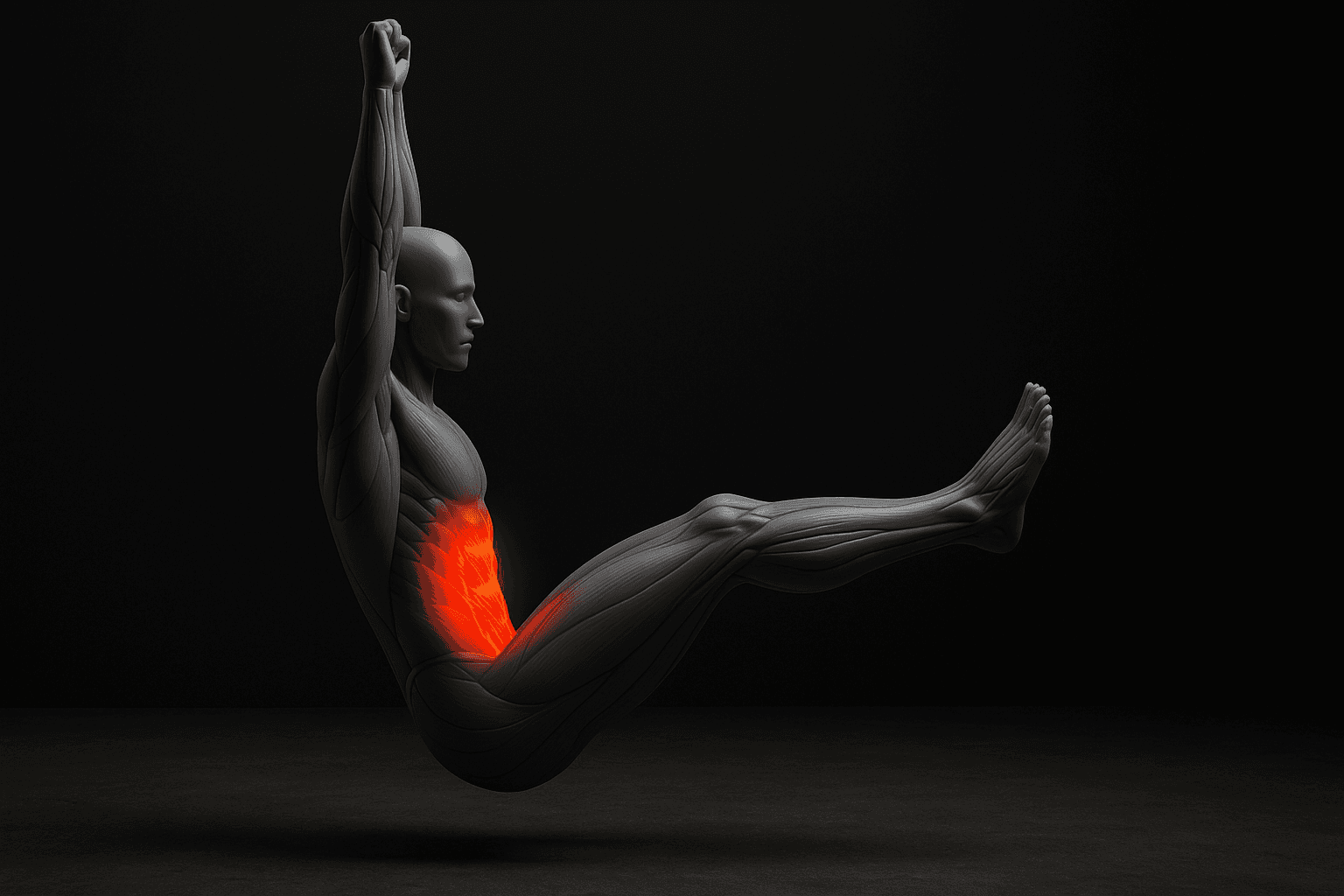
Ab Wheel Rollout: Proper Form, Step by Step
Clear, evidence-aware guide to ab wheel rollout form: setup, execution cues, breathing, tempo, progressions, common mistakes and safety guidance for lifters.

Photo by RepBro.
The ab wheel rollout builds anterior core strength when done with a neutral spine, a firm brace, and controlled range of motion. Learn set-up, breathing, tempo, and regressions first; progress gradually from knee rollouts to standing. Stop on sharp pain and consult a qualified professional for issues.
What is the correct starting position for an ab wheel rollout?
- Equipment and surface: use an ab wheel on a non-slip surface and a mat for your knees.
- Knee position: start kneeling (soft knees) with hips over knees; hands shoulder-width on the wheel handles.
- Spine and pelvis: set a neutral spine—avoid tucking or over‑arching. Think of a long line from your head to your knees.
- Brace: take a diaphragmatic inhale, expand the belly sideways/front, then brace as if preparing for a light punch to the stomach.
- Head and gaze: keep a neutral cervical position—eyes down a short distance in front of the wheel.
How do I execute the rollout with proper cues, breathing and tempo?
Step-by-step execution:
- Initiate: From the braced start, slowly push the wheel forward, maintaining the brace and a neutral spine. Move the shoulders and hips together—don’t let the hips sag.
- Range: Go as far as you can while maintaining form. For most trainees the spine should stay neutral; stop if the low back rounds or hips drop.
- Return: Pull the wheel back in under control by driving hips back using the abs rather than the arms.
Breathing cues:
- Inhale to fill the belly and prepare the brace before the movement.
- Exhale slowly and steadily as you roll out; continue to maintain intra‑abdominal pressure and control.
- Inhale as you return to the start.
Tempo recommendations:
- Controlled tempo is essential for safety and motor learning. A useful template: 2–4 seconds rolling out, optional 1–2 second brief hold at the furthest point (only if form is perfect), and 2–3 seconds back.
- Do fewer reps with clean technique. Avoid fast, ballistic rollouts until you have ample strength and control.
How should I program and progress the ab wheel rollout?
Programming guidance (evidence-aligned principles):
- Frequency: 2–3 sessions per week for most trainees, embedded in a broader strength program.
- Volume: keep volume modest while the movement is a skill—multiple short sets are better than one long set of poor reps.
- Progressions: master each step before moving on. Regress or progress based on control, not ego.
Progression ladder:
- Dead bug / bird dog / front plank (core control)
- Knee rollouts with limited range
- Rollouts to a wall or anchored strap (range-limited)
- Full knee rollouts with full range
- Elevated-hands rollouts (hands on a box) or partial standing
- Standing rollouts
Which rollout variation should I choose: kneeling or standing?
| Variation | Difficulty | Spinal load | Best for |
|---|---|---|---|
| Kneeling rollout | Low–moderate | Lower absolute load | Learning the pattern, beginners, rehabbing athletes |
| Elevated-hands/box | Moderate | Moderate | Intermediate trainees building range and strength |
| Standing rollout | High | High | Advanced trainees with proven core control |
Choose the least demanding variation that allows perfect technique.
What are common mistakes and how do I fix them?
- Mistake: Hips sagging and lumbar extension. Fix: Reduce range, re‑brace, and perform progressions. Cue “sternum toward the wheel” rather than “hips forward.”
- Mistake: Using the arms/shoulders to pull back instead of the abs. Fix: Think of reversing the motion by bringing the hips backward under control; try pausing briefly at mid‑range to practice hip control.
- Mistake: Holding breath or performing shallow breaths. Fix: Use diaphragmatic bracing—inhale to set the brace, exhale during the rollout while maintaining tension.
- Mistake: Too many reps or going to failure. Fix: Limit reps to maintain quality—stop well before form breaks down.
Is this exercise safe? When should I stop or see a professional?
Safety note: stop immediately if you experience sharp, radiating, or persistent pain. The ab wheel increases anterior load; if you have recent abdominal surgery, uncontrolled hernia, or unresolved spinal pain, consult a qualified clinician before attempting rollouts. This article does not diagnose or treat injuries.
Short FAQ
Q: Can I do rollouts every day? A: Daily heavy practice is unnecessary and may impede recovery. Aim for 2–3 sessions per week and focus on quality. If rollouts complement a high-volume program, reduce frequency or intensity to avoid excessive spinal loading.
Q: How do I know I’m ready for standing rollouts? A: You can perform multiple clean knee rollouts and elevated rollouts with full range and no low‑back compensation. Standing rollouts require high anterior core capacity and solid hip control.
Q: Are rollouts useful for athletic performance? A: Rollouts develop anterior core strength and anti‑extension control, which are components of athletic trunk stability, but they should be one element among varied core and whole‑body training.
Limitations: what apps, videos and AI coaching cannot do
- No app or video can physically correct every individual’s subtle movement errors in real time. Remote tools are useful but imperfect.
- This guide cannot replace in-person assessment for pain, hernia, or postoperative advice. If you have medical concerns or complex pain patterns, consult a qualified clinician or coach.
- Training guidance only works if you follow it consistently; consistency and progressive overload matter more than any single exercise.
Short final note: prioritize controlled technique, progress from regressions, and stop for sharp pain. For persistent issues, seek help from a qualified professional.
Frequently asked questions
- Can beginners do ab wheel rollouts?
- Yes—beginners can train toward the ab wheel by starting with regressions: knee-supported rollouts with a limited range, rollouts to a wall, and plank-based core work. Focus on form and low repetitions, 2–3 sessions per week, progressing only when you can maintain a neutral spine and full core brace.
- How many reps and sets should I do?
- Prioritize quality over quantity: use 2–4 sets of low reps while you learn the movement. For most trainees, 3–8 controlled repetitions per set is appropriate; increase range or difficulty only after you can complete each rep with a stable spine and no compensation.
- Will ab wheel rollouts hurt my lower back?
- If performed without a tight core or with excessive lumbar extension, rollouts can irritate the lower back. Stop if you feel sharp pain. Regress the exercise, work on anterior core control with safer progressions, and consult a qualified professional for persistent discomfort.