Bulgarian Split Squat Rep Range: Sets, Reps, and Progression by Goal
Bulgarian split squat rep ranges by goal: 4–6 reps for strength, 8–15 for hypertrophy, 15–20 for endurance. Includes sets, progression schemes, and BSS programming tips.
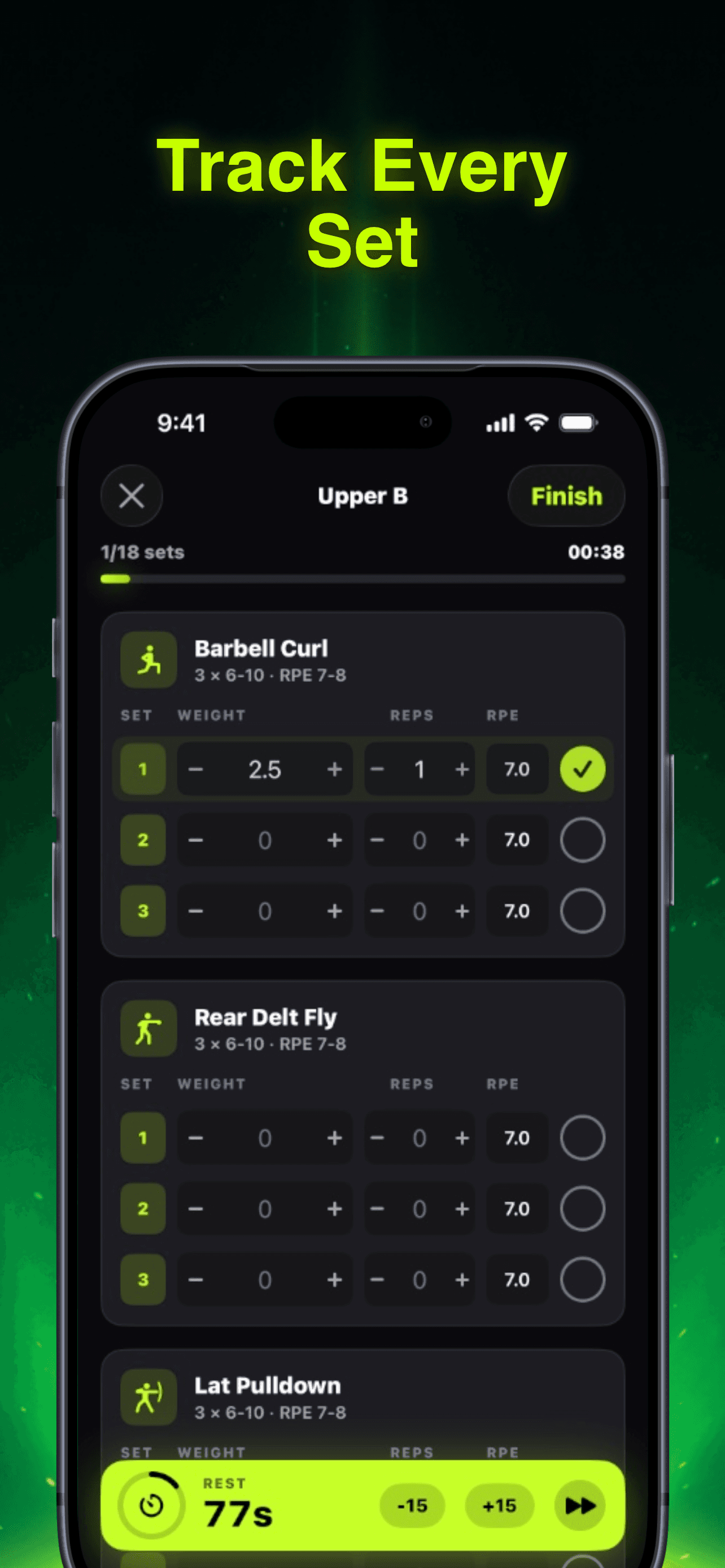
Photo by RepBro.
The Short Answer on Bulgarian Split Squat Rep Ranges
If you want a clean, direct answer: use 4–6 reps per leg for maximal strength, 8–15 reps for hypertrophy, and 15–20 reps for muscular endurance or when loading is limited. Run 3–4 working sets per leg, rest 2–3 minutes between sides, and stay within 1–3 reps in reserve (RIR) on most sets. Progress by adding load when you hit the top of your target range across all sets — not by randomly bumping weight every session.
That's the skeleton. The rest of this article puts meat on it.
Why Rep Range Actually Matters for the BSS
The Bulgarian split squat is a unilateral exercise, which means balance and coordination create a skill tax that doesn't exist on bilateral squats. Go too heavy too soon and technique falls apart — your hip shifts, your rear foot torques, and you stop training the quad and glute you came to train.
That skill tax also means the BSS responds well to moderate rep ranges. Very low reps (1–3) are hard to execute cleanly under near-maximal load on one leg. Very high reps (20+) become a cardiovascular and systemic fatigue problem before the target muscles are truly close to failure. The sweet spots are narrower than on a barbell back squat.
There's another wrinkle: the BSS loads the quads under a deep stretch — the front leg reaches a long muscle length at the bottom. Research consistently shows that stretch-mediated hypertrophy is a real, independent driver of muscle growth (Maeo et al., 2021). Full range of motion matters here more than on many exercises. That's a reason to keep reps controlled and not rush through them to chase a higher number.
Bulgarian Split Squat Rep Range by Goal
Strength: 4–6 Reps Per Leg
When your goal is maximal force production — sport performance, powerlifting accessory work, or just moving heavier loads — keep reps in the 4–6 range. Load with a barbell or heavy dumbbells. Work at roughly RPE 8–9 on your top sets.
At this rep range, the BSS builds real lower-body strength that transfers to bilateral squats and athletic output. The trade-off: your balance and technique need to be solid before you go here. Spend at least 4–6 weeks at moderate reps before loading this heavy.
Sets: 3–5 working sets per leg
Rest: 2–3 minutes between each leg
Load: ~75–85% of your estimated single-leg max
Progression: Add 2.5–5 kg (5–10 lb) when you complete all sets at the top of the range (6 reps) with at least 1 RIR
Hypertrophy: 8–15 Reps Per Leg
This is where most lifters should live most of the time. The 8–15 range balances mechanical tension and metabolic stress, and it's forgiving enough that you can maintain good technique through a full set.
RP's quad training guidelines confirm that quads respond to loads anywhere from 5 to 30 reps, with the moderate range (roughly 8–20) being the most practical for exercises like the BSS where systemic fatigue and balance can otherwise limit the set before the muscle does. For most people, 10–12 reps is the sweet spot — heavy enough to generate tension, light enough to hit depth on every rep.
Sets: 3–4 working sets per leg
Rest: 90 seconds to 2 minutes between each leg
Load: ~60–75% of your estimated single-leg max
Progression: Add reps until you hit 15 across all sets, then add load and reset to 8–10 reps
Endurance / Limited Equipment: 15–20 Reps Per Leg
Traveling, training at home, or working around a lower-body injury that restricts load? Higher rep BSS sets still build muscle and maintain strength. The catch is proximity to failure matters more here — a set of 20 done at RPE 6 does almost nothing. You need to be at RPE 8–9 by the last few reps for this range to deliver hypertrophic stimulus.
Sets: 2–3 working sets per leg
Rest: 60–90 seconds
Load: Bodyweight, light dumbbells, or a loaded backpack
Progression: Add reps, then add load when you hit 20 cleanly
How to Progress the Bulgarian Split Squat Over Time
Progression on the BSS is slower than on bilateral squats. You're moving one leg at a time, so absolute load increments are smaller. Don't expect to add 5 kg every week.
A reliable progression model for intermediate lifters:
- Week 1–2: Establish your starting weight. Pick a load where you can hit the bottom of your target rep range (e.g., 8 reps) at RPE 7–8.
- Week 3–4: Add 1–2 reps per set while keeping load constant. Aim to reach the top of your range (e.g., 15 reps) across all sets.
- Week 5: Add 2.5–5 kg (5–10 lb) and reset to the bottom of the range. Repeat the cycle.
- Every 4–6 weeks: Take a deload week. Drop to 2 sets at 60% effort. Your connective tissue and hip flexors will thank you.
This double-progression method — reps first, then load — works especially well for unilateral exercises because it gives you time to adapt to the new weight before pushing hard again.
Tracking RPE on the BSS
RPE is more useful than percentage-based loading on the BSS because your single-leg max is hard to test and varies with fatigue, balance, and how recently you squatted. Log every set with a perceived effort score. If RPE creeps above 9 on your first working set, the weight is too heavy. If you're finishing at RPE 6 on your last set, add load next session.
BSS Programming: How Many Sets Per Week?
For quad hypertrophy, RP's quad volume landmarks put the minimum effective volume at 4–6 hard sets per week and the maximum adaptive volume around 6–14 sets per week for most intermediate lifters. The BSS can account for 2–3 of those sets per session.
A practical weekly structure:
- 2 days/week legs: 3 sets BSS each session = 6 sets/week quads from BSS alone
- 3 days/week legs: 2–3 sets BSS on 2 of those sessions = 4–6 sets/week
Don't stack the BSS on top of heavy bilateral squats in the same session when you're already pushing volume. It's either your primary quad movement or a secondary one — pick a role and program accordingly.
One Common Mistake That Kills Progress
The most frequent error I see with the BSS: treating both legs as equal when they're not. Most people have a dominant leg that does more work, especially under fatigue. Always start with your weaker leg, complete all sets on that side, then match the reps on your stronger side — not the other way around. Over time, this self-corrects the imbalance instead of reinforcing it.
What to Do in Your Next Session
Pick one rep range from this article that matches your current goal. Log every set with the exact reps, load, and an RPE score. If you don't know your RPE on the BSS, aim for a weight where the last 2–3 reps feel genuinely hard but your form doesn't break down. That's your baseline. Build from there.
Tracking this data is what turns a random leg day into actual progress. RepBro logs your sets, tracks your PRs, and lets you ask the AI coach mid-session if you should swap to a different variation or adjust the load — with full context of what you just did.
Frequently asked questions
- What is the best rep range for Bulgarian split squats?
- It depends on your goal. For strength, use 4–6 reps per leg. For hypertrophy (muscle growth), 8–15 reps is the most effective range. For endurance or limited-equipment training, 15–20 reps works well as long as you stay close to failure. Most lifters should spend the majority of their training in the 8–15 rep range.
- How many sets should I do for Bulgarian split squats?
- 3–4 working sets per leg is the standard recommendation. If the BSS is your primary quad movement for the session, 4 sets is appropriate. If it's a secondary movement after heavy bilateral squats, 2–3 sets is enough. Keep total quad volume across the week between 6–14 hard sets for most intermediate lifters.
- How do I progress weight on the Bulgarian split squat?
- Use double progression: add reps each session until you hit the top of your target range across all sets, then add 2.5–5 kg and reset to the bottom of the range. For example, if you're training in the 8–15 rep range, work up to 15 reps on all sets before adding load. This cycle typically takes 2–4 weeks per weight increment.
- Can you build muscle with high-rep Bulgarian split squats?
- Yes. Research shows that rep ranges from roughly 5 to 30 can produce similar hypertrophy when sets are taken close to failure. High-rep BSS sets (15–20) can build muscle effectively, especially with limited equipment. The key is finishing at RPE 8–9 — a comfortable set of 20 won't drive growth.
- Should I do Bulgarian split squats before or after squats?
- If your goal is BSS strength or using it as a primary quad movement, do it first. If it's an accessory after bilateral squats, do it after. Avoid placing heavy BSS work after you're already fatigued from barbell squats if you're trying to progress load — your balance and technique will suffer, and injury risk goes up.
- How long should I rest between Bulgarian split squat sets?
- Rest 2–3 minutes between legs for strength-focused sets (4–6 reps). For hypertrophy work (8–15 reps), 90 seconds to 2 minutes is sufficient. For higher-rep endurance sets, 60–90 seconds works. Always complete all sets on one leg before switching, or alternate legs with full rest between each.