Full 3x vs GZCLP vs App-Based Programs: Which 3-Day Full Body Split Gets Results?
Comparing Full 3x, GZCLP, and app-based programs like Alpha Progression to help you pick the right 3-day full body split for your schedule, experience, and goals.
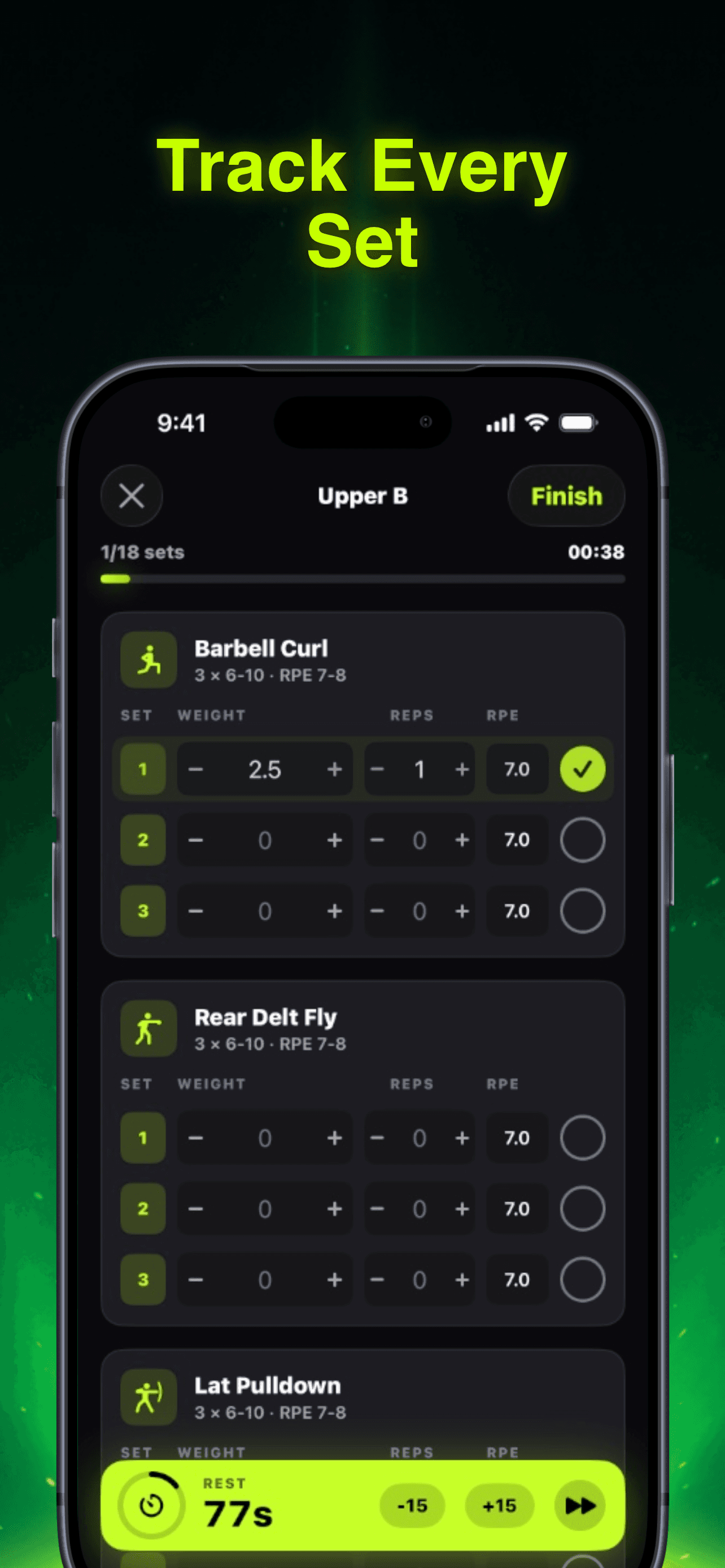
Photo by RepBro.
Three days a week, full body, compound lifts. That's the skeleton of every program in this comparison. But the details — how sets are structured, how weight progresses, how the app (or spreadsheet) manages your training — make a real difference in whether you're still lifting six months from now or stalled out on week four.
This breakdown covers the three most-discussed options for lifters running a 3-day full body schedule: Full 3x, GZCLP, and app-based programs like Alpha Progression and Fitbod (with RepBro thrown in as a direct comparison). If you're choosing between them, here's what you actually need to know.
The Quick Answer: Which Program Gets the Best Full 3x Results?
For raw beginners, GZCLP edges out generic "Full 3x" templates because its tiered structure trains each lift at two intensities per session and has a built-in progression reset protocol. For intermediate lifters or anyone who's stalled on linear progression, app-based programs that auto-regulate volume and intensity beat both. The best program is always the one you execute consistently — but structure matters for longevity.
What Is "Full 3x" and Who Is It For?
"Full 3x" isn't one specific program. It's a broad descriptor for any routine hitting the whole body three times per week, typically with three working sets per movement. Think StrongLifts 5×5 stripped down, or any basic Mon/Wed/Fri template where you squat, press, and pull every session.
The appeal is simplicity. Three sets of five, add weight every session, go home. For a true beginner — someone in their first 8–12 weeks of consistent barbell training — this works because neurological adaptation is so rapid that almost any progressive overload stimulus produces results. You don't need sophistication; you need consistency and load increases.
The problem shows up around weeks 8–16. Linear progression stalls. You miss a rep, you reset, you stall again. Generic Full 3x templates give you no real protocol for what to do next. That's where the structure of GZCLP becomes relevant.
GZCLP: The Same Frequency, More Intelligent Design
GZCLP was designed by powerlifter Cody LeFever (u/gzcl) as a beginner linear progression program derived from his broader GZCL method. It runs on the same Mon/Wed/Fri skeleton but rotates through four distinct workouts rather than repeating the same session.
The Tier System
Every session has three tiers:
- Tier 1 (T1): The primary barbell compound for the day. Heavy, low-rep, AMRAP on the final set. Starts at 5×3+.
- Tier 2 (T2): A secondary compound at moderate weight. More volume, less intensity. Starts at 3×10.
- Tier 3 (T3): Accessory work — lat pulldowns, dumbbell rows. 3×15+.
The four-day rotation looks like this:
| Day | T1 | T2 |
|---|---|---|
| 1 | Squat | Bench Press |
| 2 | Overhead Press | Deadlift |
| 3 | Bench Press | Squat |
| 4 | Deadlift | Overhead Press |
Because there are four workouts on a three-day schedule, you never do the same session on the same day of the week. Squat and deadlift volume is genuinely balanced — a persistent weakness in many beginner templates.
Progression in GZCLP
Progression is load-based and automatic:
- T1/T2: Add 5 lb to upper body lifts, 10 lb to lower body lifts after each session.
- When you fail to hit the rep target, move to the next stage (5×3+ → 6×2+ → 10×1+).
- After failing Stage 3, test a new 5-rep max and restart at 85% of that weight.
This built-in reset protocol is the reason GZCLP outlasts most simple Full 3x templates. You're not just "deloading and hoping." You're resetting with a defined method and a new target.
Who Should Run GZCLP
- Beginners who want more than the bare minimum.
- Lifters who've stalled on StrongLifts or a basic 3×5 and want a structured reset.
- Anyone who trains at a barbell-equipped gym and can commit to the four-workout rotation.
The limitation: GZCLP is a spreadsheet program. It doesn't know your fatigue, your sleep, or whether you tweaked your shoulder last Tuesday. It just adds weight.
App-Based Programs: Alpha Progression, Fitbod, and RepBro
This is where the comparison gets more nuanced, because "app-based" covers a wide range of sophistication.
Alpha Progression
Alpha Progression is a well-regarded hypertrophy-focused app. Its core strength is auto-regulating volume — it tracks your performance and nudges sets and reps based on progressive overload targets. It's more polished than a spreadsheet and handles mesocycle structure better than most free templates.
The criticism you'll see consistently: it's rigid about its own programming logic. Swapping an exercise mid-cycle or adjusting for an injury requires workarounds. It's also primarily hypertrophy-oriented, so if your main goal is strength and you want a powerlifting-adjacent structure, it can feel like a mismatch.
Fitbod
Fitbod generates workouts algorithmically based on muscle recovery state. It's convenient for lifters who don't want to think about programming at all. The downside is that the generated workouts can feel incoherent from a periodization standpoint — it's optimizing for muscle freshness, not for a coherent progression scheme across a training block.
The alpha progression vs fitbod debate usually comes down to this: Alpha Progression is better if you want structured hypertrophy programming; Fitbod is better if you want flexibility and don't care about following a defined program.
RepBro
RepBro approaches this differently. The 90-second onboarding — goal, equipment, experience level, days per week — generates a personalized split that's actually coherent as a program, not just a list of exercises. If you select three days and full-body preference, you get a structured 3x full body workout plan with T1/T2-style compound prioritization and accessory work built in.
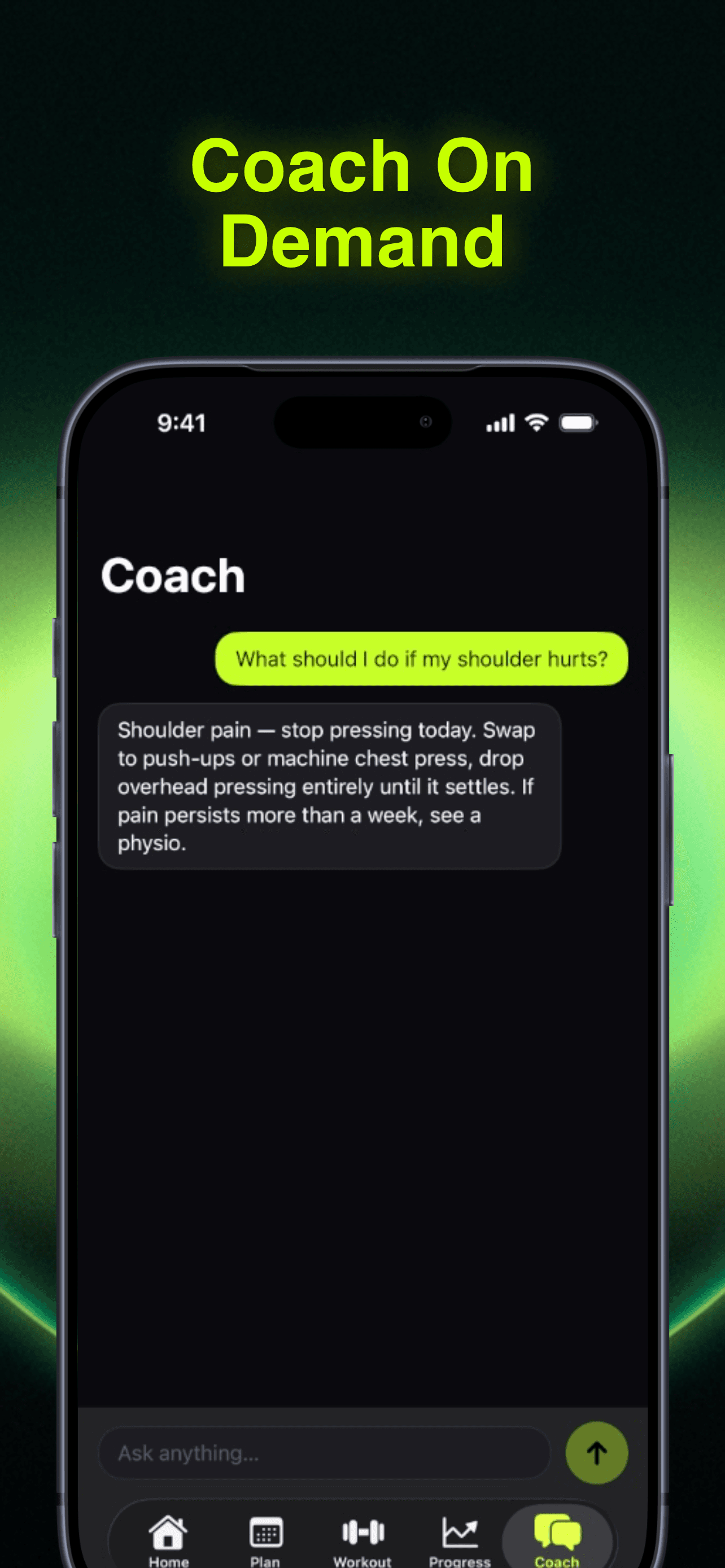
The differentiator is the in-workout AI coach. Mid-session, you can ask "should I swap Romanian deadlifts for something knee-friendly?" and the coach responds with context: it knows your plan, your logged PRs, and your equipment. That's a different category of tool than a static spreadsheet or an algorithm that just tracks muscle recovery.
For lifters who've stalled on GZCLP and want something that adapts in real time — or who want the structure of a well-designed full body program without building it themselves — RepBro closes the gap between "follow a template" and "work with a coach."
How Training Frequency Actually Affects Results
Three sessions per week is well-supported by the research. A meta-regression by Grgic et al. (2018) and subsequent volume-matched studies reviewed by Greg Nuckols at Stronger By Science consistently show that when volume is equated, higher frequency (2–3x per week per muscle group) tends to produce equal or slightly better strength gains than once-per-week training.
Three days full body hits each muscle group 3x per week — that's at the upper end of the evidence-supported frequency range for most lifters. The key phrase is when volume is equated. If you can't recover between sessions, more frequency hurts. If you're a beginner, 3x per week is nearly always appropriate.
The practical implication: the program structure (Full 3x vs. GZCLP vs. app) matters less than whether you're actually adding load over time and recovering between sessions. But structure helps you do both.
Head-to-Head Summary
| Full 3x | GZCLP | App-Based (RepBro) | |
|---|---|---|---|
| Best for | True beginners | Beginners–early intermediate | Any level |
| Progression | Add weight each session | Tiered with reset protocol | Auto-regulated |
| Adaptability | None | Low | High |
| Equipment | Barbell required | Barbell required | Any |
| Stall handling | Manual | Built-in reset | AI-coached |
| Coaching | None | None | In-workout AI |
What to Try in Your Next Session
Pick one thing to change. If you're on a generic Full 3x and you've stalled twice in the last month, download the GZCLP spreadsheet and run the four-day rotation for eight weeks. If you're already past the beginner stage and you want a program that adjusts when life happens — travel, injury, equipment changes — try a session in RepBro and let the AI coach handle the swap decisions for you. The structure is the same; the intelligence behind it is different.
If you want a 3-day full body plan that starts working on day one and adjusts as you improve, RepBro's onboarding takes 90 seconds and the first week is free.
Frequently asked questions
- What is the Full 3x program?
- Full 3x refers to any 3-day-per-week full body training program where you train every major muscle group each session. It typically uses compound barbell lifts — squat, press, deadlift — for 3 working sets per movement, with load added each session. It's not one specific program but a broad template style suited to beginners.
- How does GZCLP differ from a standard 3x full body workout?
- GZCLP uses a tiered structure: a heavy primary compound (T1), a moderate secondary compound (T2), and accessory work (T3) each session. It rotates through four workouts on a three-day schedule and includes a defined reset protocol when you stall — making it more durable than a simple add-weight-each-session template.
- Is GZCLP good for beginners?
- Yes. GZCLP is designed as a beginner linear progression program. Its main advantage over simpler templates is the tiered progression system and built-in stall handling. It balances squat and deadlift volume better than most beginner programs and can keep a new lifter progressing for 4–6 months before requiring a more complex approach.
- Alpha Progression vs Fitbod: which is better for a 3-day full body plan?
- Alpha Progression is better for structured hypertrophy programming — it auto-regulates volume across a mesocycle. Fitbod is better for flexibility and workout variety but lacks coherent periodization. Neither adapts mid-workout to your specific situation the way an AI coaching app can.
- How many sets per muscle group per week on a 3x full body program?
- Most 3x full body programs land between 9–18 sets per muscle group per week, depending on the template. GZCLP's T1+T2 structure gives each major lift roughly 15–20 weekly sets across the four-workout rotation. Research suggests 10–20 sets per week per muscle group is effective for most intermediate lifters.
- When should I switch from GZCLP to an app-based program?
- When you've exhausted the GZCLP reset protocol twice for the same lift, or when life factors — travel, equipment changes, injury — are forcing frequent manual adjustments. App-based programs with AI coaching handle these situations automatically, while a static spreadsheet program requires you to troubleshoot alone.