Full Body 3x Per Week: What Results to Realistically Expect
Training full body 3x per week builds real strength and muscle. Here's a timeline-based breakdown of what gains to expect at 4 weeks, 3 months, and 6 months.
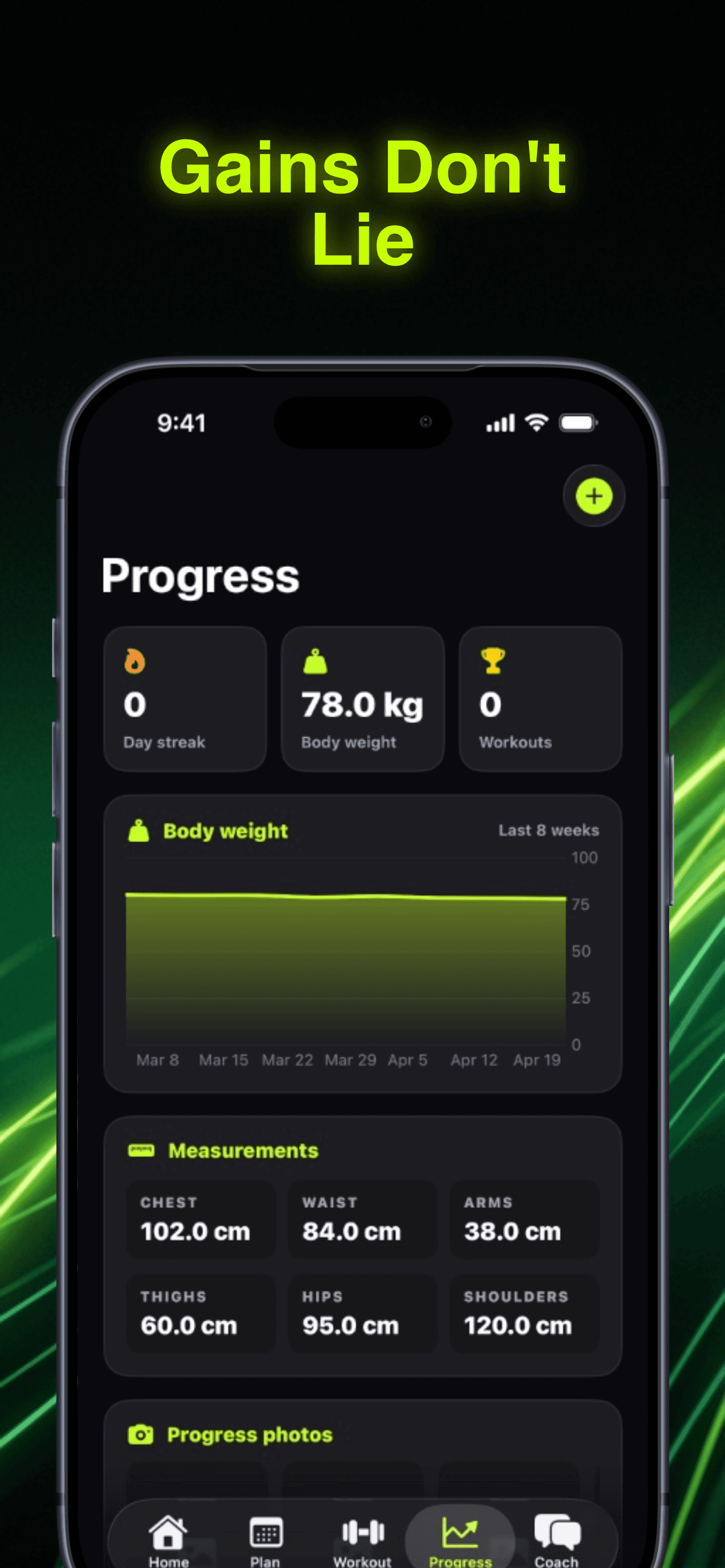
Photo by RepBro App.
What Results Can You Actually Expect from Full Body 3x Per Week?
Training full body three days a week is one of the most evidence-backed approaches for building strength and muscle, especially in the first one to two years of lifting. A beginner following a well-structured 3x full-body program can realistically expect to add 5–10 lbs to their main lifts every one to two weeks in the first 8–12 weeks, and gain roughly 1–2 lbs of lean mass per month in the first six months — provided nutrition and recovery are dialed in. Progress slows after that, but it doesn't stop.
That's the short answer. The longer one is worth reading if you want to know why this structure works and what the numbers look like at each stage.
Why Three Days Full Body Is a Legitimate Setup
The "bro split" — chest Monday, back Tuesday, legs Wednesday — dominated gym culture for decades. One muscle group, once a week. The data doesn't support it as the best approach for most people.
A 2016 meta-analysis by Schoenfeld, Ogborn, and Krieger in Sports Medicine found that training a muscle group at least twice per week produced significantly greater hypertrophy than once-per-week training, even when total volume was equated. Effect sizes: 0.49 for higher frequency vs. 0.30 for lower frequency. That's not a small gap.
A 3x full-body split hits every major muscle group three times per week. That frequency advantage is real, and it compounds over months.
The other reason it works: it's sustainable. Three sessions, not six. Life fits around it. Consistency beats optimization every time.
The Timeline: What Gains Look Like at Each Stage
Weeks 1–4: Neural Adaptations, Not Much Mirror Progress
The first month is mostly your nervous system learning to recruit motor units more efficiently. You'll add weight to the bar almost every session — this is normal and expected, not a sign you're "gifted."
Don't confuse rapid strength improvements with muscle growth. Very little new muscle tissue exists yet. What you're experiencing is coordination and neural drive improving. Still valuable. Still worth tracking.
What to expect:
- Squat, bench, and deadlift moving up 5–10 lbs per session (beginners)
- Noticeable improvements in technique and stability
- Minimal visible body composition change
- Soreness tapering off by week 3
Weeks 4–12: The Newbie Gains Window Opens
This is where real hypertrophy starts. Protein synthesis rates in untrained individuals responding to resistance training are measurably higher than in trained lifters — your body is highly sensitive to the training stimulus right now. Don't waste it.
Realistic numbers for a male beginner eating at or slightly above maintenance:
- Squat: +40–60 lbs on 1RM over 12 weeks
- Bench press: +20–35 lbs over 12 weeks
- Deadlift: +50–80 lbs over 12 weeks
- Lean mass: 1–2 lbs per month
For women, the relative strength gains are similar in percentage terms; absolute lb-on-bar increases are smaller. Lean mass gains average closer to 0.5–1 lb per month.
The single biggest driver of these gains is progressive overload — adding load, reps, or sets over time in a systematic way. Without it, you're just moving the same weight around. The 3x full-body format makes progressive overload easy to track because you're hitting each lift three times per week and have fresh data every 48 hours.
Months 3–6: Progress Slows, Doesn't Stop
By month three, the newbie adaptation curve starts to flatten. You won't be adding weight every session anymore. Weekly or even biweekly PRs become the new normal.
This is where a lot of people panic and start program-hopping. Don't. The gains are still happening — they're just smaller per unit of time.
Realistic expectations at the 3–6 month mark:
- Strength: adding 5–10 lbs to main lifts every 1–3 weeks
- Lean mass: 0.5–1 lb per month (male), 0.25–0.5 lb per month (female)
- Visible body composition change is now noticeable to others, not just you
- Work capacity and recovery between sets improves substantially
Month 6–12: Intermediate Territory
At the six-month mark, you're no longer a beginner by most definitions. Linear progression on a simple 3x full-body program may start to stall. This is the point to consider introducing periodization — undulating rep ranges, adding a fourth day, or transitioning to an upper/lower split.
That said, many lifters run effective full-body programs for a full year and beyond. The structure isn't the limitation; the programming inside it is.
What Actually Drives Results: The Progressive Overload Checklist
The format (full body 3x) creates the conditions for progress. Progressive overload is the mechanism. Here's what that means in practice:
- Add load when you can. If you hit the top of your rep range with good form, add weight next session.
- Track every set. You can't progressively overload what you're not measuring. Log weight, reps, and RPE every set.
- Don't skip sessions. Three days a week is only ~156 workouts per year. Missing one is a bigger deal than it feels.
- Eat enough protein. 0.7–1g per lb of bodyweight is a well-supported target for muscle protein synthesis.
- Sleep 7–9 hours. Growth hormone secretion and muscle repair peak during slow-wave sleep. This isn't optional.
Full Body 3x vs. Other Splits: The Honest Comparison
For beginners and early intermediates, full body 3x outperforms bro splits in nearly every research comparison — primarily because of the frequency advantage and the higher number of stimulus events per muscle per week.
For advanced lifters (2+ years of consistent training), the picture is less clear. Upper/lower and push/pull/legs splits can allow for higher per-session volume and more targeted work. But that's a problem for later.
If you're in your first year, a 3x full-body split is not a compromise. It's the right call.
One thing worth noting: a 2017 meta-analysis in the Journal of Strength and Conditioning Research confirmed that muscle hypertrophy is similar across a wide range of rep ranges and loads, as long as sets are taken close to failure. This means your 3x full-body program can use 5s, 8s, or 12s — what matters is effort and progressive overload, not the specific rep number.
A Concrete Example: 12 Weeks on a 3x Full Body Program
Say you start squatting 95 lbs for 3x5. You add 5 lbs per session, three sessions per week. After 12 weeks (36 sessions), if you hit every session, that's a theoretical 180 lbs of added load — landing you near a 275 lb squat. Real-world results with missed sessions, deload weeks, and technique work might put you at 185–220 lbs. Still a 90–125 lb improvement in 12 weeks.
That's not a fantasy. That's what happens when beginners follow a simple program and show up consistently.
The One Thing to Do in Your Next Session
Track your sets. Weight, reps, RPE — every single one. If you're not measuring your baseline today, you have no way to verify you're actually progressing in four weeks. Progress tracking is what separates people who get results from people who just go to the gym.
RepBro was built to make this frictionless — log sets in real time, watch your PRs stack up over weeks, and ask the AI coach if you're not sure whether to add weight or push more reps. Your 3x full-body program is already a good decision. Now execute it with data behind every session.
Frequently asked questions
- What results should I expect from a full body workout 3x per week?
- Beginners can expect to add 5–10 lbs to main lifts every 1–2 weeks in the first 8–12 weeks, and roughly 1–2 lbs of lean mass per month for the first six months. Results slow after the initial adaptation period but continue with consistent progressive overload.
- Is 3 days a week enough to build muscle?
- Yes. Research shows that training a muscle group at least twice per week produces significantly more hypertrophy than once per week. A full-body 3x split hits every major muscle group three times weekly, which meets or exceeds the frequency threshold for maximizing muscle growth.
- How long before I see results from a full body program?
- Strength improvements start in week 1–2 (neural adaptations). Visible body composition changes typically appear around weeks 8–12 for most people. Others notice the difference in your physique by month 3–4, assuming consistent training and adequate nutrition.
- Should beginners do full body or a split routine?
- Full body 3x per week is generally better for beginners. It provides higher training frequency per muscle group, more practice with compound lifts, and simpler programming. Bro splits work eventually, but they're inefficient in year one.
- Why does progress slow after the first 3 months on a full body program?
- The initial rapid gains are partly neural — your nervous system learning to recruit muscle more efficiently. Once that adaptation is complete, actual muscle tissue growth becomes the main driver, which is slower. This is normal and expected, not a sign your program stopped working.
- How important is progressive overload on a 3x full body split?
- It's the entire mechanism. The 3x full-body format creates the conditions for progress; progressive overload is what actually drives adaptation. Without adding load, reps, or sets over time, you're maintaining fitness, not building it.