Tricep Pushdown Alternatives at Home (Minimal Equipment)
Four practical at-home substitutes for the tricep pushdown using bands, dumbbells or bodyweight. What each preserves, what it loses, and when to return to gym equipment.
Photo by RepBro.
You can replace cable tricep pushdowns at home with high-band pushdowns, dumbbell kickbacks, overhead triceps extensions, close-grip presses/push-ups, or dips. Each preserves different parts of the pushdown stimulus (line of pull, tension, elbow position); choose the swap by whether you need constant tension, heavier load, or safer bodyweight options.
What does a tricep pushdown do that I should try to keep?
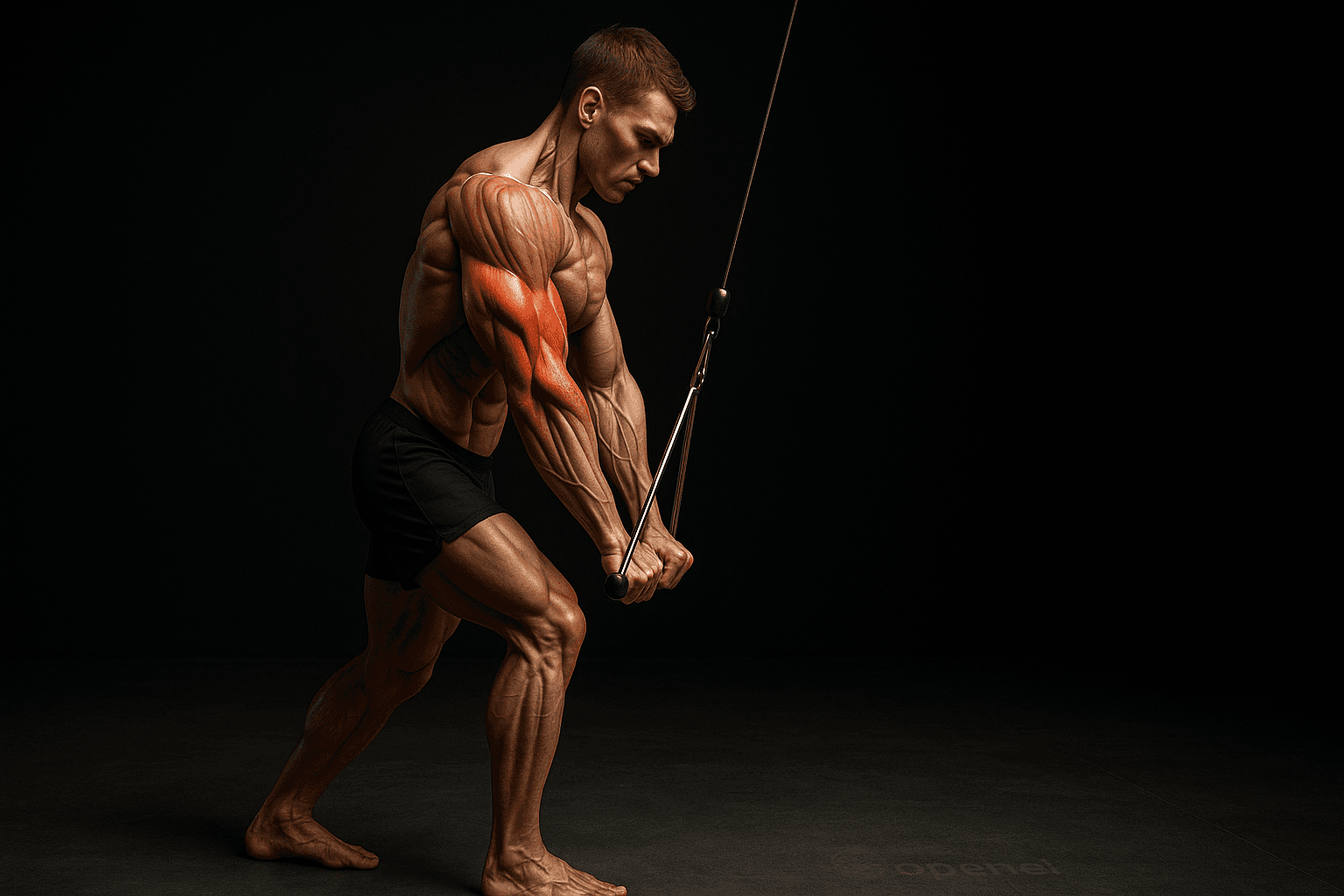
The cable pushdown provides a downward, relatively constant line of resistance with the elbows fixed at the sides, loading mostly the long and lateral heads through elbow extension. Key features to preserve when substituting: a vertical line of pull (or similar torque curve), controlled eccentric loading, and the ability to progress load over time.
What are practical at-home alternatives and what do they preserve or lose?
- High-anchored band pushdown
- How to: Anchor a band overhead, face the anchor, keep elbows tucked and drive the hands down to full elbow extension. Control the return.
- Preserves: Downward line of pull, continuous tension, similar elbow position and ROM.
- Loses: Very heavy absolute loading unless you stack multiple heavy bands; slightly different resistance curve depending on band elasticity.
- When it’s adequate: For most hypertrophy work and progressive overload if you have varied band tensions.
- Dumbbell kickbacks
- How to: Hinge at the hips, upper arm parallel to torso, extend the elbow to full lockout. Use light-to-moderate weight and strict form.
- Preserves: Long stretch at the top of contraction and a full lockout; good isolation of the triceps.
- Loses: Constant tension across the ROM is harder (gravity acts differently), and heavier loading is limited by stabilisation demands.
- When it’s adequate: For high-rep conditioning, finishing sets, or when bands aren’t available.
- Overhead triceps extensions (single-arm or two-arm, dumbbell or band)
- How to: Hold weight overhead and extend/elbow down; bands anchored low can also be used for an overhead angle.
- Preserves: Emphasizes the long head due to shoulder flexion; provides good stretch at the top of the movement.
- Loses: Different head emphasis than pushdown and a different torque curve.
- When it’s adequate: To target the long head specifically or when you want variation; combine with a pushdown-like exercise to cover all heads.
- Close-grip push-ups / floor presses
- How to: Hands placed closer than shoulder width; perform push-ups or single-arm/both-arm floor presses with dumbbells.
- Preserves: Ability to load with bodyweight or external weight, builds pressing strength and high mechanical tension at the elbow.
- Loses: Less isolation (shoulder and chest contribute) and different line of force compared with a vertical pushdown.
- When it’s adequate: When you want to work triceps plus pressing strength and when heavy loading with dumbbells is available.
- Dips (bench/chair or parallel if available)
- How to: Use parallel bars or a sturdy bench/chair; keep torso upright to emphasize triceps and lower to a controlled depth.
- Preserves: High-load capability and a long range of motion; effective for mass and strength.
- Loses: More shoulder involvement and potential for discomfort if shoulder mobility or joint issues exist.
- When it’s adequate: When you can perform dips pain-free and want a heavier compound triceps movement.
How should I program these swaps for progress?
- Frequency: Train triceps 2–3 times per week, either spread across push workouts or included with upper-body sessions.
- Volume: The consensus for hypertrophy is to aim at an appropriate weekly set total for the triceps; distribute sets across sessions and progress load or reps when you hit the top of a rep range.
- Rep ranges: Use a mix: lower reps (3–6) for strength if you can load heavily (dips/weighted presses), moderate (6–12) for balanced hypertrophy, and higher reps (12–20) for metabolic/finishers.
- Progression: Increase band tension, add reps, slow eccentrics, add weight (dumbbell, weighted dip), or change leverage. Track performance and increase overload gradually.
How do these alternatives compare at a glance?
| Exercise | Equipment | Head emphasis | Constant tension | Loadability | Technical difficulty |
|---|---|---|---|---|---|
| Band pushdown | Band | Lateral/long | High | Moderate | Low |
| Dumbbell kickback | Dumbbell | Lateral | Low | Low-Moderate | Medium |
| Overhead extension | Dumbbell/Band | Long | Moderate | Moderate | Medium |
| Close-grip push-up/press | Bodyweight/Dumbbell | Overall | Low-Moderate | Moderate-High | Low-Medium |
| Dips | Bench/Bars | Overall | Low | High | Medium-High |
When is an at-home swap NOT enough and should I go to a gym?
Consider the gym when you need heavy, incremental loading beyond what bands and dumbbells allow (progressive loading for maximal strength), when you require precise resistance curves (cables), or when you want to use specialized attachments and safety racks. Also go to a gym if rehabilitation or advanced technique requires machine-controlled movement.
Safety note
Stop any exercise that causes sharp joint pain. Maintain neutral wrist and shoulder positions, control eccentrics, and avoid excessive momentum. If you have an existing shoulder or elbow injury, consult a qualified professional before loading these movements. This guide does not diagnose or promise injury prevention.
What limitations should I expect from apps and AI coaching?
No app or AI can watch you in real time and correct subtle technique faults reliably. They cannot replace in-person assessment for pain-driven movement problems or clinical rehabilitation. Also, a plan only works if you follow it consistently; tracking tools help, but adherence and progressive overload come from your training habits and recovery management.
Note on tools: if you track sessions and progress, simple logging apps can help structure overload and volume. For tracking and guided sessions, consider using an evidence-aware training log like RepBro for simple progression tracking.
Limitations (honest):
- Apps can’t replace a hands-on coach for form correction or a clinician for injury rehab.
- You won’t get maximal heavy loading at home unless you have heavy dumbbells or specialized bands.
- Any plan only works with consistent training and sensible recovery.
If you want a simple starter pairing: use a high-anchored band pushdown (daily-like tension) plus 2–3 sets of dips or close-grip presses per session, and progressively increase resistance or reps. That combination covers the pushdown’s tension and adds the heavier loading compound stimulus you need to progress at home.
References and evidence basis: recommendations follow widely accepted resistance-training principles (progressive overload, frequency of 2–3 sessions/week for muscle groups, varied rep ranges for strength vs hypertrophy) as described in current training consensus literature and position statements.
Frequently asked questions
- Can I build triceps at home without a cable machine?
- Yes. You can effectively train the triceps at home using bands, dumbbells, and bodyweight. Prioritize progressive overload, appropriate volume, and exercise variety (different elbow angles) to stimulate all triceps heads. Heavy loading is easier in a gym, but hypertrophy is achievable at home with consistent progression.
- Which at-home move mimics a cable pushdown most closely?
- A high-anchored band pushdown mimics the cable pushdown's downward line of pull and constant tension. Use a strong band anchored overhead, keep elbows tucked, and control both concentric and eccentric phases for the closest match in muscle tension and movement pattern.
- How often should I train triceps at home?
- Train triceps 2–3 times per week as part of upper-body or push-focused sessions, distributing sets across the week. Use progressive overload and monitor fatigue; adjust sets and intensity if recovery or performance drops. Consistency matters more than exact frequency.