Skull Crusher: Proper Form, Step by Step
Clear, safety-first skull crusher form guide: setup, execution cues, breathing, tempo, weight guidance, common mistakes and fixes.
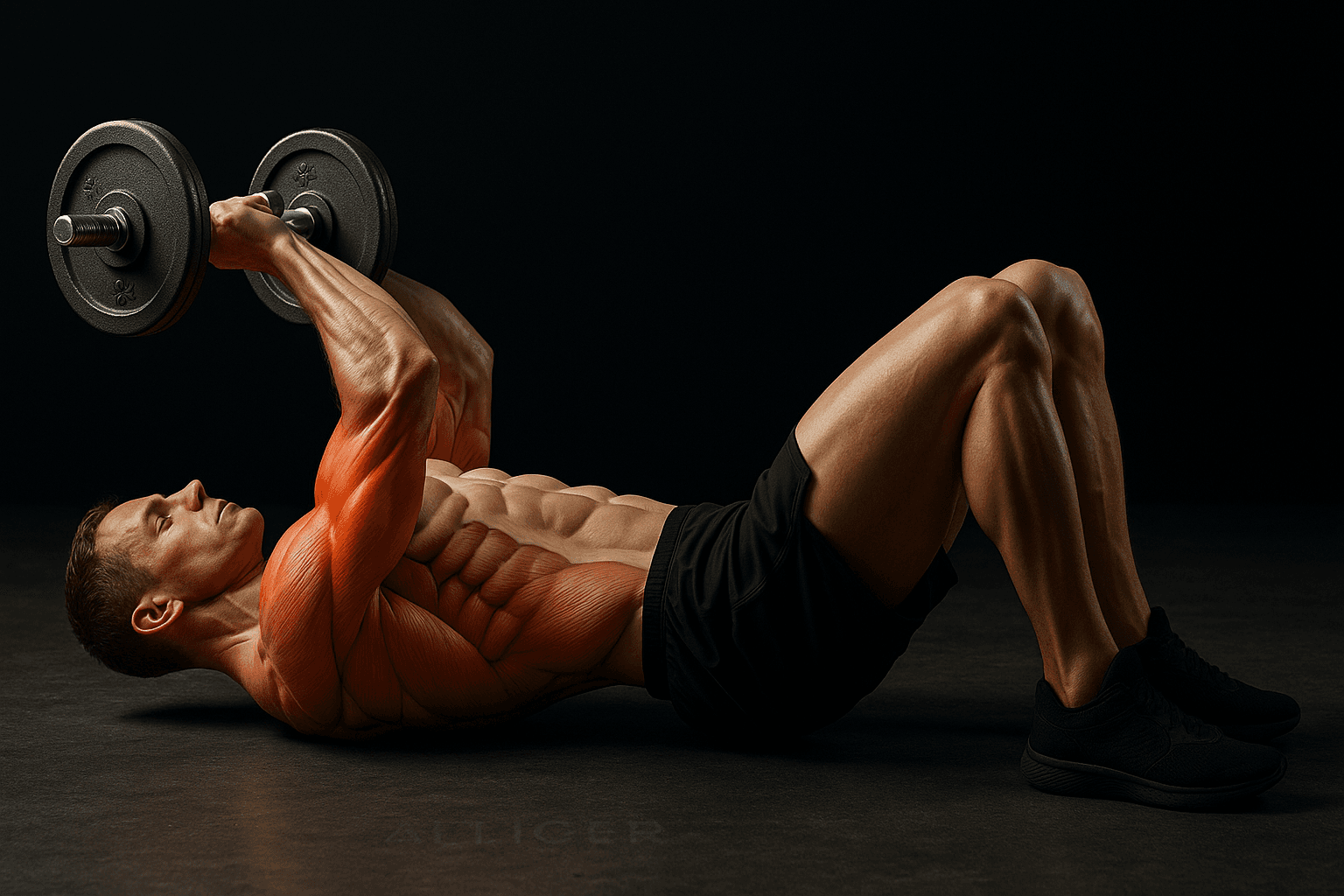
Photo by RepBro.
Skull crusher proper form is: lie on a flat bench with feet planted, upper arms roughly perpendicular to the floor, elbows pointed up and fixed in place, lower the bar under control to just above your forehead (or slightly behind the head if using skull-crusher variation), then extend the elbows until arms are nearly straight. Keep the movement at the elbow joint — do not let the upper arms move forward or back.
What is a skull crusher and when should you use it?
A skull crusher (lying triceps extension) is a single-joint triceps exercise that targets the long and lateral heads. Use it for direct triceps development, as an accessory after pressing work, or on an arm-focused day. It’s a technical exercise — pick moderate loads and prioritize strict technique over heavy weight.
How do I set up? (Step-by-step)
- Equipment: use an EZ bar, straight bar, or pair of dumbbells. An EZ bar typically reduces wrist strain.
- Bench: lie flat on a bench with your eyes roughly aligned under the bar. Feet planted and low back neutral.
- Grip width: for an EZ bar, hold hands about shoulder-width apart. For a straight bar, use a shoulder-width grip. For dumbbells, palms face each other or in neutral rotation.
- Upper-arm position: bring the bar to full extension over your chest. Rotate slightly so your wrists are comfortable. Keep upper arms vertical (perpendicular to the floor) and elbows pointing up.
- Scapular and core set: retract your shoulder blades lightly and brace your core to prevent arching. Maintain this position throughout the set.
How to execute the rep — strict cues
- Descend (eccentric): inhale and bend the elbows, sending the forearms back toward your head. Aim to lower the bar to just above the forehead or slightly behind it — do not touch the skull or bounce off your face.
- Keep the upper arms still: think 'hinge at the elbow only'. If your upper arms move, reduce the weight.
- Bottom position: pause 0–1 seconds at the bottom with tension on the triceps; avoid relaxing the joint.
- Ascend (concentric): exhale and extend the elbows, driving the weight back to full extension without hyperextending the elbows.
- Repeat for the planned reps.
Concrete cues: point your elbows at the ceiling, pretend your forearms are doors that swing only at the hinge, and keep wrists neutral. If elbows wander forward, the load transfers to the shoulders.
Breathing and tempo
- Breathing: inhale on the eccentric (lowering), exhale on the concentric (pushing up).
- Tempo example for hypertrophy: 3-0-1-0 (3s lowering, 0s pause, 1s lift, 0s top pause). For strength focus use 2-0-1, and for control-focused carries use 4-0-1.
- Rest: 60–120s between sets depending on intensity and program.
Loading, reps and set suggestions
- Strength: 4–6 reps, heavy but strict; use spotter or safety rails for loaded bars.
- Hypertrophy: 8–12 reps at a controlled tempo (3s eccentrics).
- Endurance/conditioning: 12–20 reps with lighter load and strict form. Start with a weight you can control for the lower end of your target rep range. If your elbows start drifting before you complete the set, reduce load by 10–20%.
Common mistakes and how to fix them
- Mistake: elbows flare or drift forward/back. Fix: reduce weight, shorten range slightly, and use the cue 'keep elbows pointed at the ceiling'. Tape a small sticker on the ceiling to keep focus.
- Mistake: upper arms move (shoulder involvement). Fix: pause at the top between reps, practice slow eccentrics, and lock the scapulae. You can also do floor skull crushers (lying on the floor) — they limit range and reduce shoulder involvement.
- Mistake: lowering the bar to the forehead and bouncing. Fix: lower to just above the forehead without contact; use a shallow pause to keep tension.
- Mistake: wrist extension (bent wrists). Fix: use an EZ bar, grip the bar firmly, and keep wrists straight; consider wrist wraps if needed.
- Mistake: excessive arching of the lower back to 'help' the lift. Fix: drive feet into the floor, brace the core, and lower weight.
Variations and when to use them
- EZ bar: best for most lifters to reduce wrist stress.
- Straight bar: increases forearm pronation demands and can feel less comfortable for some.
- Dumbbells: allow natural wrist rotation and independent arm movement — use if you have unilateral imbalance or elbow discomfort.
- Floor skull crusher: limits range of motion and shoulder strain; useful as a regression or for rehabbing load progression.
Safety note
Stop immediately if you feel sharp or shooting pain in the elbow, shoulder, or neck. This guide does not diagnose injuries — consult a qualified professional for pain or persistent problems. Use a spotter when using heavy loads and progress conservatively.
Short FAQ
Q: Are skull crushers bad for elbows? A: Not inherently. Pain usually comes from poor technique or excessive load. Reduce weight, correct form, or switch to dumbbells/EZ bar; consult a professional if pain persists.
Q: Should I lock out fully? A: Yes, extend the elbow to near full lockout without hyperextending. A tiny touch at the top maintains tension; avoid aggressive elbow hyperextension.
Q: How do skull crushers compare to close-grip bench press? A: Skull crushers isolate the triceps more; close-grip bench presses involve more shoulder and chest. Both are useful — see comparisons on how to structure accessory work in your program at RepBro and related articles at RepBro vs.
Honest takeaway: If you keep your upper arms still, use moderate loads, and prioritize a slow eccentric with controlled reps, skull crushers are a safe, effective triceps builder — stop on sharp pain and seek professional advice if problems persist.
Frequently asked questions
- Can I do skull crushers with dumbbells or an EZ bar?
- Yes. EZ bars reduce wrist strain and are the most common choice; straight bars are fine if your wrists tolerate them; dumbbells allow independent arm movement and can reduce elbow stress but require more control.
- How much weight should I use for skull crushers?
- Start light enough to perform 8–12 strict reps with controlled tempo. If you can't keep elbows still for 8 reps, drop the weight 10–20% until you can.
- Do skull crushers hurt the elbows?
- Discomfort can come from poor form or previous joint issues. Stop on sharp pain and consult a professional; adjusting grip, using an EZ bar, or switching to dumbbells often reduces stress.