How Many Sets and Reps for the Pallof Press?
Clear, evidence-aware set, rep, frequency and progression ranges for the Pallof press by goal (strength, hypertrophy, endurance), plus week-to-week progression and when to add weight vs reps.
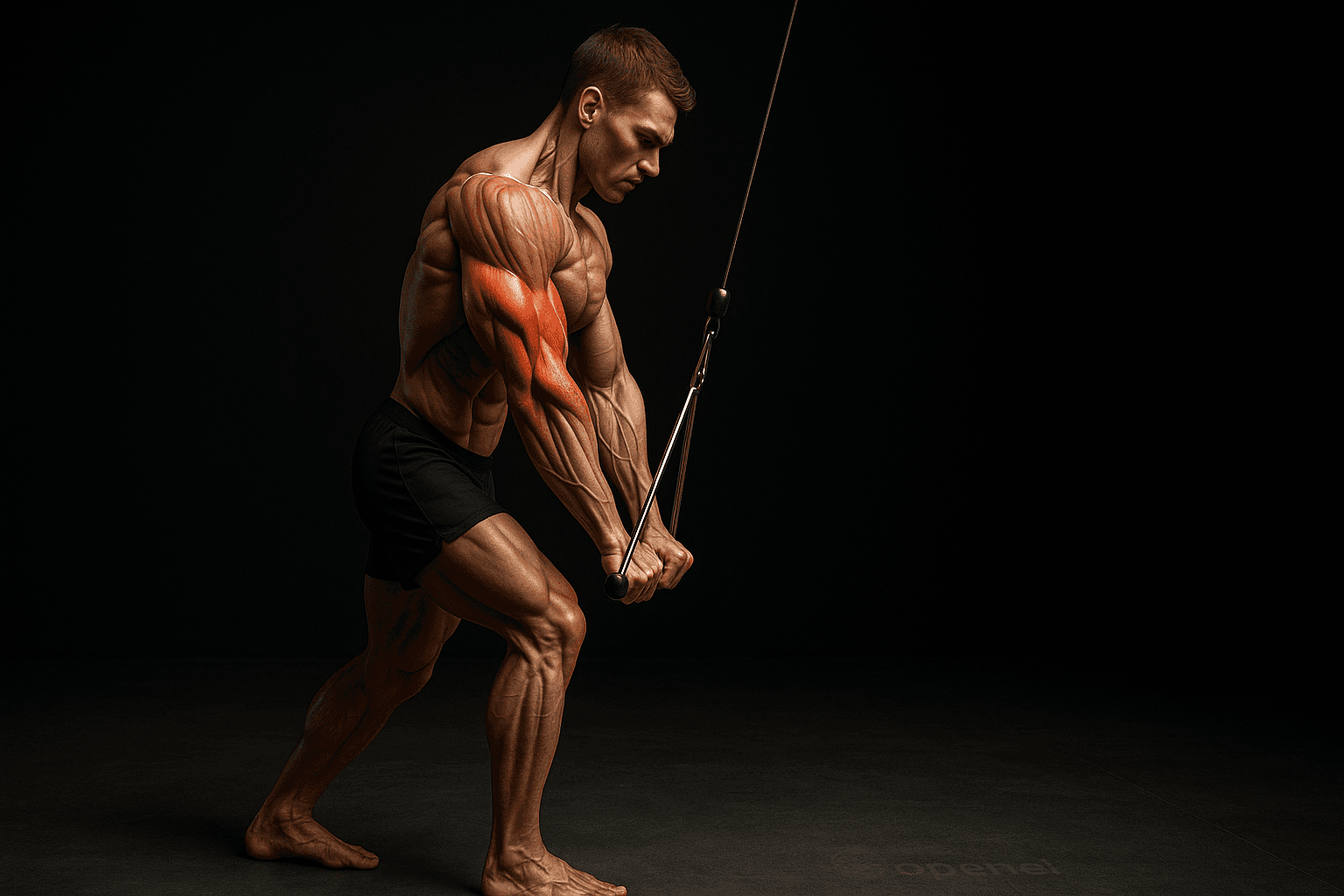
Photo by RepBro.
Answer-first
For strength aim for 2–4 sets of 4–8 reps; for hypertrophy 3–4 sets of 8–12 reps; for endurance 2–4 sets of 15–30+ reps or timed holds. Train the Pallof press 2–4×/week, progress by adding reps then small weight increases, and increase load only when you can complete top-range reps with clean technique.
What is the purpose of the Pallof press and how should that affect sets and reps?
The Pallof press is an anti-rotation core exercise: its primary role is to develop the ability to resist rotary forces and stabilize the trunk under load. Unlike bilateral lifts where 1–5RM strength is central, the Pallof press is trained across a spectrum depending on your goal. Choose sets/reps with that role in mind:
- Strength (force production/resisting higher loads): fewer reps with higher resistance so the nervous system and connective tissue adapt. 2–4 sets of 4–8 reps.
- Hypertrophy (muscle size and cross-sectional work for the trunk): moderate reps with moderate load. 3–4 sets of 8–12 reps.
- Endurance (local muscular endurance and prolonged anti-rotation): higher reps or time-based holds. 2–4 sets of 15–30+ reps or 20–60 second isometric holds.
These ranges align with general resistance-training consensus (strength: lower reps, hypertrophy: mid reps, endurance: higher reps/time) adapted for an anti-rotation movement.
How often should I do the Pallof press each week?
Train the Pallof press 2–4 times per week. If you’re prioritizing maximal strength, 2–3 focused sessions with more recovery between heavy sessions is appropriate. For hypertrophy and endurance goals, 2–4 weekly touchpoints integrate better — some sessions can be lighter or used as warm-up/core accessory work. Core muscles tolerate relatively frequent training, but when using heavier load give ~48 hours between intense sessions.
How should I structure rest and tempo for Pallof press sets?
Rest between sets should reflect your goal:
- Strength: 90–180 seconds.
- Hypertrophy: 60–90 seconds.
- Endurance: 30–60 seconds or straight-set circuiting.
Tempo matters for anti-rotation control. Use a controlled 1–3 second concentric press, a 1–2 second isometric at full extension if desired, and a 2–4 second eccentric return. Slower tempo increases time under tension and can make a lighter load more challenging without changing resistance.
How do I progress week to week on the Pallof press?
Progression follows the tried-and-true principle: increase the training stimulus gradually and monitor technique. A practical, evidence-aligned sequence:
- Choose the target rep range for your goal. 2. Add 1–3 reps per set each week until you reach the top of the range while keeping good form and RPE roughly ≤7–8. 3. Once you can hit the upper bound comfortably for all sets, increase resistance by the smallest feasible increment (a stronger band, small plate, or 5–10% load). 4. Drop reps back to the lower end of the range and repeat.
Example 4-week progression (hypertrophy goal, 3 sets of 8–12):
- Week 1: 3×8 at band tension A
- Week 2: 3×9 at band tension A
- Week 3: 3×11 at band tension A
- Week 4: Increase to band tension B, 3×8
This pattern keeps volume and intensity balanced and reduces injury risk from sudden large jumps.
When should I add weight versus add reps?
Add reps first. If you can complete all planned sets and the top of your rep range with strict form and an RPE ≤7, add 1–3 reps per set for subsequent sessions. Once you reach the top of the range across sets, increase resistance by the smallest practical step (around a 5–10% increment or the next stronger band). Prioritize technique: if you compensate with hip rotation, trunk tilt, or breath-holding, do not increase load until you correct these errors.
Practical signals to add weight:
- You can complete the target sets/reps for two sessions in a row with good form and RPE ≤7.
- Your posture and anti-rotation hold remain tight through the full range.
Signals to add reps or slow tempo instead:
- You can’t increase load without losing alignment.
- You want more time under tension to develop endurance or hypertrophic stimulus.
How should I set load for the Pallof press (band tension, cable, dumbbell)?
Use the implement that lets you follow your rep-range rules. For band or cable: choose a tension such that the last 1–2 reps of each set are challenging but achievable with control. If using a dumbbell overhead (offset press), follow the same logic: heavier for low reps, lighter for endurance. Small increments matter: bands come in discrete tensions; add reps/tempo to bridge gaps.
Comparison: what do sets/reps look like by goal?
| Goal | Sets | Reps (or time) | Load cue | Rest |
|---|---|---|---|---|
| Strength | 2–4 | 4–8 | Heavy; last reps hard but controlled | 90–180s |
| Hypertrophy | 3–4 | 8–12 | Moderate; technical control | 60–90s |
| Endurance | 2–4 | 15–30+ (or 20–60s holds) | Lighter; sustained tension | 30–60s |
Safety and form notes
Stop if you feel sharp or unusual pain and consult a qualified professional. Keep a neutral spine, avoid excessive hip or shoulder rotation, and breathe (avoid prolonged Valsalva on high-rep sets). This guidance is educational, not medical advice.
Limitations — what apps or AI coaching cannot do for you
No app or AI can directly observe and correct your technique in real time; video feedback from a qualified coach is often necessary to fix movement faults. If you have a history of back pain, recent surgery, or a current injury, consult a clinician or physiotherapist before progressing. A program only produces results when consistently executed — adherence and recovery matter more than tiny differences in programming.
Track simple metrics (sets, reps, load, RPE) session-to-session; tools like RepBro can help keep consistent logs but do not replace professional assessment.
Final practical tip: prioritize clean anti-rotation form over arbitrary rep targets. Increase stimulus gradually: add reps first, then small load increments, and prefer frequency of 2–4×/week adapted to intensity and recovery.
Frequently asked questions
- How many sets and reps should I do for the Pallof press?
- For strength aim for 2–4 sets of 4–8 reps at heavier resistance; for hypertrophy 3–4 sets of 8–12 reps; for endurance 2–4 sets of 15–30+ reps or timed holds. Use higher frequency (2–4×/week) and progress by adding reps first, then load.
- How often should I train the Pallof press each week?
- Train the Pallof press 2–4 times per week. For strength, 2–3 focused sessions with heavier resistance; for hypertrophy and endurance, 2–4 sessions including it as part of core or warm-up work. Allow 48 hours for recovery when using heavier loads.
- When should I add weight versus add reps on the Pallof press?
- Add reps until you reach the top of your target range with good technique and RPE ≤7; then increase resistance by the smallest practical increment (~5–10% or next stronger band). If form breaks, reduce load or volume and fix technique before increasing load.