Incline Bench Press Alternatives at Home (Minimal Equipment)
Five practical incline-bench alternatives you can do at home with bodyweight, dumbbells, or bands. What each keeps or loses compared to incline press and when to return to a gym.
Photo by RepBro.
You can replicate most upper‑chest and anterior-shoulder stimulus at home using dumbbell incline substitutes, banded incline presses, elevated push-ups, and single-arm pressing. Each preserves pressing mechanics but changes loading pattern, stability demand, and maximal load — use them for strength maintenance and hypertrophy until gym access is needed.
What are practical incline bench press alternatives at home?
Here are four to five effective options that use minimal equipment: dumbbells, resistance bands, and bodyweight.
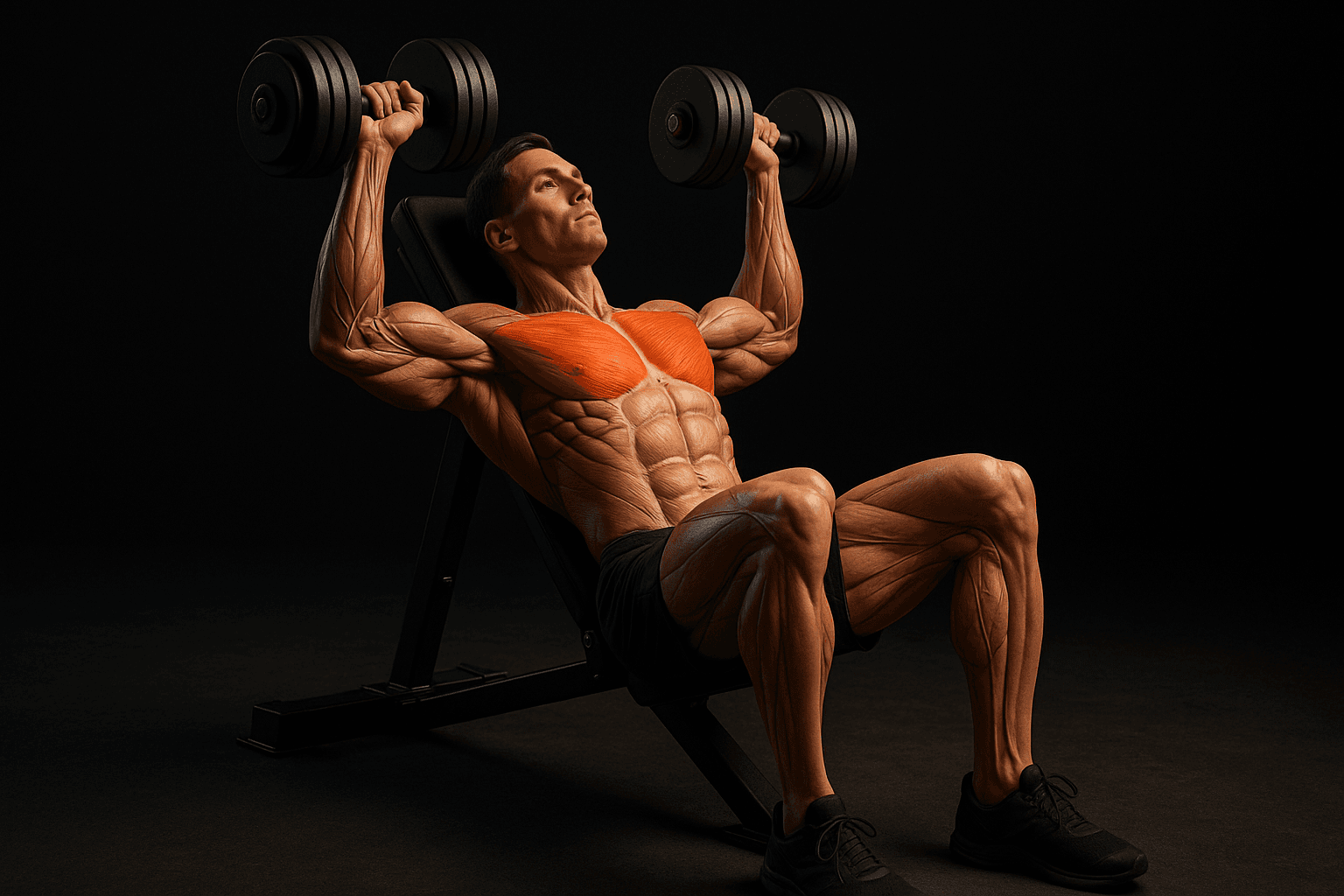
- Dumbbell incline press (set an adjustable bench or use a stable incline surface)
- Feet-elevated push-ups (feet elevated 30–45 cm / 12–18 in to shift emphasis upward)
- Band-resisted incline press (anchor low and press upward along an incline path)
- Single-arm dumbbell incline press or landmine-style press (use a corner or sleeves if no landmine)
- Decline-to-incline chest fly-to-press combo (for time-under-tension and upper-chest feel)
How does each alternative compare to a barbell incline press: what is preserved and what is lost?
| Exercise | Equipment | What it preserves | What it loses | When the swap is adequate |
|---|---|---|---|---|
| Dumbbell incline press | Dumbbells + incline surface | Similar shoulder angle, unilateral work, ROM control | Maximal absolute load and exact barbell groove | Adequate for hypertrophy and unilateral balance; return to gym for very heavy sets |
| Feet-elevated push-ups | Bodyweight | Horizontal-to-incline angle, core stability, high time-under-tension | Precise load progression and maximal resistance | Adequate for beginners and conditioning; add weight or progressions for strength goals |
| Band incline press | Bands + anchor | Variable resistance, continuous tension | Consistent load across ROM and maximal eccentric loading | Adequate when bands provide sufficient top-range resistance; limit if bands cap absolute load |
| Single-arm dumbbell/landmine press | Dumbbell or barbell sleeve | Trunk anti-rotation, unilateral overload, incline trajectory | Symmetric bar loading and very heavy absolute load | Adequate for strength asymmetries and hypertrophy; less ideal if you need heavy paired loading |
| Fly-to-press combo | Dumbbells or bands | Upper-chest isolation and TUT, pressing pattern | Pure heavy compound overload and heavy low-rep strength stimulus | Adequate as accessory work to increase size when heavy loading unavailable |
How do these swaps change training effect: strength vs hypertrophy?
- Hypertrophy: These alternatives preserve time-under-tension and muscle activation if you can provide progressive overload. Using higher volumes, slower eccentrics, and moderate loads will support size gains.
- Strength (maximal barbell strength): Alternatives limit how heavy you can go, how you train low-rep near-max sets, and bar-specific motor patterns. Barbell practice in a gym is preferable for low-rep strength specificity.
Programming guidance based on consensus principles (evidence-aware):
- Train pressing 2–3 times per week to balance recovery and stimulus.
- Use progressive overload: increase reps, sets, tempo, or resistance when you can perform current volume easily.
- Include deloads or reduced-volume weeks periodically to avoid accumulation of fatigue.
How do I progress these exercises at home without a bench or heavy weight?
- Adjust leverage (raise or lower feet/anchor points).
- Add reps or sets and shorten rest to increase workload.
- Use slower eccentrics, pauses at bottom, or band chains for more top-end tension.
- For dumbbells, use unilateral work, slower tempo, or more sets when heavier weights are unavailable.
When is a home swap adequate and when should I go back to the gym?
Keep using at-home alternatives when:
- You can still progressively overload (more reps, sets, or harder variations).
- Your goal is hypertrophy or general upper-body strength.
- You need convenience or are recovering from a break.
Consider returning to the gym when:
- You cannot increase resistance safely (no heavier dumbbells, bands maxed out).
- Your goals require very heavy barbell doubles/singles or exact incline bar mechanics.
- You need spotter access or load increments smaller than your home equipment allows.
What are the safety precautions I should follow?
Stop any set if you feel sharp pain; mild discomfort from loaded pressing can be normal, but sharp or unusual pain is not. Pay attention to scapular control and shoulder positioning — avoid excessive flaring of the elbows if you have shoulder issues. Use controlled tempos; don’t sacrifice form for reps. Consult a qualified professional for persistent pain or rehab.
What can apps and AI coaching not do for my pressing technique or rehab?
Apps and AI can track sets, suggest progressions, and log volume, but they cannot see and correct your real-time form, feel tissue quality, or diagnose injuries. They also can’t replace hands-on guidance for complex movement faults, individualized rehab programming, or manual therapy — see a qualified coach or clinician when needed.
Limitations — what this guide does not cover
This article focuses on practical substitutions and programming principles, not individualized rehab or medical advice. No app, including AI, can fully replace a live coach for form correction or a licensed clinician for injury diagnosis and treatment. A program only works if you consistently follow it; consistency and recovery are the limiting factors, not the tool.
Safety reminder: This information is educational and not a medical diagnosis. If you have a pre-existing condition, recent surgery, or persistent pain, consult a qualified professional before changing your program.
Frequently asked questions
- Can I replace the incline bench press with bodyweight or bands at home?
- Yes. Bodyweight and band variations can maintain upper-chest emphasis and pressing volume when you can’t access a gym. They change load characteristics and range-of-motion control, so monitor progressive overload and add external load or gym sessions when you can no longer increase resistance safely.
- How often should I train pressing movements at home for growth?
- Train pressing around two to three times per week and accumulate multiple challenging sets across sessions. Prioritize progressive overload (more reps, sets, or resistance over time) and include lighter weeks or reduced volume periodically to recover and reduce injury risk.
- When is it time to return to the gym for incline pressing?
- Return when you can’t increase resistance safely at home, when you need very heavy singles/doubles for strength goals, or when you want precise bar-path and spotter access. For hypertrophy, many can remain at home as long as they can progressively overload.