Front Squat: Muscles Worked and Best Alternatives
Learn which muscles the front squat targets, where it fits in your program, and 4 practical alternatives with when to choose each for equipment, injuries, or plateaus.
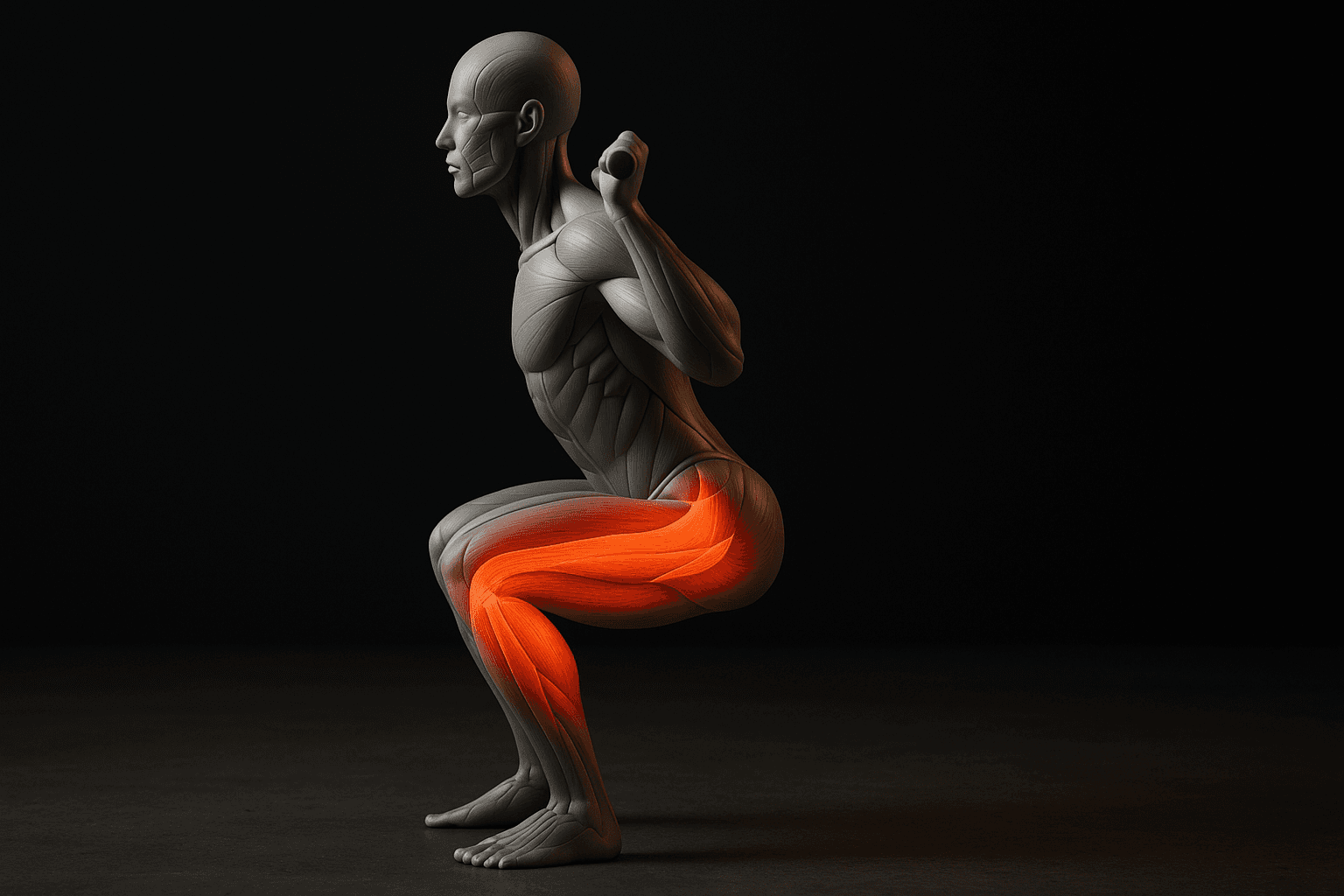
Photo by RepBro.
Front squats primarily train the quadriceps (vastus lateralis/medialis/intermedius and rectus femoris) and the core. Secondary muscles include the glutes, adductors, hamstrings (to a lesser degree than back squats), spinal erectors, and upper back/shoulder stabilizers that keep the torso upright and the bar in position.
What exactly does the front squat emphasize compared with other squats?
- Primary: quadriceps and anterior core. Because the bar sits on the front of the shoulders, you maintain a more upright torso and push more through knee extension. That shifts load toward the quads.
- Secondary: gluteus maximus and adductors assist hip extension; hamstrings act eccentrically and assist at end range; spinal erectors, trapezius, lats and the shoulder/elbow muscles work isometrically to hold the rack position.
- Comparison: relative to a low-bar back squat, front squats reduce lumbar shear and increase knee flexion demand. Compared to a goblet squat, front squats scale to much heavier loads.
How should the front squat fit into a training program?
- Programming role: use front squats as a primary lower-body lift when the goal is quad strength/hypertrophy, improving upright control, or improving the clean/weightlifting positions.
- Frequency: 1–3 times per week. Beginners: 1x/week. Intermediate lifters: 2x/week is common (one heavier, one lighter/technique session). Advanced lifters may use front squats up to 3x/week in a managed cycle.
- Set and rep ranges: strength — 3–6 sets of 3–6 reps; hypertrophy — 3–5 sets of 6–12 reps; technique/conditioning — 2–4 sets of 12–20 reps with lighter load. Use 2–3 minutes between heavy sets and 60–90 seconds for hypertrophy work.
- Pairing: follow front squats with posterior-chain accessories (Romanian deadlifts, glute bridges), single-leg work (split squats), and core/anti-extension drills. If your priority is maximal squat load, alternate front and back squat phases.
How to front squat safely (short form and safety note)
- Rack the bar in a clean position across the front delts with elbows high. Grip can be clean (crossed forearms) or front-rack with fingers under the bar depending on shoulder mobility.
- Descend with hips back and knees tracking over toes, keep chest up and elbows high, descend to a depth you can control, then drive through the midfoot to stand.
- Safety note: stop on sharp pain, don’t train through new joint pain, and consult a qualified coach or healthcare professional for persistent issues or if you need technical fixes. Use conservative loading while learning form.
When is the front squat not the best choice, and what are solid alternatives?
Below are four practical alternatives with clear situations when to choose each.
- Goblet squat
- When to pick it: no barbell available, teaching squat mechanics, beginners, or as a high-quality accessory. Works with a single dumbbell or kettlebell.
- Why it works: keeps torso upright and demands quad control like the front squat, but is easier on the wrists and shoulders and safe for high reps.
- Limitations: load ceiling is low — not ideal for long-term heavy strength progression.
- High-bar back squat
- When to pick it: you have a barbell and want larger load capacity while still keeping a relatively upright torso (compared with low-bar). Use when the goal is overall leg strength and you need more loading potential than front squats allow.
- Why it works: slightly more posterior chain involvement than front squats but still effective for quads; easier on wrists and shoulders because bar rests on traps.
- Limitations: increases lower-back loading compared with front squats, so avoid if low-back pain flares with back loading.
- Bulgarian split squat (rear-foot-elevated split squat)
- When to pick it: unilateral strength/endurance, correcting side-to-side imbalances, or when spinal loading must be minimized (shoulders and back under less compressive load).
- Why it works: forces deep knee flexion and strong quad activation per leg, improves balance and hip stability, and transfers to single-leg strength deficits that might limit bilateral squat progress.
- Limitations: more demanding on balance and mobility; load placement varies depending on whether you hold dumbbells or a barbell.
- Leg press or hack squat (machine)
- When to pick it: heavy quad loading with minimal demand on upper-back or shoulder mobility, or when you have low-back issues that make axial loading uncomfortable.
- Why it works: allows high training loads with controlled movement path and lower technical demand. Good for hitting volume in hypertrophy phases or if barbell front rack hurts shoulders/wrists.
- Limitations: less core/anti-flexion demand and less carryover to free-weight balance and stability. Machines vary in foot placement and muscle emphasis — choose foot position to bias quads (lower on platform) or glutes (higher).
What to do when you hit a plateau on front squats?
- Check basics: mobility (ankle dorsiflexion, thoracic extension, shoulder mobility) and technique (elbow height, foot placement, depth).
- Program interventions: add concentrated heavy sets (6–8 weeks of 3–5 sets of 3–5 reps), increase weekly volume modestly (10–20%), or use pausing/tempo reps (2–3s pause at the bottom) to improve position strength.
- Use alternatives: rotate in Bulgarian split squats or leg press for 4–6 weeks to raise overall quad capacity, then return to front squats stronger.
How to choose among these options for common constraints?
- No barbell: choose goblet or split squats.
- Shoulder/wrist pain from front rack: use clean grip sparingly, try the crossed-arm front rack, or use machine alternatives (leg press) and unilateral work.
- Low-back sensitivity to heavy axial loads: prefer Bulgarian split squats and controlled machine work; front squats can be OK but test carefully.
- Need more load capacity: high-bar back squat or leg press.
For tracking and programming front squats or swapping alternatives into an existing plan, consider using a coach-friendly app like RepBro — compare program versions when switching movements at https://www.repbro.app/vs.
One-sentence takeaway: Front squats are a top choice when your priority is quadriceps strength and upright position work, but practical alternatives (goblet, high-bar back squats, Bulgarian split squats, and machines) let you manage equipment limits, injuries, and plateaus without losing progress.
Frequently asked questions
- Are front squats better for quads than back squats?
- Yes — front squats bias the quadriceps more because the torso stays more upright and the knee travels farther forward. Back squats allow more hip hinge, so they recruit the posterior chain (glutes, hamstrings, spinal erectors) relatively more.
- How often should I front squat?
- 1–3 times per week depending on goals: strength phases often use 2 sessions/week (3–6 sets of 3–6 reps), hypertrophy 1–2 times/week (3–5 sets of 6–12 reps). Adjust volume based on recovery and other leg work.
- Are front squats safe for people with low-back issues?
- Front squats reduce shear on the lower back compared with heavy low-bar back squats for many lifters because of the more upright torso, but any exercise can aggravate an existing problem. Stop on sharp pain and consult a clinician before loading.