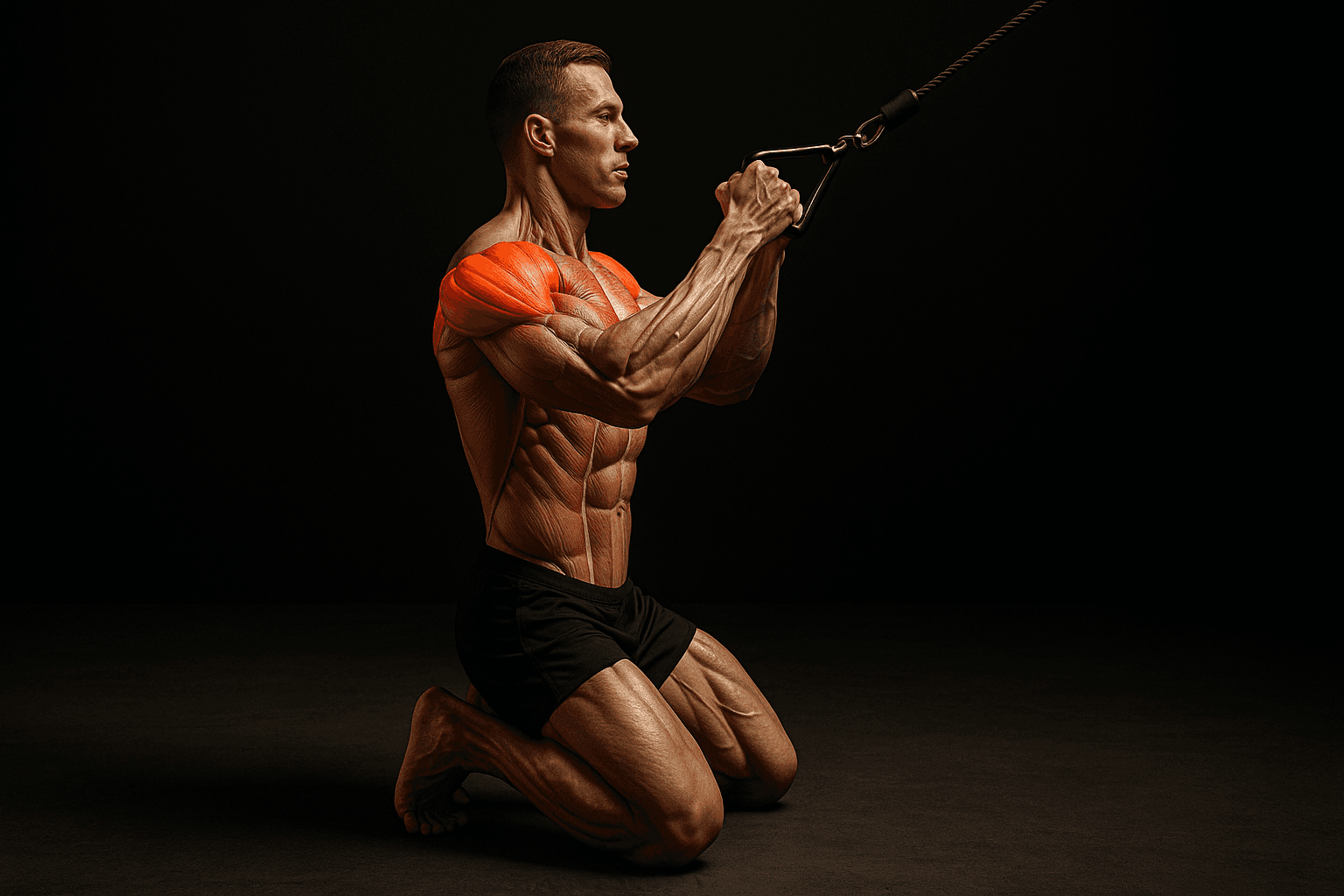
Face Pull Alternatives at Home (Minimal Equipment)
Five at-home substitutes for the face pull using bands, dumbbells, or bodyweight, with what each preserves/loses and when to choose a gym instead.
Photo by RepBro.
Face pulls primarily train scapular retraction, posterior deltoids, and external rotators with a high horizontal pull + external rotation. At home you can substitute band face-pulls, band pull‑aparts, dumbbell reverse flies, prone Y/Ts, and bodyweight rows. Each preserves some elements and loses others—see below.
Why are lifters doing face pulls in the first place?
Face pulls combine horizontal pulling with external rotation and active scapular retraction. That mix targets the posterior deltoid, upper/mid trapezius and the rotator cuff. The cable+rope set-up gives a high, slightly upward line of pull with independent arm movement and constant tension through the range.
Which at-home alternatives can reproduce those cues?
- Band face pull (anchor at eye level)
- How to: Anchor a medium-to-heavy band at about eye height. Hold the band with a rope-like grip, pull elbows out and back, finishing with hands beside ears and external rotation (thumbs pointing behind you).
- What it preserves: Similar pulling angle, external rotation cue, continuous tension.
- What it loses: Band resistance curve differs from cable; harder to match consistent load at the end range or to precisely change angle. Single-band setups can pull your anchor point off-line if unstable.
- When it’s adequate: Excellent for most home lifters for technique and hypertrophy work. Get to a gym when you need heavier, reliably incremental loading or bilateral isolation.
- Band pull-apart (chest-level or high band variations)
- How to: Hold a band with arms extended; pull the band apart until hands pass the torso. Perform with hands at chest height for mid traps or at upper-chest/eye level to bias upper traps and posterior delts.
- What it preserves: Scapular retraction and posterior chain activation; easy to increase volume and frequency.
- What it loses: Less of the external rotation and less high-line-of-pull specificity than face pulls.
- When it’s adequate: Use as a frequent accessory for posture and upper-back volume. Add external rotator-specific drills if your goal is cuff strength.
- Dumbbell bent-over reverse fly (seated or standing)
- How to: Hinge from the hips, chest nearly parallel to the floor, raise dumbbells laterally with elbows slightly bent, finish with shoulder blades pinched.
- What it preserves: Horizontal abduction and posterior deltoid loading; good for hypertrophy with higher loads.
- What it loses: External rotation component and the high-line pull; both-arm dumbbell exercises can promote momentum if unloaded improperly.
- When it’s adequate: Great when you have dumbbells and want straightforward posterior-deltoid strength. Move to band face-pulls or cables if you also need cuff-focused external rotation work.
- Prone Y/T/I raises (bodyweight or light dumbbells)
- How to: Lie prone on a bench or the floor. Raise arms into Y, T, and I positions, maintaining scapular retraction and a neutral cervical spine.
- What it preserves: Scapular control and endurance-oriented posterior chain strength; excellent for teaching scapular mechanics.
- What it loses: Heavy loading and external rotation resistance; limited progressive overload unless you add weight or tempo changes.
- When it’s adequate: Use for rehab-style stimulus, endurance, or improving movement quality. Use heavier options when seeking strength gains.
- Inverted rows / table rows (bodyweight)
- How to: Position under a sturdy table or low bar, pull chest to the edge/bar with elbows tracking wide to emphasize upper back.
- What it preserves: Horizontal pulling pattern, scapular retraction, and higher loading capacity than most bodyweight band moves.
- What it loses: External rotation emphasis and the upward line of pull; equipment needed to set a row at a higher angle.
- When it’s adequate: Good when you need heavier bodyweight loading; progress by changing angle or adding weight.
How should I program these substitutes?
- Frequency: 2–3 sessions per week for posterior shoulder/upper-back accessory work (consistent with general resistance-training recommendations for major muscle groups).
- Sets & reps: 2–4 sets of 8–20 reps depending on load. Use heavier dumbbells or a more tense band for lower reps; higher reps for endurance or light bands.
- Progression: Increase band tension or dumbbell load, add reps, slow eccentrics, or add sets. Track volume and push progressive overload over weeks while monitoring recovery.
Quick comparison table
| Exercise | Preserves from face pull | Loses vs face pull | When it's sufficient |
|---|---|---|---|
| Band face pull | Pull angle, external rotation, tension | Exact load increments | Most home users; plateau triggers gym visit |
| Band pull-apart | Scapular retraction, easy volume | External rotation, high pull line | Daily posture work; pair with cuff drills |
| DB reverse fly | Posterior deltoid load, heavier resistance | External rotation, constant tension | When you have dumbbells for strength work |
| Prone Y/T/I | Scapular control, rotator cuff endurance | Heavy progressive loading | Rehab or technique work; add load for strength |
| Inverted row | Horizontal pull, higher load | External rotation emphasis, high angle | Good for strength; combine with cuff exercises |
Safety note
Stop any exercise that causes sharp shoulder pain. If you have existing shoulder injuries or instability, consult a qualified clinician before progressing. None of this is a diagnostic tool or a guaranteed injury-prevention method.
Limitations (what an app or article can’t do)
- No app or article can see or correct your movement in real time; video feedback from a qualified coach is needed for precise form cues.
- Serious shoulder pain, structural injuries or post-surgical rehab require evaluation and prescription by a licensed clinician or physiotherapist.
- A program only works if you follow it consistently; frequency and progressive overload matter more than the specific app you use.
If you want an easy way to log sets, reps, and progressive overload at home, apps such as RepBro can help track progress and remind you to increase tension as you improve.
Bottom line
Face-pull function can be recreated at home using bands, dumbbells, and bodyweight. Choose the variation that preserves the cue you most need—external rotation or scapular retraction—and program it 2–3 times weekly with progressive overload. If you need fine-grained load increments, maximum resistance, or independent-arm cable lines, consider gym equipment.
Frequently asked questions
- Can I replace face pulls entirely with at-home alternatives?
- Yes—many at-home exercises can replicate the face pull’s main functions (scapular retraction, posterior deltoid and external rotation work). However, exact muscle loading and joint angle control are harder to match without a high-pulley cable setup; you should progress to gym equipment when you need finer load progression or reach a strength plateau.
- How often should I do pull-apart or face-pull–style work?
- General guidance is to train posterior shoulder and upper-back accessory work 2–3 times per week. Use 2–4 sets per exercise and 8–20 reps depending on load. Prioritise progressive overload and recovery—if soreness impairs main lifts, reduce frequency or volume.
- Which at-home exercise best targets external rotation?
- Band or dumbbell external-rotation drills (side-lying or standing with a band) most specifically load the rotator cuff’s external rotators. They do less scapular retraction than face pulls, so pair them with a horizontal pulling pattern like band pull-aparts or inverted rows for balance.