Dumbbell Shoulder Press: Muscles Worked and Best Alternatives
Which muscles the dumbbell shoulder press trains (primary/secondary), where it fits in training, and 3–4 practical alternatives with when to pick each.
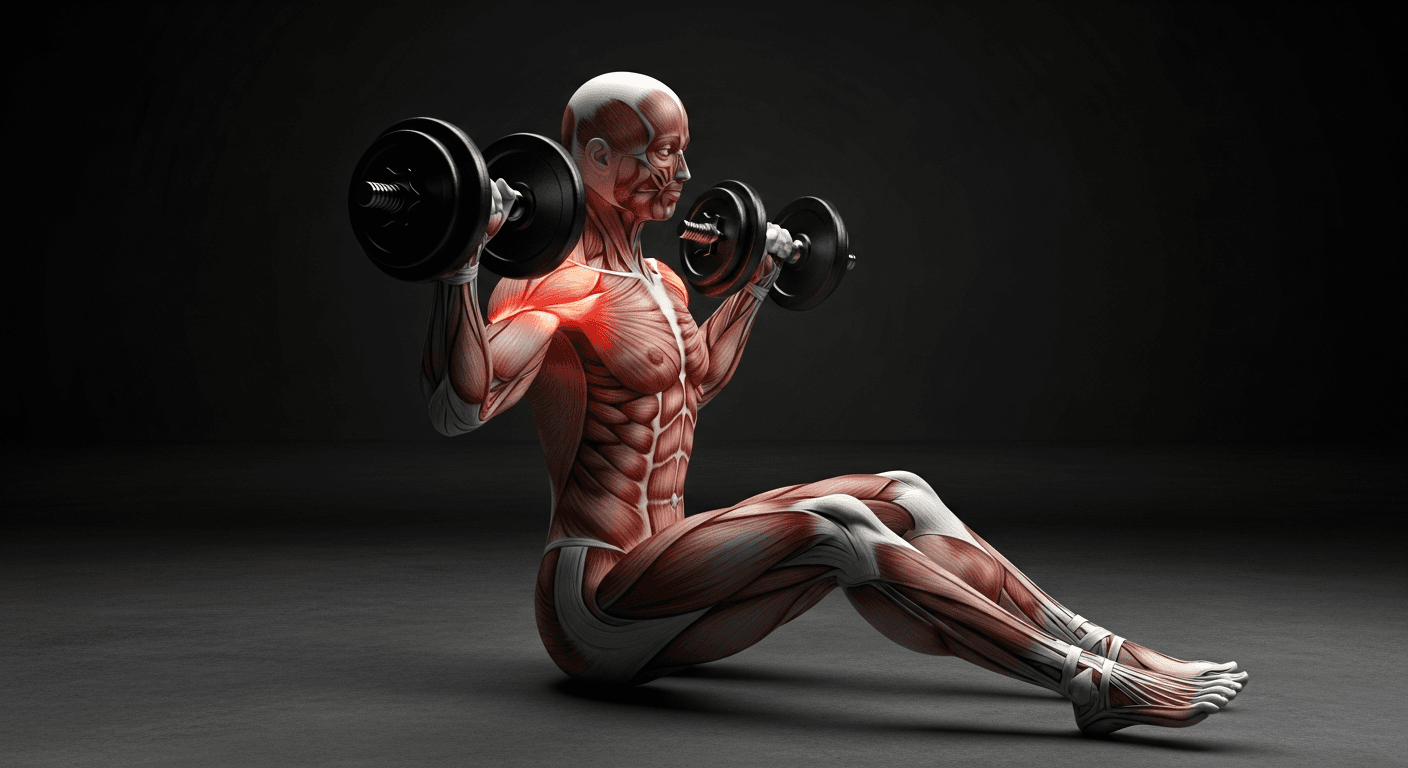
Photo by RepBro.
What muscles does the dumbbell shoulder press work?
The dumbbell shoulder press primarily trains the anterior deltoid (front deltoid). Secondary movers are the lateral deltoid, triceps brachii, and the clavicular portion of the pectoralis major; stabilizers include the rotator cuff and serratus anterior. In short: main driver = anterior deltoid; assistant movers = lateral deltoid and triceps; stabilizers = rotator cuff/upper back.
How much do each of those muscles contribute?
Quantifying exact percentages varies by technique, but expect the anterior deltoid to do most of the concentric work, the lateral deltoid to contribute a moderate share (more with a slightly wider/elbow-out setup), and the triceps to take over as the elbow extends near lockout. If you press with a neutral grip, you slightly reduce anterior deltoid loading and increase triceps/rotator cuff demand.
Where does the dumbbell shoulder press fit in a training program?
- Frequency: 1–2 dedicated pressing sessions per week for beginners; 2–3 times per week for intermediate trainees using different intensities.
- Sets & reps: 3–5 sets. For strength use 4–6 reps; for hypertrophy 6–12 reps. For endurance or conditioning, 12–20 reps with lighter loads.
- Placement: Put it on a "push" day (chest/shoulders/triceps) or an upper-body day. Use it early in the workout if it's a priority exercise.
- Progression: Add load, increase reps, add a set, or improve tempo (e.g., slow 3-second eccentric) to progress. Track lifts and progression; if you use an app, you can log presses in RepBro for consistent progression.
How should I perform the dumbbell shoulder press (form and safety)?
Setup: Sit or stand with feet under hips, neutral spine, shoulder blades slightly retracted. Start with dumbbells at shoulder height, palms facing forward (or neutral if preferred). Press the dumbbells overhead in a straight or slightly angled path until arms are near full extension without locking aggressively. Lower under control back to the start.
Form cues: Keep core braced, avoid overarching the low back, don’t flare elbows excessively forward, and move the shoulder blade as a stable base rather than letting it protract wildly.
Safety note: Stop immediately on sharp joint pain. If you have persistent pain, consult a qualified health professional. This article does not diagnose injuries.
What are good alternatives to the dumbbell shoulder press and when to pick them?
- Barbell Overhead Press (Strict)
- When to pick it: You want to develop maximal pressing strength and use heavier bilateral loading.
- Equipment: Barbell and rack or power cage.
- Pros: Easier to load heavy, simpler progression, better for raw strength and neural adaptation.
- Cons: Less unilateral control; can expose shoulder asymmetries. May stress the low back more when standing if mobility is limited.
- Best if: Your goal is upper-body strength or you have access to a barbell and want a simple incremental loading strategy. For a direct comparison, consider reading a barbell vs dumbbell press guide: https://www.repbro.app/vs
- Seated Machine Shoulder Press (Lever or Plate-Loaded)
- When to pick it: You have shoulder pain with free weights, need a safer single-joint option, or want to isolate deltoids with minimized stabilization demands.
- Equipment: Shoulder press machine.
- Pros: Stable path, easy to load, often more joint-friendly for beginners or rehab phases.
- Cons: Fixed path can force awkward shoulder angles for some lifters; less core demand.
- Best if: You need reduced stabilization, are returning from a minor shoulder complaint, or are working high volume without taxing stabilizers.
- Landmine Press (Single-Arm or Double-Arm)
- When to pick it: You have limited shoulder mobility, need a more natural arc for the shoulder, or training space is limited.
- Equipment: Barbell and landmine attachment (or wedge in a corner).
- Pros: More natural arc and reduced shear on the shoulder joint, great for unilateral work and core tension; useful for progressing pressing strength without full overhead stress.
- Cons: Not as heavy as barbell pressing for some setups; requires a landmine or corner setup.
- Best if: You’re dealing with shoulder impingement tendencies, have limited mobility, or want a transitional press to rebuild tolerance.
- Push Press (Barbell or Dumbbell)
- When to pick it: You want to overcome a bench or sticking point using hip drive and train power/overload.
- Equipment: Barbell or dumbbells.
- Pros: Lets you use heavier loads by adding leg drive, teaches transfer of leg drive to upper body, helpful for increasing overload if strict press stalls.
- Cons: Less pure shoulder isolation; technique introduces a dip-and-drive that changes stimulus.
- Best if: You’ve plateaued on strict presses and need to train heavier loads or add power qualities.
How to choose between alternatives (equipment limits, injuries, plateaus)
- No barbell access: Use dumbbells, landmine, or machine presses. Landmine is low-cost and shoulder-friendly.
- Shoulder pain or mobility limits: Prefer machine press or landmine; use neutral grips and reduce ROM before consulting a clinician.
- Stalled progression on strict dumbbell presses: Cycle in barbell press or push press for 4–8 weeks, then return to strict pressing with higher loads.
- Want size but low fatigue on stabilizers: Use machines for higher-volume phases and keep free-weight presses earlier in the week.
Final programming tips
- Keep one heavy pressing movement per session and supplement with 1–2 accessory moves (lateral raises, face pulls, triceps work).
- Track volume: aim for 9–20 hard sets per week for the shoulder complex depending on training phase and experience.
- Swap variants every 4–8 weeks if gains stall: change load, tempo, or swap to an alternative (landmine or machine) to refresh progress.
One-sentence takeaway: The dumbbell shoulder press is primarily an anterior deltoid and triceps mover that fits well on push or upper days, and practical alternatives (barbell strict/push press, machine press, landmine) let you manage equipment limits, pain, or plateaus without losing shoulder development.
Frequently asked questions
- Is the dumbbell shoulder press better than the barbell press for shoulders?
- Dumbbells increase unilateral control and shoulder ROM, so they often reduce imbalances and increase deltoid activation per side. Barbell pressing allows heavier absolute loads and can be better for maximal strength. Pick based on goals and equipment.
- How often should I do the dumbbell shoulder press?
- 2 times per week is a good starting point for most lifters. Use 3–5 sets per session and 4–12 reps depending on whether you prioritize strength (4–6), mixed strength/hypertrophy (6–8), or hypertrophy (8–12).
- What if I have shoulder pain during the press?
- Stop if you feel sharp or joint pain. Reduce range of motion, try neutral-grip presses, or choose alternatives (landmine, machine) and consult a qualified clinician if pain persists.