Dumbbell Curl: Muscles Worked and Best Alternatives
Clear, practical breakdown of what muscles the dumbbell curl trains, where it fits in a program, and 4 alternatives with when to use each.
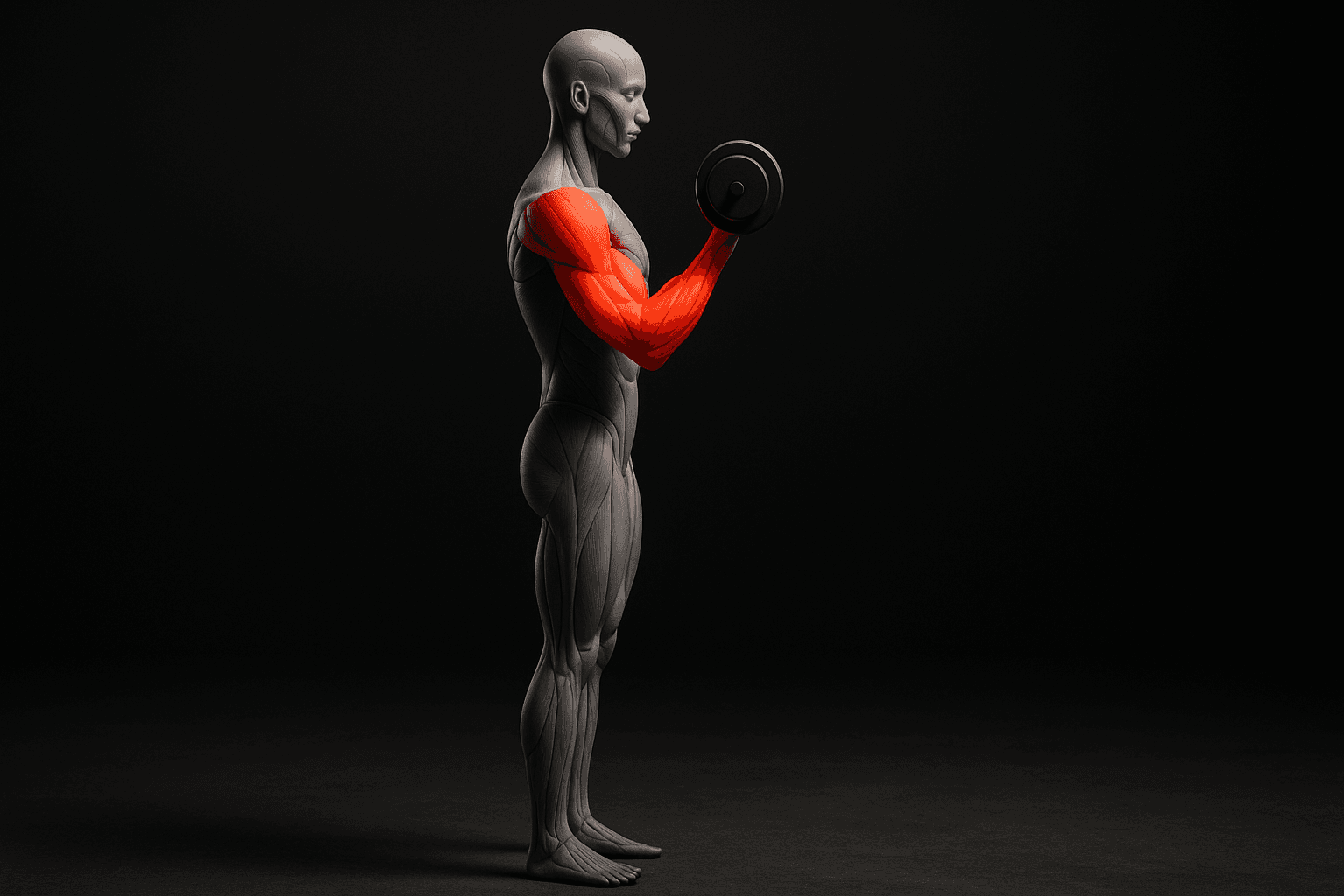
Photo by RepBro.
The dumbbell curl primarily trains elbow flexion and forearm supination: the main movers are the biceps brachii (both long and short heads), with the brachialis and brachioradialis as key secondary contributors; wrist/finger flexors and the shoulder stabilizers assist. In short: it’s a primarily elbow-flexor exercise that targets the biceps and nearby forearm muscles.
What exactly does the dumbbell curl work?
- Primary: biceps brachii (responsible for elbow flexion and forearm supination). The biceps has a long and short head; both work during curls.
- Secondary: brachialis (lies under the biceps and helps elbow flexion) and brachioradialis (important when the forearm is neutral or semi-pronated).
- Tertiary/stabilizers: wrist flexors, anterior deltoid and rotator cuff muscles provide stabilization of the upper arm and shoulder.
The amount each muscle contributes depends on grip and forearm position. A supinated curl (palm up) emphasizes the biceps brachii and supination; a hammer grip (neutral) shifts load toward brachialis and brachioradialis.
How should you perform the standard standing dumbbell curl?
- Start standing or seated with core braced and feet hip-width.
- Hold dumbbells at your sides, palms facing forward (supinated) or neutral if doing hammer curls.
- Keep elbows tucked to the sides; curl the weight up by flexing the elbow. Turn the wrist to full supination as you approach the top if using a supinated grip.
- Lower under control to near full elbow extension without locking aggressively.
- Typical dosing: 3–4 sets of 6–15 reps depending on goals; 60–120 seconds rest for hypertrophy, 2–3 minutes for heavier strength work.
Form cues: move only at the elbow (avoid big torso lean), control the eccentric (lowering) phase 1–3 seconds, and choose a weight that allows clean reps. Progress by adding small increments (for example 1–2.5 kg / 2–5 lb) or increasing reps.
Where does the dumbbell curl fit in a training program?
- Role: accessory/isolation exercise for upper-arm development and elbow flexor strength. Not a compound main lift.
- Frequency: 1–3 short biceps-focused sessions per week; two sessions is a sensible default for most trainees.
- Placement: after compound upper-body exercises (presses, rows, pull-ups). Place curls near the end of a session so they don't fatigue larger pulling muscles early.
- Load and volume: aim for 6–15 total working sets per week for most trainees (including different curl variations). Adjust based on recovery and goals.
Use dumbbell curls when you want unilateral work to correct imbalances, improve peak and shape of the biceps, or add volume without fatiguing grip and larger back muscles excessively.
What are the best alternatives and when to pick each?
Below are four practical alternatives, with reasons to choose each based on equipment, injury history, or training goals.
- Hammer Curl (dumbbell or rope)
- Muscles targeted: brachialis and brachioradialis more than a supinated curl; still works the biceps.
- When to pick it: you have wrist discomfort or elbow pain with full supination, or you want thicker forearm and arm girth. Also useful if you want to reduce strain on the biceps tendon while maintaining elbow flexion work.
- Equipment: a pair of dumbbells or a cable machine with a rope.
- EZ-bar or Barbell Curl
- Muscles targeted: biceps brachii, with a more symmetric load allowing heavier absolute loads.
- When to pick it: you're trying to lift heavier for strength or want to reduce time spent on unilateral work. EZ-bars can be kinder to wrists than straight bars.
- Equipment: barbell or EZ-bar and weights.
- Caveat: heavy bilateral loading can mask side-to-side imbalances.
- Cable Curl (single-handle or rope)
- Muscles targeted: biceps with more consistent tension throughout the range.
- When to pick it: you’ve stalled on free-weight curls and need constant tension to stress the muscle differently, or you want cleaner eccentric control and positional variety (low-to-high, high-to-low). Good when you have limited dumbbells but access to a cable stack.
- Equipment: cable machine. Use rope for hammer-style cable curls.
- Chin-up (underhand/neutral grip) — weighted or bodyweight
- Muscles targeted: biceps plus latissimus dorsi and other upper-body pullers; highest overall loading of elbow flexors when performed close-grip underhand.
- When to pick it: you want a compound alternative that builds biceps and back together, or you have limited time and want more bang-per-exercise. Also useful when you’re past isolation-focused hypertrophy and want functional strength.
- Equipment: pull-up bar, and added weight if you can already do multiple bodyweight reps.
When stuck on a plateau: rotate between these options for 4–6 weeks. Swap load types (heavy low reps with barbell, higher reps with cable, unilateral emphasis with dumbbells) and adjust range/tension to provide a new stimulus.
Any safety considerations?
Stop if you feel sharp or unusual pain; mild muscle soreness is normal but sharp joint pain is not. Use appropriate loads to maintain strict form. If you have a preexisting elbow, wrist, or shoulder condition, consult a healthcare or movement professional before progressing intensity.
How to choose between them quickly?
- Limited equipment: prioritize dumbbell or bodyweight chin variations.
- Wrist/elbow discomfort with supination: pick hammer curls or rope cable curls.
- Want to lift heavier/track strength: use barbell/EZ-bar curls.
- Want overall pull strength and efficiency: pick chin-ups or weighted chin-ups.
Links and tools: if you track workouts or compare variations, the RepBro app helps log sets/reps and compare lifts over time: https://apps.apple.com/us/app/gym-workout-coach-repbro/id6763749305. For side-by-side comparisons of variations, see https://www.repbro.app/vs.
One-sentence takeaway: The dumbbell curl is a straightforward, effective elbow-flexion exercise that primarily hits the biceps and nearby forearm muscles — choose hammer curls, barbell/EZ-bar curls, cable curls, or chin-ups when equipment, pain, or training goals make them a smarter match.
Frequently asked questions
- Does the dumbbell curl work the long and short head of the biceps?
- Yes. The dumbbell curl trains both biceps heads; supinating the forearm (turning palm up) and curling through a full range emphasizes the long head more, while variations like wide-grip curls bias the short head slightly. Genetics determine visible 'peak.'
- How many sets and reps of dumbbell curls should I do?
- For hypertrophy: 3–5 sets of 6–15 reps. For strength: 3–6 sets of 4–8 reps with heavier loads. Two biceps-specific sessions per week is a practical starting point.
- Are unilateral dumbbell curls better than barbell curls?
- Unilateral dumbbell curls reduce left-right imbalances and allow slightly different paths per arm; barbell/EZ-bar curls let you lift heavier overall. Which is 'better' depends on goals and equipment.