Dead Bug Alternatives at Home (Minimal Equipment)
Four practical dead bug substitutes you can do at home with bodyweight, a band, or one dumbbell. What each keeps, what it loses, and when to return to gym equipment.
Photo by RepBro.
If you don’t have room or equipment for the classic dead bug, you can keep the same core control with supine marching/leg lowers, bird-dog, hollow holds (or marching hollow), a band Pallof press, or a dumbbell-loaded dead-bug variation. Each preserves different aspects — pick by goal.
What does a dead bug actually train?
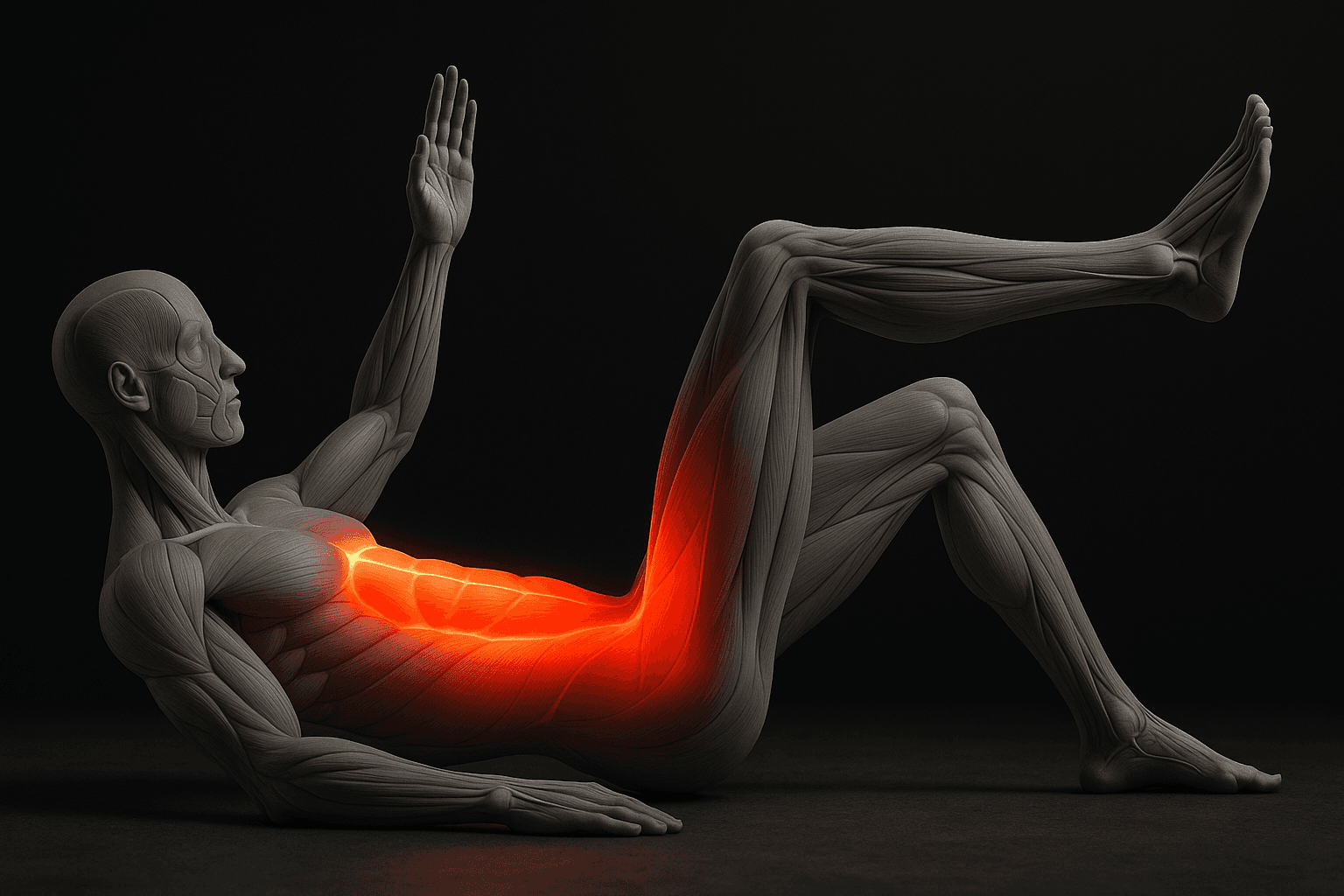
The dead bug is primarily a lumbar–pelvic stabilizer: it teaches the abs to control spinal extension while the limbs move, and it trains contralateral coordination (opposite arm/leg moving) without gross trunk rotation. It’s low-load and high-tech for motor control rather than big-force development.
What are effective dead bug alternatives I can do at home with minimal gear?
Below are five practical substitutions. For each I list what it preserves relative to the dead bug, what it loses, and when the swap is adequate.
- Supine marching or leg lowers (bodyweight)
- What it preserves: supine position, emphasis on posterior pelvic tilt and anti-extension, limb movement that challenges core control.
- What it loses: precise contralateral sequencing (unless you march opposite limbs deliberately); easier to cheat with hip flexors if form drifts.
- When adequate: when you need a simple, low-risk way to build pelvic control and abdominal endurance at home.
- Bird-dog (quadruped)
- What it preserves: contralateral patterning and pelvic stability; uses gravity differently but still demands anti-extension and coordination.
- What it loses: supine-specific breathing cues and the exact abdominal bracing pattern used in dead bugs; different spinal loading because you’re on hands and knees.
- When adequate: when you want a low-impact, functional alternative that’s easy to regress/progress.
- Hollow hold or marching hollow (bodyweight)
- What it preserves: anti-extension tolerance and a strong cue for bracing; good for increasing midline stiffness.
- What it loses: alternating limb coordination and the dynamic limb-driven control cue of dead bugs.
- When adequate: when your goal is to raise abdominal stiffness and endurance rather than inter-limb coordination.
- Pallof press (resistance band)
- What it preserves: core anti-rotation and bracing under an external load; builds unilateral trunk stiffness that supports dead-bug control.
- What it loses: the dead bug’s emphasis on resisting extension with limb movement; it’s a different plane (rotation) not pure sagittal control.
- When adequate: when you want to add progressive external load for trunk stiffness at home.
- Single-arm dumbbell dead-bug-style press (one dumbbell)
- What it preserves: anti-extension with added external load and an anti-rotation challenge if using one arm overhead; closer to a gym progression.
- What it loses: requires more load and shoulder stability, which can shift emphasis away from pure lumbar motor control if done poorly.
- When adequate: when you can maintain textbook bracing and need an incremental load option without gym machines.
How do these alternatives compare at a glance?
| Exercise | Preserves pelvic anti-extension | Preserves contralateral coordination | Adds progressive load | Equipment needed |
|---|---|---|---|---|
| Dead bug (benchmark) | Yes | Yes | Limited (bodyweight or light load) | None/bench |
| Supine marching/leg lowers | Yes | Partially | No | None |
| Bird-dog | Yes | Yes | No | None |
| Hollow hold/march | Yes (stiffness) | No | No | None |
| Pallof press | Partially (rotation focus) | No | Yes (band) | Band |
| Single-arm dumbbell variant | Partially | Partially | Yes (dumbbell) | 1 dumbbell |
How should I progress and program these at home?
- Frequency: train core stability 2–3 times per week, integrated into warm-ups or finishers.
- Sets and reps: 2–4 sets. For dynamic patterning (marching, bird-dog) use 8–15 reps each side; for holds use 20–60 seconds or sets of controlled marches within a hold.
- Progression: make exercises harder by increasing range of motion, adding limb load, slowing tempo, adding external resistance (band/dumbbell), or increasing time under tension.
- Regression: reduce ROM, perform supported variations (knees bent, hands underneath low back), or shorten holds.
These programming guidelines reflect common coaching practice: prioritize quality of movement and incremental difficulty rather than high rep counts of sloppy reps.
When is swapping okay and when should I go back to the gym for a real dead bug?
Swap at home when your goals are motor control, endurance, or basic pelvic stability and you can’t use a bench or controlled surface. Return to the gym if you need fine-grained coaching feedback, progressive external load beyond your dumbbell/band, or if you’re rehabbing an injury under a clinician’s protocol that specifies the original exercise.
What safety cues should I follow?
- Keep a neutral-to-slightly-posterior pelvic tilt and avoid letting the low back arch away from the floor (supine drills) or sag (quadruped drills).
- Breathe: exhale during the challenging part of the movement to help maintain intra-abdominal pressure without breath-holding.
- Stop on sharp or radiating pain and consult a qualified professional if symptoms persist. This article does not diagnose injuries.
What can't apps or AI coaching do for my dead bug practice?
- No app or AI can reliably see and correct your form in real time across every camera angle; live, hands-on feedback from a trained coach or clinician is still necessary for complex movement faults.
- Apps can give programming and videos, but they can’t diagnose tissue irritability, respond to acute pain, or modify a rehab protocol the way an on-site clinician can.
- Consistency and real-world supervision matter: a plan is only effective if you execute it progressively and safely.
Limitations
- This guide focuses on general strength and motor-control work. If you have acute low-back pain, recent spinal surgery, or a clinical condition, consult a physiotherapist or medical professional before attempting progressions. No remote guide replaces individualized assessment.
Safety note: stop any exercise that causes sharp pain or neurological symptoms (numbness, tingling, weakness). For persistent problems get evaluated by a qualified professional.
If you want concise, workout-friendly progressions that fit into a two- or three-day routine, use a simple template: one stability movement (2–4 sets) per session plus one loaded anti-rotation exercise once per week. That approach preserves motor control while letting you build capacity safely at home.
Frequently asked questions
- Can I replace the dead bug with other home exercises and still get the same core benefits?
- Yes. Several home exercises preserve the dead bug’s core principles—pelvic control, anti-extension, and contralateral coordination. Some options trade exact spinal-loading and fine motor control for convenience or extra anti-rotation work; pick the substitute based on your goal and current capacity.
- How often should I train these dead bug alternatives at home?
- Train core stability 2–3 times per week alongside your main lifting sessions. Use 2–4 sets per exercise, and choose either repetitions (8–15) or time-based holds (20–60 seconds) depending on the variant; increase difficulty gradually as control improves.
- When should I go back to the gym to do the traditional dead bug?
- Return to the gym when you need a precisely coached progression, heavier resisted variations, or a controlled surface (bench) for feedback. If you’ve maxed out bodyweight progressions or want objective load progression, gym access is useful.