The Most Common Bulgarian Split Squat Mistakes (and How to Fix Them)
Learn the 7 most common Bulgarian split squat mistakes, why they happen, what they cost, and one concrete fix for each—practical cues and numbers to improve form.
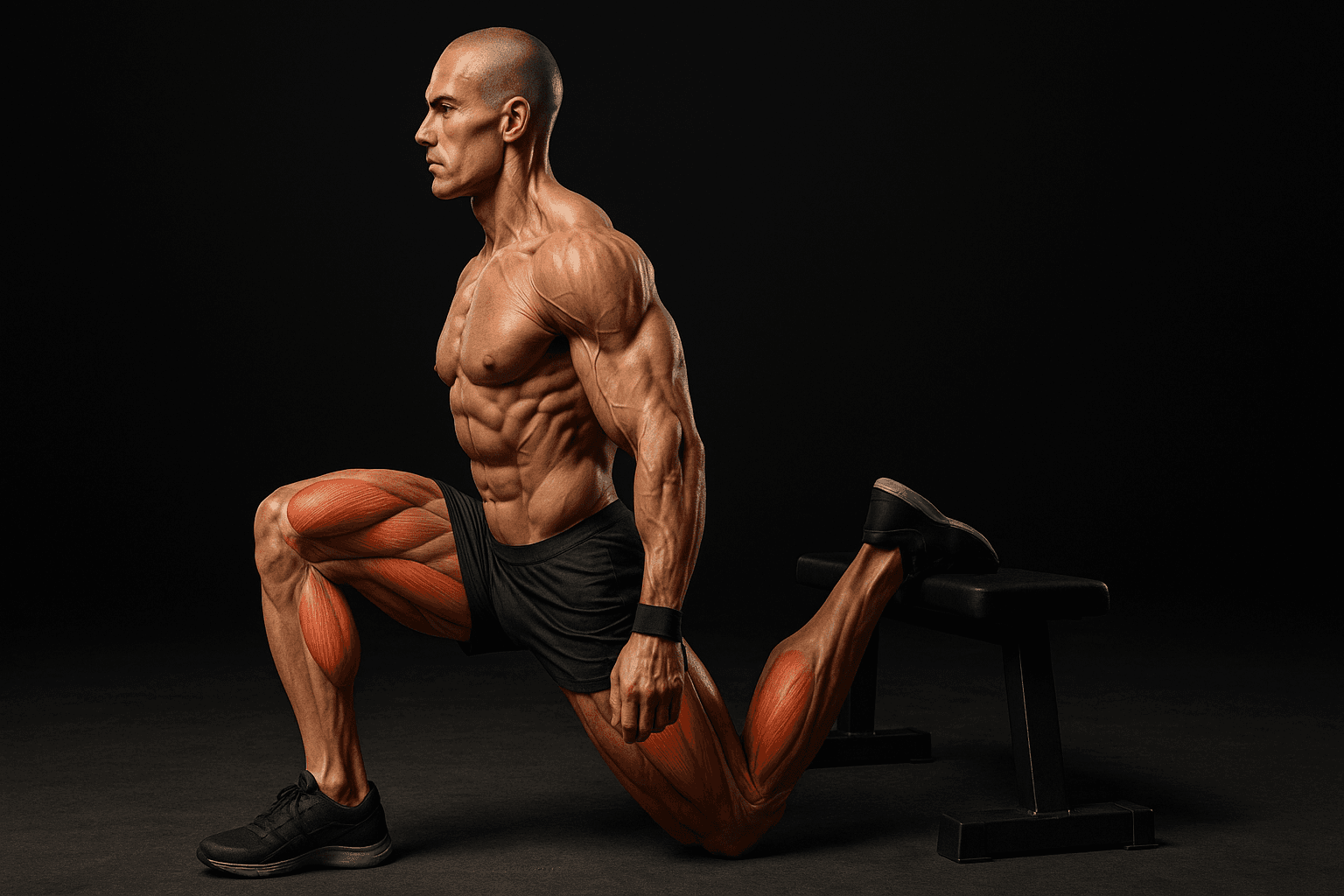
Photo by RepBro.
The most common Bulgarian split squat mistakes are poor set-up (step length), torso collapse, rear-foot height errors, knee caving (valgus), unloading the front leg, bouncing at the bottom, and weak bracing—each costs you strength, balance, or increases injury risk. Below are why each happens, what it costs, and one concrete fix you can apply immediately.
Why is my step too short (and how do I fix it)?
Why it happens: People step back only one sneaker-length or follow the bench instead of finding the right distance. Tight hips or fear of balance also encourage a short stance.
What it costs: Short step length pushes the front knee forward, increasing knee shear and reducing hip/glute activation. You get less strength transfer and potential discomfort.
Concrete fix: Set your distance so the front shin is near-vertical at the bottom. Method: stand with the rear foot on the bench, lower slowly until your front thigh is roughly parallel; if your knee tracks far past your toes, step the rear foot further back 5–10 cm (2–4 in) and try again. Repeat until the front knee sits over the ankle at depth.
Why does my torso lean forward so much?
Why it happens: Weak core or poor cueing, combined with trying to lift heavier weights, leads to hip hingeing instead of an upright split squat. Holding heavy dumbbells poorly can also pull you forward.
What it costs: Forward lean shifts load to the hip extensors and lower back, reducing quad emphasis and raising low-back strain.
Concrete fix: Use a goblet hold (one kettlebell/dumbbell at chest) and brace the ribs down. Inhale, brace like you’re about to be punched, keep the chest tall, and perform a 2-0-1 tempo (2s down, 0s pause, 1s up). The goblet weight forces an upright torso and you can quantify progress.
Why is my rear foot on the bench too high or too low?
Why it happens: People use whatever bench is available—often too high—or stick the rear foot flat on a box that doesn't match their hip mobility.
What it costs: A too-high rear foot exaggerates lumbar extension and alters mechanics; too low limits range and can make you cheat by loading the back leg more.
Concrete fix: Use a rear platform about 40 cm (16 in) high as a starting point. If depth feels restricted or the front knee drifts forward, drop to ~30 cm (12 in). If you can’t control 40 cm with good form, lower the bench until stable control is possible.
Why does my front knee collapse inward (valgus)?
Why it happens: Weak hip abductors/external rotators (gluteus medius), poor motor control, or foot pronation cause the knee to cave in under load.
What it costs: Knee valgus increases risk of overuse stress on the knee and reduces force transfer through the hip, limiting strength gains.
Concrete fix: Add a light loop band above the knees and push the front knee out against it during the descent. Do 2–3 sets of 8–12 reps focusing on actively “pressing the knee away” and practice single-leg glute medius exercises (clams, band walks) 2x/week.
Why do I shift weight into my rear foot?
Why it happens: It's easier to offload the working leg when fatigued or if the rear foot placement gives you a support surface.
What it costs: You rob the front leg of training stimulus and train an imbalanced movement pattern, limiting hypertrophy and strength in the intended limb.
Concrete fix: Cue "drive through the front heel" and place a small weight plate (1–2 cm) under the rear toes to discourage pressing with the rear foot. Ensure the majority of weight sits on the front midfoot/heel by nudging the front knee slightly forward until you feel pressure under the heel.
Why do I bounce at the bottom or rush the rep?
Why it happens: Trying to move more reps with less control or using momentum because the load is near your limit.
What it costs: Bouncing reduces time under tension, increases uncontrolled joint loading, and limits strength adaptations.
Concrete fix: Use a deliberate tempo: 2 seconds down, pause 1 second at the bottom, 1 second up (2-1-1). Touch a soft target (stacked mats) as a contact point instead of bouncing and control every rep for 2–4 sets of 6–12 clean reps.
Why am I shaky or losing balance mid-rep?
Why it happens: Poor core bracing, insufficient single-leg stability, or too much weight relative to your balance capacity.
What it costs: Wasted reps, compromised technique, and higher chance of compensatory patterns that stress joints.
Concrete fix: Reduce load by 20–30% and focus on a controlled 2-0-1 tempo for 3–4 sessions while practicing breathing/bracing: inhale into the belly, brace the core, and maintain a neutral pelvis. Progressively add load once 3 sets of 8 controlled reps are stable.
Safety note: Stop on sharp pain; if you experience persistent joint pain or unusual symptoms, consult a qualified professional. This article provides technique guidance, not diagnosis.
Want an easy way to track cues, tempos, and progressive overload? Use RepBro to log set-up and tempo, or compare coaching approaches on https://www.repbro.app/vs.
One-sentence takeaway: Fix setup, control descent, and prioritize loading the front leg with an upright torso and braced core to get safer, more effective Bulgarian split squats.
Frequently asked questions
- How deep should a Bulgarian split squat be?
- Aim for the front thigh to reach roughly parallel to the floor (about 90° at the front knee) with the front shin near vertical. Depth is limited by control and pain-free movement, not by touching floor.
- What bench height should I use for my rear foot?
- Start with a bench or box around 40 cm (16 in). Lower to a 30 cm (12 in) surface if you lack hip mobility; raise to 45 cm (18 in) only if you can control the movement without rocking.
- Are Bulgarian split squats safer than barbell back squats?
- They reduce spinal loading and can be safer for unilateral strength and balance, but safety depends on technique, load, and pre-existing issues—stop on sharp pain and consult a professional when unsure.