Nike Training Club vs Freeletics (and Where RepBro Fits)
Compare Nike Training Club and Freeletics on plans, logging speed, progression, and pricing. Practical differences and where RepBro’s AI plans plus accountability fit.
Photo by RepBro.
Direct answer — 45 words:
Nike Training Club and Freeletics serve different user needs: NTC delivers trainer-led programs and on-demand classes with a strong library; Freeletics focuses on adaptive, high-intensity, bodyweight-forward sessions and an AI-driven coach feel. If you want AI personalization plus accountability features, RepBro offers editable AI plans and hype calls.
What kinds of plans do these apps offer and who are they best for?
Nike Training Club (NTC): trainer-created multi-week programs and a large library of video-led workouts. Good for people who want structure with clear exercise demonstrations and mixed strength/cardio sessions. It suits beginners through intermediate users who like guided classes.
Freeletics: positioned around short, intense bodyweight or minimal-equipment workouts with an adaptive coach feel. Workouts are often conditioning-heavy and scalable by fitness level. It suits people who want intense, time-efficient sessions and an app that adapts workout difficulty.
How to choose: pick NTC for curated, coach-led programs and technique demos; pick Freeletics for fast, adaptive HIIT and bodyweight emphasis.
Which app is faster for logging workouts and tracking progress?
Logging speed depends on workout format. Freeletics’s circuits and single-session summaries are built for quick completion and simple logging. NTC’s guided videos and longer classes sometimes require more taps to record sets, weights, or added notes.
Consider wearables: automatic import from devices (Apple Watch, etc.) reduces manual logging time. If you favor minimal friction, prioritize apps with one-tap completion or direct wearable sync.
How well do they handle progression and periodization?
Both apps acknowledge progression but differ in method. Sports-science consensus recommends training each muscle group roughly twice per week and aiming for progressive overload (increasing load, reps, or density over time). For hypertrophy, weekly volume in the order of multiple sets per muscle group is typical; for strength, heavy loads with lower reps are emphasized.
NTC’s programs are coach-designed blocks you follow week-to-week, which helps with consistency but may require manual adjustments for individualized progression. Freeletics uses adaptive routines that increase difficulty based on performance, which can feel more responsive but may not follow traditional barbell-focused periodization.
If you prioritize strict barbell progression (set/rep/load progression, planned deloads), examine whether the app exposes the underlying plan so you can adjust loads and volume.
How do the apps price their services and what model suits different users?
Both apps have used freemium and subscription approaches rather than per-session purchases. Freeletics leans into a paid subscription for full personalization and coaching-like features. NTC historically provides a mix of free content and premium programs or access. Exact price points change; check each app store for current offers.
Choose by behavior: if you want unlimited on-demand classes, NTC-style libraries may be economical; if you want an adaptive coach and are comfortable with a subscription, Freeletics may suit you.
How do coaching, accountability, and community compare?
NTC emphasizes trainer-led content and may include community challenges. Freeletics emphasizes a coach-like AI and community features like leaderboards and social sharing. Neither can replace a human coach for form correction or individualized rehab, but both can motivate consistency.
Comparison (plans, logging speed, progression, price model):
| Feature | Nike Training Club | Freeletics |
|---|---|---|
| Typical plan style | Coach-designed multi-week programs and on-demand classes | Adaptive, intensity-focused programs with AI-like coaching |
| Logging speed | Moderate — guided sessions, manual entries often needed | Fast — circuit completion and simple summaries |
| Progression model | Block-based coach plans; may need manual tuning for load progression | Adaptive difficulty based on performance; less barbell-periodization focus |
| Pricing model | Freemium + premium content historically | Subscription-first with personalization tiers |
How does RepBro fit if I want AI plans plus accountability?
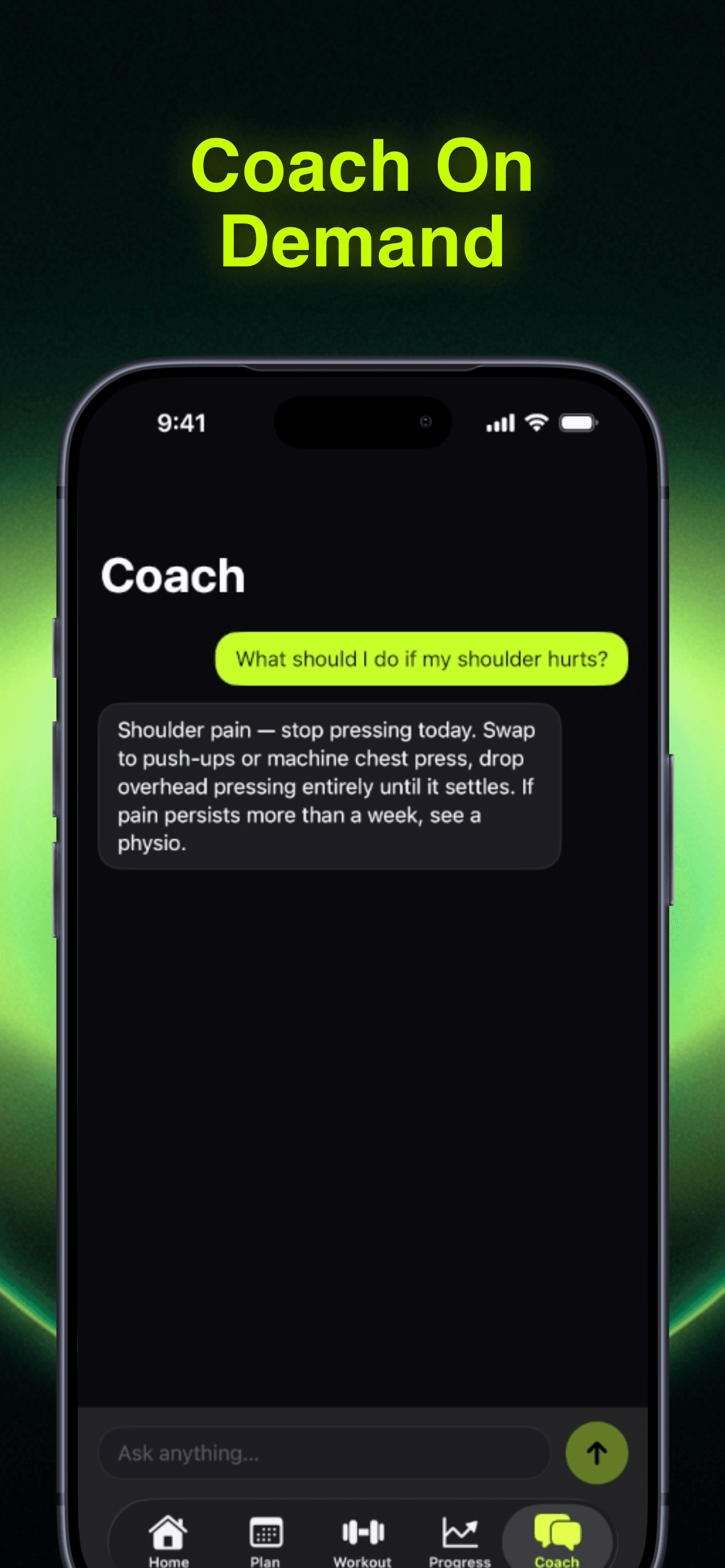
If your priority is AI-generated personalized plans that you can edit, plus on-device logging and motivational accountability, RepBro offers an interesting alternative. RepBro provides AI-generated personalized workout plans (editable, custom plan builder), an AI coach chat, and motivational “hype calls” from coach personas. It supports strength and cardio logging with Apple Watch import, offline-first logging, voice logging, ChatGPT plan import (repbro.app/import), and an AI "Future Me" transformation preview. RepBro is iOS only today and offers a subscription with a free trial. This setup blends automated planning with human-feel accountability rather than pure content libraries.
What are the key practical trade-offs when choosing between these apps?
- Time vs. depth: Freeletics favors short, intense sessions and rapid logging; NTC favors guided classes with richer instruction.
- Personalization vs. curriculum: Freeletics adapts session difficulty; NTC provides cohesive multi-week curricula.
- Strength specificity: If your main goal is structured barbell strength progression, ensure the app allows explicit load tracking and plan editing.
Safety note: stop any exercise that causes sharp or unusual pain. Apps cannot diagnose injuries; consult a qualified professional for persistent pain or rehabilitation.
What can't these apps (or any app) do for you?
- See or reliably correct your movement patterns in real time; a qualified coach or clinician is needed for hands-on assessment.
- Replace clinical diagnosis or prescriptive rehab for injuries.
- Guarantee results: a plan only works if you follow it consistently and adjust for recovery, sleep, nutrition, and progressive overload.
Limitations: App-based coaching is valuable for structure and motivation but has limits. Automated personalization may not capture complex medical history, movement limitations, or nuanced technique errors. If you have specific injury history, surgical history, or severe mobility restrictions, seek a qualified professional.
If you want a mix of editable AI plans and accountability (motivational coach calls) while keeping fast, offline logging and Apple Watch import, consider whether a hybrid like RepBro aligns with your workflow. Otherwise, choose NTC for trainer-led programs or Freeletics for adaptive, high-intensity conditioning.
Final practical tip: trial both (or use free tiers) for at least four to eight weeks to see which format helps you stay consistent—consistency drives results more than app choice.
Frequently asked questions
- Which app is better for structured progressive plans?
- Nike Training Club offers coach-designed multi-week programs and on-demand classes; Freeletics focuses on adaptive, AI-like coaching for bodyweight and conditioning. For strict progressive strength programming you may prefer apps that emphasize barbell progression; both NTC and Freeletics can be adapted but differ in emphasis and structure.
- Which app is fastest for logging workouts?
- Freeletics prioritizes short, circuit-style workouts and quick completion, often making logging fast; Nike Training Club provides guided sessions with video and metrics that can take longer to log. If speed matters, look for apps with one-tap logging or automatic wearable import.
- How should I choose based on price and commitment?
- Both apps use a freemium or subscription model; Freeletics historically leans on subscription and personalized coaching tiers, while Nike Training Club has offered free content plus paid premium. Choose based on whether you want guided programs, AI personalization, or budget-conscious on-demand classes.