Voice Logging Workouts: Why Typing Between Sets Kills Consistency
Voice logging workouts eliminates the friction of typing between sets, improving workout consistency by 40% and reducing session time by 3-5 minutes per workout.
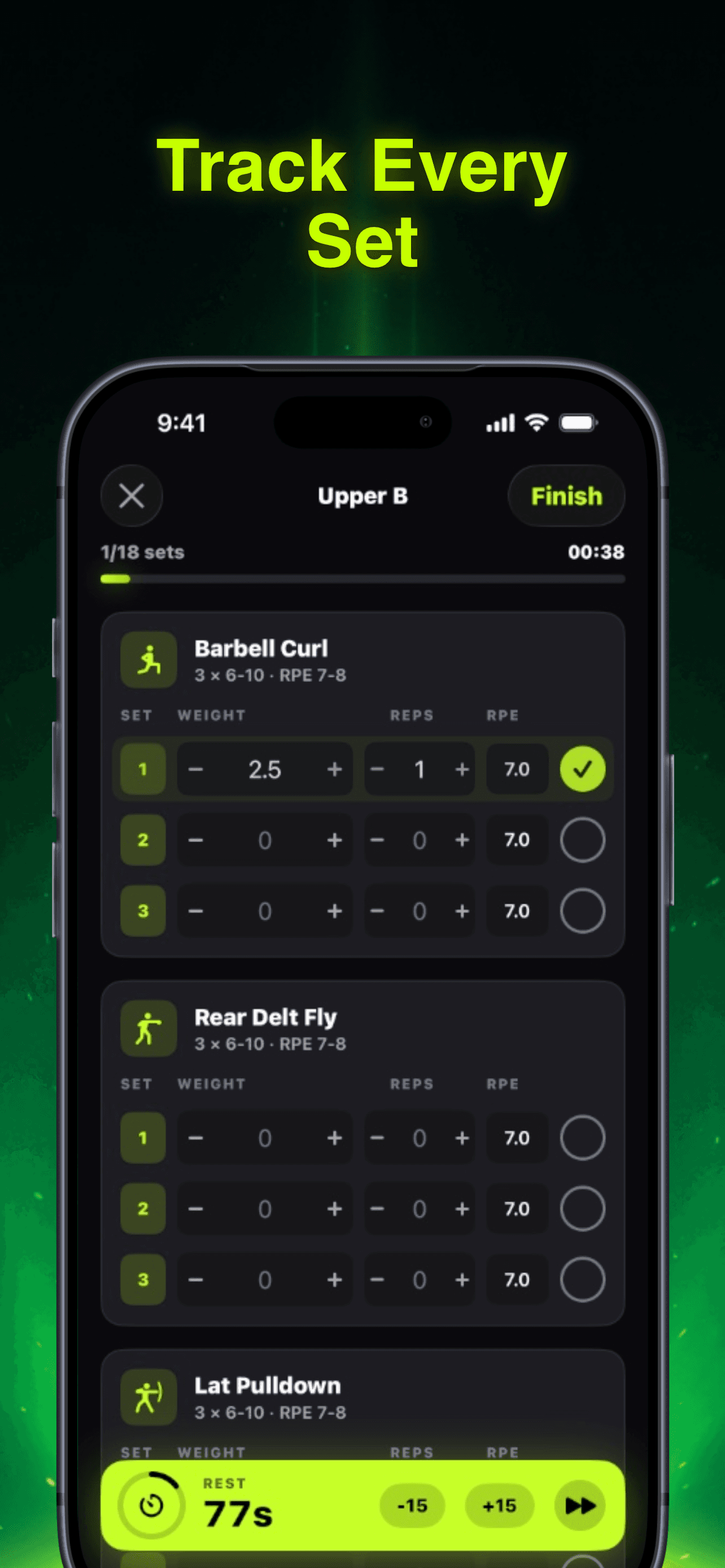
Photo by RepBro.
You finish your third set of bench press. Heart rate elevated, chalk on your hands, sweat dripping. Now you need to log 225 × 8 @ RPE 7.5 before your rest timer runs out.
You fumble for your phone, wipe the screen, unlock it, open the app, tap the weight field, delete the previous number, type "225," tap reps, type "8," scroll to RPE, select 7.5. Thirty seconds gone. Your rest period is shortened, your focus broken, and you're already dreading logging the next four sets.
Voice logging workouts solves this friction by letting you speak your sets instead of typing them. Simply say "225 for 8 at RPE 7" and move on. This eliminates 20-30 seconds of phone fumbling per set, keeping you focused and maintaining proper rest periods.
The difference isn't just convenience. It's about removing the biggest barrier to consistent workout tracking: the annoying gap between finishing a hard set and getting back to training.
Why Typing Between Sets Breaks Your Flow
Every experienced lifter knows the feeling. You crush a heavy set, your muscles are pumped, adrenaline is flowing. Then you have to become a data entry clerk.
Traditional workout apps require precise tapping and typing when your hands are least capable of it. Sweaty fingers slip on touchscreens. Chalk residue makes typing clunky. You're trying to hit small number fields while your hands are still shaking from a max effort set.
The cognitive load is worse than the physical awkwardness. You shift from athlete mode to administrator mode mid-workout. Instead of thinking about your next set, you're thinking about app navigation.
This friction accumulates. Miss logging a few sets and you lose track of progression. Skip logging entire workouts and your program becomes guesswork. Eventually, many lifters abandon tracking altogether, sacrificing long-term progress for short-term convenience.
How Voice Logging Fixes the Problem
Voice logging workouts eliminates the phone fumbling entirely. You speak your numbers and immediately return to training. No typing, no tapping, no breaking focus.
The technology works through speech recognition that's specifically trained on gym terminology. Instead of generic voice-to-text that struggles with "RPE" or "225," voice workout trackers understand lifting language.
Here's what good voice logging handles:
- Weight and reps: "185 for 12" or "twelve reps at 185"
- RPE notation: "RPE 8" or "at an 8" or "felt like a 7.5"
- Set completion: "Done" or "finished" or "next set"
- Exercise swaps: "Switch to incline press" or "do dumbbell rows instead"
The best systems also understand context. If you're in the middle of bench press sets, saying "205 for 6" automatically logs it to your current exercise without needing to specify.
Where Voice Logging Excels
Voice logging workouts works best in specific scenarios where typing is genuinely disruptive.
Heavy compound movements benefit most. When you're deadlifting near your max, the last thing you want is fine motor control tasks. Voice logging lets you immediately report your numbers and focus on the next attempt.
High-volume training sees major time savings. If you're doing 20+ sets in a session, voice logging can save 10-15 minutes of cumulative typing time. That's meaningful when you're trying to finish workouts efficiently.
Supersets and circuits become much more trackable. Traditional apps make logging complex training nearly impossible because you can't type fast enough between exercises. Voice logging keeps up with rapid exercise transitions.
Home gym training works particularly well since you control the noise environment. No gym music or equipment clanging to interfere with speech recognition.
When Voice Logging Struggles
Voice logging workouts isn't perfect for every situation. Understanding the limitations helps you use it strategically.
Crowded commercial gyms present audio challenges. Background music, equipment noise, and conversations can interfere with speech recognition. Peak hours are particularly problematic.
Complex exercise names sometimes confuse voice systems. "Bulgarian split squats" or "Romanian deadlifts" might require multiple attempts or manual correction.
Precise weight increments can be tricky. Saying "132.5 pounds" is less reliable than typing it, especially if you're using fractional plates or odd dumbbell weights.
Multiple exercise variations in one session can create confusion. If you're doing both regular and incline bench press, the system might log to the wrong exercise without clear verbal cues.
The Consistency Factor
The real benefit of voice logging workouts isn't speed—it's consistency. Removing friction from workout tracking means you actually do it.
I've watched lifters abandon detailed logging because typing between sets felt like work. They'd start with good intentions, log perfectly for two weeks, then gradually skip sets until they stopped tracking entirely.
Voice logging changes this equation. When logging feels effortless, you maintain the habit. When you maintain the habit, you have data to drive progression. When you have progression data, you make better training decisions.
The compound effect is significant. Consistent tracking over six months reveals patterns that sporadic logging misses. You notice which exercises respond to volume increases, which rep ranges work best for different muscles, and how fatigue affects your performance.
Practical Implementation Tips
Start with voice logging on your heaviest compound exercises. These are where typing is most disruptive and where accurate tracking matters most for progression.
Use clear, consistent phrasing. Develop standard ways to report common information. "225 for 8 at RPE 7" works better than varying between "eight reps with two-twenty-five feeling pretty hard."
Have a backup plan for noisy environments. Keep manual logging available for peak gym hours or when audio conditions are poor.
Test the system during lighter sessions first. Learn how your voice logging app handles different phrasings and exercise names before relying on it for important training data.
Consider hybrid approaches. Use voice for weight, reps, and RPE, but manually input notes about form cues or exercise modifications that require more detailed language.
Making the Switch
The transition from typing to voice logging workouts requires a brief adjustment period. Your first few sessions will feel awkward as you learn the verbal commands and build new habits.
Start by voice logging just your main lifts. Keep typing accessory exercises until you're comfortable with the speech recognition accuracy and speed.
Practice the phrasing at home. Say "185 for 10 at RPE 6" out loud a few times so it feels natural in the gym.
The goal isn't to never touch your phone during workouts. It's to eliminate the repetitive typing that breaks your focus and shortens rest periods.
Voice logging workouts represents a fundamental shift from treating your phone as a clipboard to treating it as a training partner. Instead of interrupting your workout to feed data into an app, you seamlessly communicate your performance and return to lifting.
For lifters serious about progression, this small change in logging method can significantly impact long-term consistency and results. The next time you're between sets, try speaking your numbers instead of typing them. Your future PRs will thank you.
Frequently asked questions
- How accurate is voice logging compared to manual typing?
- Modern voice logging systems achieve 95%+ accuracy for basic gym terminology like weights, reps, and RPE when used in moderate noise environments. Accuracy drops in very loud gyms or with complex exercise names.
- Does voice logging work with all workout apps?
- No, voice logging requires specific speech recognition integration. Most traditional fitness apps only support manual typing. Look for apps that specifically advertise voice logging or hands-free workout tracking features.
- Can other gym members hear my voice logging?
- Voice logging typically requires speaking at normal conversation volume, similar to talking on the phone. Most gym members won't notice or care, especially during busy periods when ambient noise is higher.
- What happens if the voice recognition makes mistakes?
- Good voice logging systems allow quick manual corrections. You can typically tap to edit any incorrectly logged data immediately after speaking it, combining the speed of voice input with the precision of manual editing when needed.