Upper Lower Split: The 4-Day Program That Fits a Busy Week
An upper lower split trains each muscle twice weekly across 4 workouts. Perfect for intermediate lifters who want balanced development without the time commitment of 6-day routines.
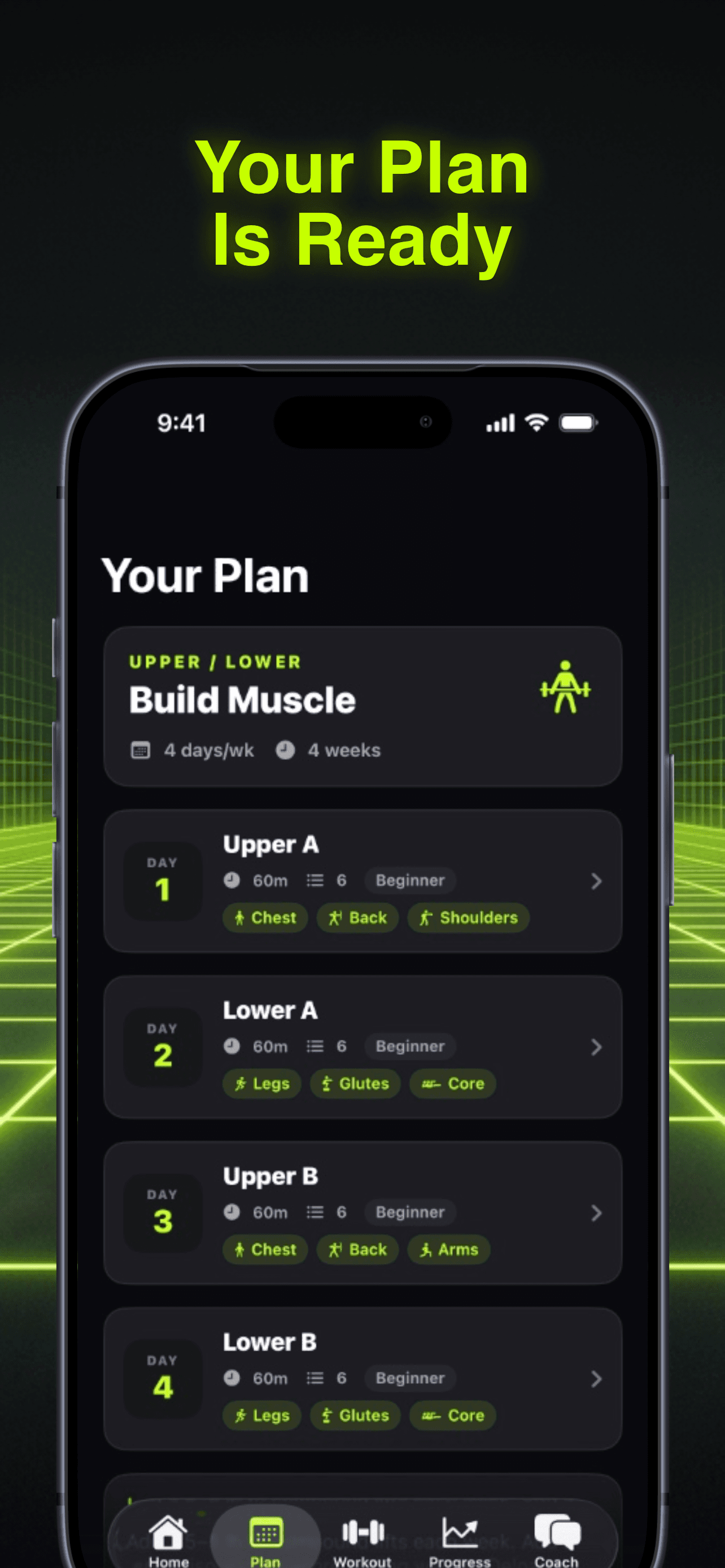
Photo by RepBro.
You walk into the gym four days a week. Two days you train your upper body. Two days you hammer your lower body. That's an upper lower split in its simplest form.
An upper lower split divides your training into upper body days (chest, back, shoulders, arms) and lower body days (quads, hamstrings, glutes, calves). Most lifters run this as a 4-day program, training each muscle group twice per week with 48-72 hours of recovery between sessions.
This split sits in the sweet spot between full-body routines (which can feel rushed) and push/pull/legs programs (which demand 6 days in the gym). For intermediate lifters juggling work, family, and other commitments, the upper lower split delivers serious results without consuming your entire week.
Why the Upper Lower Split Works
The upper lower split succeeds because it respects two fundamental training principles: adequate volume and sufficient recovery.
Training each muscle group twice per week hits the optimal frequency zone for most lifters. Research consistently shows that hitting muscles 2-3 times weekly produces better hypertrophy than once-weekly training. The upper lower split nails this frequency while keeping your gym schedule manageable.
Recovery happens between sessions, not just between weeks. After crushing your chest, shoulders, and triceps on Monday, those muscles get 72 hours to rebuild before your next upper session on Thursday. Meanwhile, your legs stay fresh for Tuesday's lower body workout.
The time efficiency factor matters too. You get 45-60 minutes per muscle group across two weekly sessions. That's enough volume for serious progress without marathon gym sessions that drain your motivation.
The Basic Upper Lower Split Template
Here's how most lifters structure their upper lower split:
Monday: Upper Body
- Bench press or push-up variation
- Bent-over row or pull-up
- Overhead press
- Lat pulldown or chin-up
- Dips or close-grip bench
- Barbell or dumbbell curls
Tuesday: Lower Body
- Squat variation
- Romanian deadlift
- Bulgarian split squat or lunge
- Hip thrust or glute bridge
- Calf raises
- Plank or abs circuit
Wednesday: Rest
Thursday: Upper Body
- Incline dumbbell press
- Cable row or T-bar row
- Lateral raises
- Face pulls
- Tricep pushdowns
- Hammer curls
Friday: Lower Body
- Deadlift variation
- Front squat or leg press
- Walking lunges
- Leg curls
- Standing calf raises
- Russian twists
Weekend: Rest
Each workout hits the major movement patterns for that half of your body. You'll notice the second upper and lower sessions use slightly different exercises. This variation prevents staleness while targeting muscles from different angles.
Who Should Choose Upper Lower Over Other Splits?
The upper lower split isn't universal. It works best for specific lifter profiles.
Choose upper lower if you're an intermediate lifter. You've mastered basic movement patterns and can handle moderate training volumes. Beginners often do better with full-body routines that practice movements more frequently. Advanced lifters might need the specialization of a push/pull/legs or body part split.
Pick this split if you have 4 consistent gym days per week. The beauty lies in the predictable schedule. Missing one workout doesn't derail your entire week like it might with a 6-day program.
Upper lower works when you want balanced development. Each session trains multiple muscle groups, preventing the muscle imbalances that can develop from focusing too heavily on "mirror muscles" or neglecting posterior chain work.
Consider this split if you enjoy longer workouts. Each session typically runs 45-75 minutes since you're training an entire half of your body. If you prefer shorter, more frequent sessions, full-body training might suit you better.
Upper Lower Split vs Push Pull Legs: Which Wins?
The eternal debate between upper lower split vs PPL comes down to your schedule and recovery capacity.
Push/pull/legs splits allow more specialization. You can dedicate an entire workout to just pushing movements, really focusing on chest, shoulders, and triceps. The trade-off? You need 6 gym days for twice-weekly frequency, or you accept training each muscle group only once per week.
Upper lower splits require fewer gym days but demand longer sessions. You're training opposing muscle groups in the same workout, which can impact performance on later exercises. Your bench press might suffer if you've already exhausted your shoulders with overhead pressing.
For most lifters with normal jobs and responsibilities, the upper lower split wins on practicality. Four gym days beats six gym days when you're trying to maintain consistency over months and years.
Programming Your Upper Lower Split for Results
Successful upper lower programming follows a few key principles that maximize your time investment.
Start each session with your heaviest compound movement. Begin upper days with bench press, overhead press, or weighted pull-ups. Start lower days with squats or deadlifts. Your nervous system is freshest at the beginning of workouts.
Alternate between horizontal and vertical movements. If you bench press first, follow with a rowing movement. This approach maintains muscle balance and lets antagonist muscles recover between exercises.
Use different rep ranges across the week. Your first upper session might emphasize strength with 3-5 reps on main lifts. The second upper session could focus on hypertrophy with 8-12 reps. This variation prevents adaptation and keeps training interesting.
Don't neglect unilateral work. Include single-arm and single-leg exercises to address imbalances that bilateral movements miss. Bulgarian split squats, single-arm rows, and unilateral pressing variations earn their place in any well-designed program.
Common Upper Lower Split Mistakes to Avoid
Even simple splits can go wrong with poor execution. These mistakes sabotage progress.
Mistake 1: Ignoring progression. Just showing up isn't enough. Track your weights, reps, and sets. Add weight or reps each week. Progressive overload drives adaptation.
Mistake 2: Skipping warm-ups. Jumping straight into heavy squats or bench press invites injury. Spend 10-15 minutes preparing your body with dynamic movements and lighter loads.
Mistake 3: Training through excessive fatigue. The upper lower split allows for hard training, but crushing yourself every session leads to burnout. Some days should feel challenging but manageable.
Mistake 4: Neglecting posterior chain work. It's easy to get caught up in bench pressing and squatting while shortchanging rows, pull-ups, and hip hinge movements. Balance pushing with pulling.
Making Your Upper Lower Split Stick
Consistency beats perfection in strength training. The best program is the one you'll actually follow for months.
Schedule your four training days like important meetings. Block the time in your calendar. Treat these appointments with yourself as non-negotiable.
Prepare for obstacles. Know which exercises you'll substitute when equipment isn't available. Have a plan for shorter workouts when time is tight. Flexibility within structure prevents missed sessions.
Track everything that matters. Weight lifted, reps completed, how you felt during the workout. This data guides your progression and helps you identify what's working.
The upper lower split works because it's simple enough to follow consistently while providing enough stimulus for continued progress. You train each muscle twice weekly, get adequate recovery, and maintain a sustainable gym schedule.
If you're ready to commit to four quality training sessions per week, the upper lower split might be exactly what your routine needs. Pick your exercises, plan your progression, and start building the consistency that transforms good intentions into measurable results."
Frequently asked questions
- How many days per week should I do an upper lower split?
- Most lifters follow a 4-day upper lower split, training upper body twice and lower body twice per week. This provides optimal muscle frequency while allowing adequate recovery between sessions.
- Is upper lower split good for beginners?
- Upper lower splits work better for intermediate lifters who have mastered basic movement patterns. Beginners typically benefit more from full-body routines that practice movements more frequently.
- Upper lower split vs push pull legs - which is better?
- Upper lower requires only 4 gym days compared to PPL's 6 days for twice-weekly frequency. PPL allows more specialization but demands greater time commitment. Choose based on your schedule and consistency.
- How long should upper lower workouts be?
- Upper lower workouts typically last 45-75 minutes since you're training an entire half of your body. This is longer than full-body sessions but allows for adequate volume per muscle group.
- Can I do upper lower split 5 days a week?
- A 5-day upper lower split is possible but requires careful planning. You might alternate 2 upper/3 lower one week, then 3 upper/2 lower the next week, but 4 days is more sustainable long-term.