Sets and Reps by Goal: A Simple Reference Table
Complete guide to sets and reps for strength, hypertrophy, and endurance. Use 1-5 reps for strength, 6-12 for muscle growth, and 15+ for endurance training.
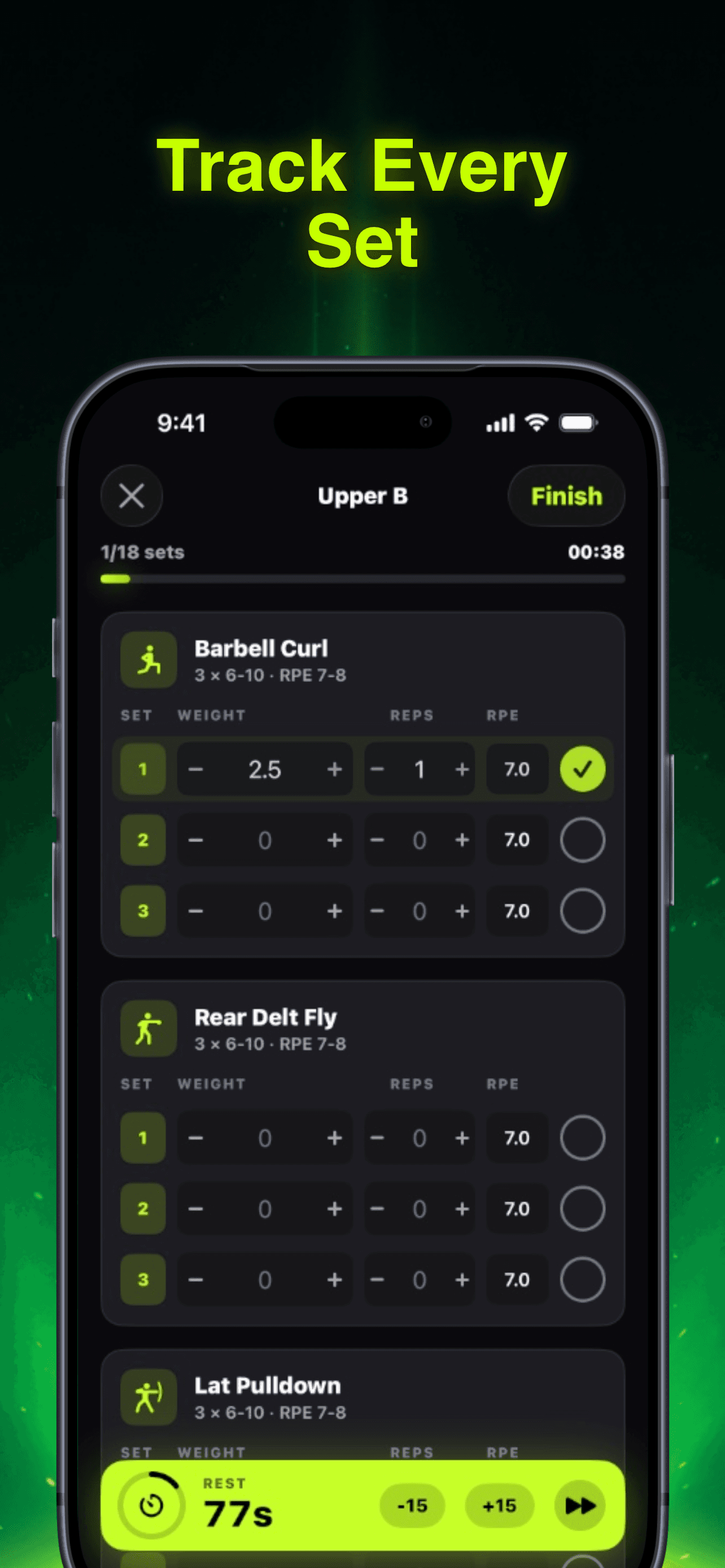
Photo by RepBro.
You walk into the gym with a clear goal but fuzzy execution. Should you do 3 sets of 8 or 5 sets of 5? The answer depends entirely on what you're trying to achieve.
Sets and reps by goal break down into three main categories: 1-5 reps for maximum strength, 6-12 reps for muscle growth (hypertrophy), and 15+ reps for muscular endurance. Each rep range triggers different physiological adaptations, making your choice of sets and reps the most important programming decision you'll make.
Here's your complete reference guide to matching your training volume to your goals.
The Science Behind Rep Ranges
Different rep ranges stress your muscles in fundamentally different ways. Low reps with heavy weight primarily develop your neuromuscular system's ability to recruit motor units efficiently. This builds maximum strength.
Moderate reps create the perfect storm for muscle growth. You lift heavy enough to recruit high-threshold motor units while accumulating enough volume to trigger protein synthesis. The 6-12 rep range maximizes mechanical tension and metabolic stress.
High rep ranges develop your muscles' ability to resist fatigue and clear metabolic byproducts. This builds endurance but contributes less to strength or size gains.
Sets and Reps for Maximum Strength
Goal: Lift the heaviest weight possible
- Rep Range: 1-5 reps
- Sets: 3-6 sets
- Rest: 3-5 minutes
- Load: 85-100% of 1RM
Strength training demands high intensity and low volume per set. Your nervous system needs to practice recruiting maximum motor units without accumulating fatigue that interferes with technique.
The classic 5x5 protocol works because it gives you enough practice at heavy weights while maintaining quality. Powerlifters often use even lower reps closer to competition, working singles and doubles to groove their competition lifts.
One mistake I see constantly: trying to build strength with 8-10 rep sets. You can't practice maximum effort with submaximal loads. If strength is your goal, you need to lift heavy weights.
How Many Sets and Reps for Muscle Growth
Goal: Build maximum muscle mass
- Rep Range: 6-12 reps (sweet spot: 8-10)
- Sets: 3-5 sets per exercise
- Rest: 2-3 minutes
- Load: 65-85% of 1RM
Hypertrophy training balances mechanical tension with training volume. The 6-12 rep range lets you use meaningful weight while accumulating enough volume to stimulate growth.
Research consistently shows muscle growth occurs across a wide rep range, but the 6-12 zone offers the best efficiency. You can handle heavier loads than high-rep training while doing more volume than strength work.
For muscle building, your weekly volume matters more than individual workout structure. Aim for 10-20 sets per muscle group per week, distributed across 2-3 training sessions.
Hypertrophy Set and Rep Combinations That Work
- 3 sets x 8-10 reps: Classic bodybuilding approach
- 4 sets x 6-8 reps: Strength-focused hypertrophy
- 5 sets x 8-12 reps: High-volume muscle building
- Drop sets: One heavy set followed by reduced weight for more reps
Sets and Reps for Muscular Endurance
Goal: Resist fatigue and improve work capacity
- Rep Range: 15+ reps (often 15-25)
- Sets: 2-4 sets
- Rest: 30-90 seconds
- Load: 50-65% of 1RM
Endurance training develops your muscles' ability to perform repeated contractions without fatigue. This improves capillary density, mitochondrial function, and lactate buffering.
High-rep training works well for muscle groups that need endurance in daily life or sport. Think about a cyclist's legs or a swimmer's shoulders. These athletes benefit from sets of 20+ reps.
For general fitness, endurance training makes a good addition to strength and hypertrophy work, but shouldn't be your primary focus if size or strength matter to you.
The Complete Sets and Reps Reference Table
| Goal | Reps | Sets | Rest | Load (% 1RM) | Best For |
|---|---|---|---|---|---|
| Maximum Strength | 1-5 | 3-6 | 3-5 min | 85-100% | Powerlifting, 1RM testing |
| Strength-Power | 3-6 | 3-5 | 3-4 min | 80-90% | Athletic performance |
| Hypertrophy | 6-12 | 3-5 | 2-3 min | 65-85% | Muscle building |
| Strength-Endurance | 12-15 | 3-4 | 1-2 min | 60-70% | General fitness |
| Muscular Endurance | 15+ | 2-4 | 30-90 sec | 50-65% | Sport-specific endurance |
How to Apply This to Your Training
Start by identifying your primary goal. Most lifters benefit from periodizing their training, spending 4-6 weeks focused on one rep range before switching.
A beginner might spend their first year primarily in the 6-12 rep range, building muscle and learning movement patterns. An intermediate lifter could alternate between strength phases (3-5 reps) and hypertrophy phases (8-12 reps).
Advanced lifters often use daily undulating periodization, hitting different rep ranges within the same week. Monday might be strength work (3-5 reps), Wednesday hypertrophy (8-12 reps), and Friday power development (5-8 reps with explosive intent).
Programming Multiple Goals
You don't have to choose just one rep range. Many effective programs combine different ranges:
- Compound movements: Lower reps (3-6) for strength
- Isolation exercises: Higher reps (8-15) for muscle growth
- Accessory work: Moderate to high reps (10-20) for volume and joint health
Common Mistakes with Sets and Reps
Mistake 1: Using the same rep range for everything. Your squat and lateral raises don't need identical programming. Heavy compound movements often work best in the 3-8 rep range, while isolation exercises shine at 10-20 reps.
Mistake 2: Ignoring progressive overload. Rep ranges matter, but increasing difficulty over time matters more. Whether you add weight, reps, or sets, you need progression.
Mistake 3: Switching programs too frequently. Give each rep range 4-6 weeks to work. Your body needs time to adapt to any training stimulus.
The next time you plan a workout, match your sets and reps to your goal. If you want to get stronger, lift heavy for low reps. If you want bigger muscles, work in the 6-12 range with solid volume. If you need endurance, embrace the higher rep ranges that make your muscles burn.
Your training app should make this choice automatic. Instead of guessing whether to do 3x8 or 5x5, let AI programming match your sets and reps to your specific goals and current strength levels.
Frequently asked questions
- What rep range is best for muscle growth?
- The 6-12 rep range is optimal for muscle growth (hypertrophy). This range allows you to use meaningful weight while accumulating enough training volume to stimulate protein synthesis. The sweet spot is 8-10 reps for most exercises.
- How many sets should I do for strength training?
- For maximum strength, perform 3-6 sets of 1-5 reps with 85-100% of your 1RM. Rest 3-5 minutes between sets to maintain power output. The classic 5x5 protocol is effective for building strength in compound movements.
- Can I build muscle with high reps?
- Yes, but it's less efficient. While muscle growth can occur with 15+ reps, the 6-12 rep range offers better results per unit of time invested. High reps work better for muscular endurance than maximum muscle growth.
- How long should I rest between sets?
- Rest periods depend on your goal: 3-5 minutes for strength (1-5 reps), 2-3 minutes for hypertrophy (6-12 reps), and 30-90 seconds for endurance (15+ reps). Longer rest periods allow better performance on subsequent sets.
- Should I use the same rep range for all exercises?
- No. Compound movements like squats and deadlifts often work best with lower reps (3-8) for strength and safety, while isolation exercises like bicep curls can handle higher reps (10-20) effectively.