5 Progressive Overload Schemes That Don't Require Adding Weight
Progressive overload schemes beyond adding weight: increase volume, density, frequency, range of motion, or time under tension. These methods work when plates run out or strength gains stall.
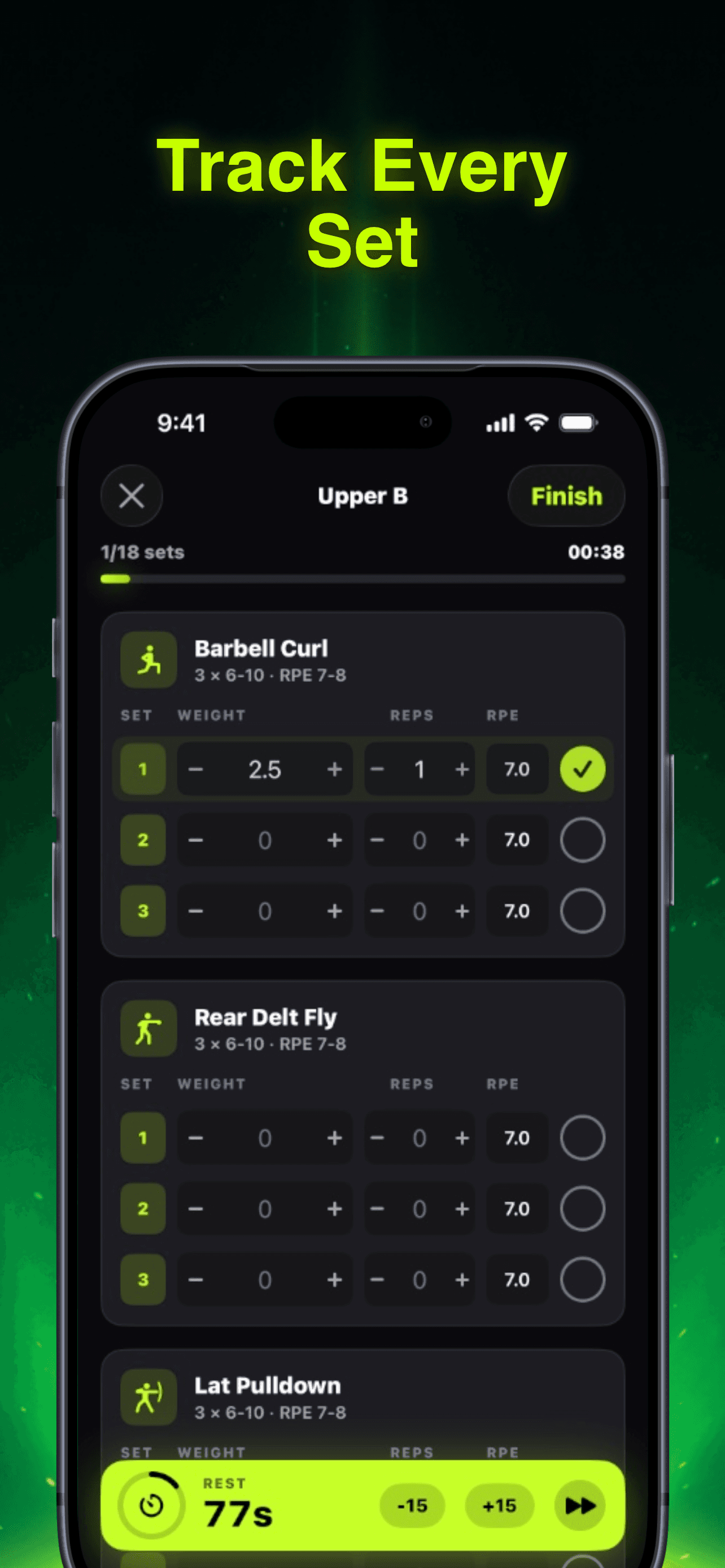
Photo by RepBro.
You're three months into your program. Your bench press has jumped from 135 to 185 pounds, your squat from 185 to 225. Then it happens: the weight stops moving up. You miss reps. The bar feels heavier than it should. You've hit your first real plateau.
Most lifters think progressive overload means one thing: add more weight to the bar. But that's just one tool in a much larger toolkit. Progressive overload schemes that don't rely on adding weight include increasing volume (more sets or reps), improving training density (less rest between sets), raising frequency (more sessions per week), expanding range of motion, or extending time under tension. These methods become essential when strength gains slow, equipment limits you, or you're working around injuries.
Here are five proven progressive overload schemes that work without touching the weight plates.
Volume Progression: The Most Reliable Method
Volume progression means doing more total work at the same weight. You can add sets, add reps, or both. This is the most researched and reliable form of progressive overload after load increases.
Start with rep progression within a set range. If your program calls for 3 sets of 8-12 reps, work from 3x8 to 3x12 before adding weight. When you can hit 3x12 with good form, you've earned the right to increase load and drop back to 3x8.
Set progression works when rep ranges get unwieldy. Instead of pushing from 3x12 to 3x15 (which shifts toward endurance), add a fourth set and work back up through the rep range. Go from 3x12 to 4x8, then progress to 4x12.
The math is simple: 3x12 = 36 total reps. 4x8 = 32 reps initially, but 4x12 = 48 reps at completion. You've increased weekly volume by 33% without adding a single plate.
Volume progression works because muscle growth responds primarily to total weekly volume. Research consistently shows that higher volumes drive greater hypertrophy, assuming you can recover from the work.
Density Training: Do More in Less Time
Density progression means completing the same work in less time. This creates a different training stimulus and can break through plateaus when straight volume increases stall.
The simplest approach: reduce rest periods systematically. If you normally rest 3 minutes between sets, drop to 2:45 this week, 2:30 next week, and so on until you reach a minimum effective rest (usually 90 seconds for compound movements, 60 seconds for isolation work).
Cluster sets offer another density option. Instead of doing 3x10 with 3-minute rests, do 6x5 with 90-second rests. Same total volume, higher training density. Your cardiovascular system works harder, and you maintain higher average intensity throughout the session.
Time-based circuits maximize density. Set a 15-minute timer and see how many rounds of a 3-exercise circuit you can complete. Next session, try to beat that number. You're adding volume while improving work capacity.
Density training improves your ability to handle volume and can reveal strength reserves you didn't know existed. When you go back to longer rest periods, the original weights often feel lighter.
Frequency Manipulation: Train More Often
Frequency progression means hitting the same muscle groups or movements more often each week. This works through multiple mechanisms: more practice with movement patterns, higher weekly volume distribution, and improved recovery between sessions.
The Bulgarian method takes this to an extreme, training the same lifts daily. Most lifters don't need that approach, but the principle scales down. If you squat once per week, try twice. If you train chest twice per week, try three times with lower per-session volume.
Frequency works best with submaximal loads. Instead of one brutal chest session per week, split that volume across three easier sessions. You'll likely find you can handle more total weekly volume this way.
Movement-specific frequency helps with skill acquisition. If your bench press technique breaks down under load, more frequent practice at 80-85% can improve motor patterns without the fatigue of maximum attempts.
Research supports frequency for both strength and hypertrophy. Higher frequency training often produces superior results compared to lower frequency with the same weekly volume, particularly for compound movements.
Range of Motion Progression
Range of motion (ROM) progression means gradually increasing how far you move the weight through space. This works because muscles are stronger at different joint angles, and full ROM generally produces better hypertrophy outcomes.
Deficit work is the most common approach. Elevate your feet for push-ups, stand on plates for Romanian deadlifts, or use a deeper bench position for dips. These variations stretch the target muscles further and create new adaptation demands.
Pause reps eliminate the stretch reflex and force you to generate strength from dead stops. Add 2-second pauses at the bottom of squats, bench presses, or rows. The same weight becomes significantly more challenging.
1.5 reps combine full and partial ROM within the same rep. For squats, descend fully, come halfway up, descend again, then complete the full rep. This increases time under tension and challenges muscles through multiple joint angles.
Tempo manipulation affects ROM indirectly. Slow eccentrics (3-5 seconds down) increase time under tension in the stretched position, where muscles are most vulnerable and adaptation is greatest.
Time Under Tension: Slow Down to Speed Up
Time under tension (TUT) progression means controlling lifting tempo to increase how long muscles work per set. This creates mechanical stress without requiring heavier loads.
Eccentric emphasis is the most effective TUT method. The lowering portion of each rep is where muscles can handle the most load and where microscopic damage (a hypertrophy signal) occurs most readily. Try 4-second negatives on any exercise.
Isometric holds add TUT at specific joint angles. Hold the bottom of a squat for 5 seconds, pause at the top of a pull-up, or maintain tension at the peak contraction of a bicep curl. These holds target weak points and improve strength at specific positions.
Tempo prescriptions give you precise control. A 3-1-2-1 tempo means 3 seconds down, 1-second pause, 2 seconds up, 1-second pause. The same 10 reps now take 70 seconds instead of 30.
TUT methods work because they increase metabolic stress, one of the three primary drivers of muscle growth alongside mechanical tension and muscle damage.
How to Choose Your Progressive Overload Scheme
Different schemes work better for different goals and situations. Volume progression suits hypertrophy-focused lifters with good recovery. Density training helps when time is limited. Frequency manipulation works for skill development and breaking plateaus. ROM progression targets weak points. TUT methods create new stimuli when other approaches stall.
Your equipment situation matters too. Home gym lifters with limited plates benefit most from volume, frequency, and TUT progressions. Commercial gym users can leverage any method but might prefer density training during busy hours.
Start with volume progression—it's the most straightforward and well-researched. When that stops working, layer in one additional method rather than trying multiple schemes simultaneously.
The key insight: progressive overload isn't about the weight on the bar. It's about consistently challenging your body in new ways. These five schemes ensure you never run out of ways to progress, whether you're training in a fully equipped gym or your garage with a single pair of dumbbells.
Try one new progressive overload scheme in your next training session. Your muscles don't care if the challenge comes from heavier weight or smarter programming—they just respond to the demand you place on them.
Frequently asked questions
- What is progressive overload without adding weight?
- Progressive overload without adding weight includes increasing volume (more sets/reps), improving density (less rest), raising frequency (more sessions), expanding range of motion, or extending time under tension. These methods challenge muscles in new ways when weight increases stall.
- Which progressive overload method works best for muscle growth?
- Volume progression (adding sets or reps) is the most reliable method for hypertrophy after load increases. Research shows muscle growth responds primarily to total weekly volume, making this the go-to choice for size gains.
- How do you progress when you can't add more weight?
- Progress by manipulating training variables: add reps (8 to 12), add sets (3x12 to 4x8), reduce rest periods (3 minutes to 2 minutes), increase frequency (once to twice per week), or slow down tempo (4-second negatives).
- Does training density improve strength?
- Yes, density training (doing more work in less time) can improve strength by enhancing work capacity and revealing strength reserves. When you return to longer rest periods, the original weights often feel lighter.
- How often should you change progressive overload methods?
- Start with volume progression and use it until gains stall (typically 4-8 weeks). Then add one additional method rather than changing completely. Avoid using multiple new schemes simultaneously to track what's working.