Minimalist Training: Two Lifts a Day, Real Results
A practical minimalist training program: two compound lifts per session, 4 days/week, exact sets/reps, progression rules, substitutions, and who should avoid it.
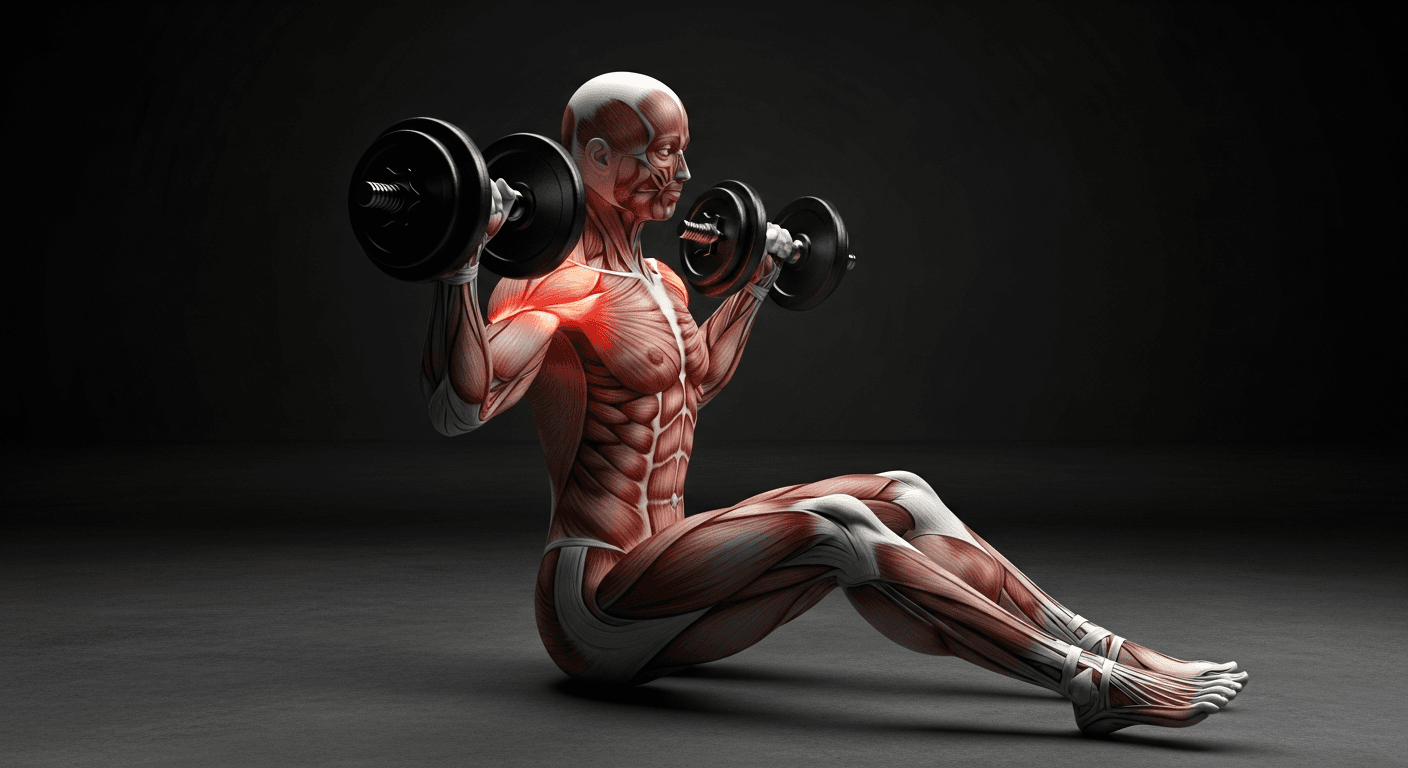
Photo by RepBro.
Yes—"minimalist training" that limits each workout to two main lifts, done consistently with progressive overload, produces real improvements in strength, work capacity, and muscle mass for most non-elite trainees. Below is a concrete, evidence-aware 4×/week program, the logic for exercise choice, exact progression rules, and who should not use it.
What does a 2-lifts-a-day minimalist week look like?
This plan is 4 workouts per week (Mon/Tue/Thu/Fri). Each session has one primary strength lift (low reps, heavier) and one secondary compound lift (moderate reps, volume). Total workout time: 30–50 minutes.
Week layout
-
Monday — Lower A
- Back squat: 5 sets × 5 reps (5x5)
- Romanian deadlift: 3 sets × 8 reps (3x8)
-
Tuesday — Upper A
- Bench press: 5 × 5
- Bent-over row (barbell or dumbbell): 3 × 8
-
Thursday — Lower B
- Deadlift (conventional or trap bar): 5 × 3
- Front squat or goblet squat: 3 × 6
-
Friday — Upper B
- Overhead press: 5 × 5
- Chin-up or lat pulldown: 3 × 6–10
Optional: 2–3 short accessory sets after the secondary lift for core or unilateral balance (e.g., 2×10 single-leg RDLs, 2×15 plank/side plank variations).
Adjustments for time or equipment: substitute barbells with dumbbells or kettlebells (e.g., goblet squat for front squat; single-arm dumbbell press for OHP). Track the program in RepBro and import routines using https://www.repbro.app/import if you want to automate progression and logging.
Why two compound lifts per session? What's the selection logic?
- Prioritize multi-joint, high-return movements: squats, deadlifts, presses, rows, and pull-ups. These move the most load and transfer to daily life and strength.
- Pair one lower and one upper or one heavy and one moderately voluminous lift to spread fatigue and keep sessions short.
- Keep accessory work minimal and purposeful: single-leg or anti-rotation core work if needed, not long isolation circuits.
- Choose variations to protect joints or fit equipment: if you have knee pain with back squats, use front squats or goblet squats; if barbells aren’t available, choose heavy dumbbell alternatives.
Goal: maintain high mechanical tension and frequency without high session volume.
How do I progress week to week?
Progression rules (concrete):
- Linear progression first: increase load each session until you miss the prescribed reps on the final set.
- Lower-body primary lifts (squat/deadlift): add 2.5–5 kg (5–10 lb) when you complete all working sets and reps.
- Upper-body primary lifts (bench/OHP): add 1.25–2.5 kg (2.5–5 lb).
- Secondary lift progression: increase reps within the target range first. When you hit the top rep across all sets twice, increase load by the smallest practical increment (e.g., 1–2.5 kg/2–5 lb).
- Auto-regulation rule: if you miss the target reps for the primary lift two sessions in a row, reduce load by ~10% (or drop one 5 kg/10 lb step), recover for that session, and resume progression.
- When linear gains stop consistently, switch to a 3–6 week block structure: 3 weeks of progressive loading (intensity up) then 1 week of lighter volume (deload/recovery), or use RPE targets (primary lifts at RPE 7–9, secondaries at RPE 6–8).
Rest and tempo
- Rest 2–5 minutes between heavy primary sets. Rest 60–90 seconds between secondary sets. Control eccentric tempo (2–3 seconds) on secondaries for tension.
What about form and safety cues?
- Warm up with 5–10 minutes of light cardio and specific movement warm-ups (empty bar sets, mobility for targeted joints).
- Use progressive warm-up sets for the primary lift until you reach working weight.
- Stop and seek professional help if you feel sharp or unusual joint pain—do not push through sharp pain. This article does not diagnose or prescribe treatment.
Who is this minimalist approach not right for?
- Competitive athletes needing high-skill, high-volume, or highly specific conditioning (e.g., Olympic lifters, bodybuilders in contest prep). They require more exercise variety and session frequency.
- People with uncontrolled or acute injuries and those under clinical rehabilitation supervision—follow a clinician's program instead.
- Trainees whose sole goal is extreme hypertrophy and who need >10–20 weekly sets per muscle; minimal two-lift days limit per-muscle volume and may be insufficient.
- Absolute novices who lack basic movement competency and cannot safely perform barbell/dumbbell patterns; they should start with supervised coaching or a beginner-focused skills phase.
How do I know it’s working?
Track 4 objective markers: training load (weight × reps), consistency (attendance), performance on primary lifts (are the numbers rising?), and how you feel (sleep, energy, soreness). If training load increases over 6–8 weeks and you’re recovering between sessions, it’s working. If not, adjust frequency, volume, or recovery.
What are simple substitutions for busy schedules?
- Only 3 days/week available: do Lower A, Upper A, and a combined Lower B+Upper B session (primary lift + one secondary) and rotate the extra lifts across weeks.
- Travel or limited equipment: do goblet squats, single-leg RDLs, push-ups (weighted if possible), and rows (band or single-arm). Keep the two-lift structure.
One safety note on form: always prioritize technique—stop if you experience sharp pain and consult a qualified professional for persistent issues.
Final takeaway: Two focused compound lifts per session, done four times a week with clear progression, will deliver measurable strength and conditioning improvements for most time-crunched trainees—unless your goals require much higher volume, sport specificity, or clinical supervision.
Frequently asked questions
- How long should each two-lift session take?
- Plan for 30–50 minutes: 15–30 minutes for the primary lift (warm-up + 3–6 working sets) and 10–20 minutes for the secondary lift plus a short accessory or mobility finish.
- Can beginners use this two-lift approach?
- Yes—if they can perform the basic movement patterns with safe technique. Beginners should prioritize coaching on movement quality and use conservative progression (smaller jumps in load).
- What if I can only train three days a week?
- Use the same lifts but combine a Lower and Upper session into one 'full-body' day (primary lift + secondary lift) and rotate through the four-session plan across two weeks.