How to Plan a Workout Week from Scratch (Step-by-Step Framework)
Learn how to plan a workout week tailored to your schedule, goals, and recovery needs. A systematic approach to building weekly splits that actually work for your lifestyle.
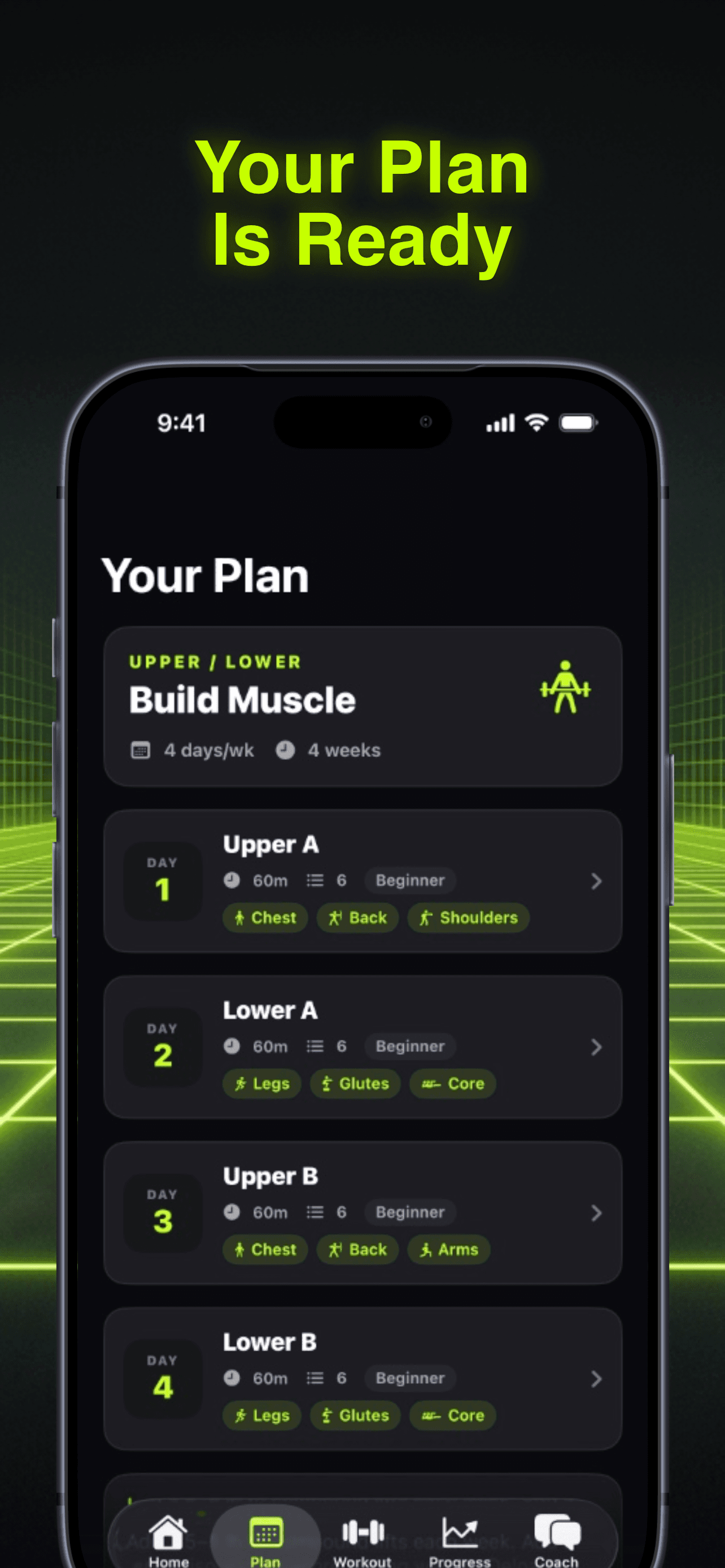
Photo by RepBro.
Most lifters approach workout planning backwards. They grab a template from Reddit, follow it for three weeks, then wonder why they're burned out or missing sessions.
Here's how to plan a workout week from scratch: Start with your available days and recovery capacity, assign muscle groups based on training frequency research (2-3x per week for most muscles), then structure sessions around compound movements. This systematic approach creates a sustainable weekly schedule that fits your life instead of fighting it.
The difference between a good plan and a great one isn't the exercises. It's whether you can execute it consistently for months.
Step 1: Map Your Real Schedule
Before touching a single exercise, audit your actual availability. Not your ideal schedule—your real one.
Count your available training days per week. Include commute time, shower time, and a 15-minute buffer for life happening. If you can realistically train 4 days but plan for 6, you're setting up failure.
Consider these schedule factors:
- Work demands: Are Mondays always chaotic? Plan lighter sessions or rest days.
- Social commitments: Friday night plans conflict with Saturday morning deadlifts.
- Energy patterns: Are you a morning person or do you peak at 6 PM?
- Recovery needs: How do you feel training consecutive days versus alternating?
I learned this the hard way. My first "perfect" 6-day program lasted exactly 11 days because I didn't account for my Tuesday evening meetings.
Write down your available slots before moving to step 2. Be honest about what you can sustain for 12 weeks, not 12 days.
Step 2: Determine Training Frequency Per Muscle Group
Research consistently shows that training each muscle group 2-3 times per week optimizes growth and strength gains. Higher frequencies work better than once-weekly "bro splits" for most lifters.
Here's how to distribute frequency based on your available days:
3 Days Per Week:
- Full body each session
- Hit every major muscle group 3x per week
- Focus on compound movements
4 Days Per Week:
- Upper/lower split (2x per week each)
- Or push/pull/legs + one repeat session
- Each muscle group trained 2x per week
5-6 Days Per Week:
- Push/pull/legs repeated
- Or upper/lower with additional specialization day
- Most muscle groups hit 2-3x per week
The key insight: more days doesn't automatically mean better results. Consistency at lower frequency beats sporadic high-frequency training.
Step 3: Assign Primary Movement Patterns
Every effective workout week needs these movement patterns distributed across your sessions:
- Horizontal push (bench press, push-ups)
- Vertical push (overhead press, dips)
- Horizontal pull (rows, reverse flies)
- Vertical pull (pull-ups, lat pulldowns)
- Knee-dominant (squats, lunges)
- Hip-dominant (deadlifts, hip thrusts)
Don't try to cram every pattern into every session. Distribute them based on your split:
Full Body Example:
- Session A: Squat, bench, row, overhead press
- Session B: Deadlift, pull-up, dip, lunge
- Session C: Front squat, incline press, lat pulldown, hip thrust
Upper/Lower Example:
- Upper: Bench, row, overhead press, pull-up, dips
- Lower: Squat, deadlift, lunge, hip thrust, calf raise
Step 4: Structure Individual Sessions
Each workout should follow this basic template:
- Warm-up (5-10 minutes): Dynamic movement, activation exercises
- Primary lift (15-20 minutes): Your heaviest, most demanding exercise
- Secondary lifts (20-25 minutes): Supporting movements, moderate intensity
- Accessories (10-15 minutes): Isolation work, weak point targeting
- Cool-down (5 minutes): Light stretching, mobility
Keep total session time realistic. Most lifters can sustain 45-75 minute workouts. Longer sessions often mean either too much volume or too much rest between sets.
Order exercises from most to least demanding. Deadlifts before bicep curls, not the other way around.
How Many Sets Per Muscle Per Week?
Volume guidelines based on current research:
- Beginners: 8-12 sets per muscle per week
- Intermediate: 12-18 sets per muscle per week
- Advanced: 16-24+ sets per muscle per week
These are working sets at appropriate intensity (RPE 6-9). Warm-up sets don't count.
Start conservative. You can always add volume. You can't always recover from too much.
Step 5: Plan Recovery and Deload Weeks
Your workout week isn't just about training days. Recovery is when adaptation happens.
Between Sessions:
- Minimum 48 hours between training the same muscle group intensely
- Sleep 7-9 hours per night consistently
- Manage stress outside the gym
Weekly Structure:
- Include at least one complete rest day
- Consider active recovery (walking, light yoga, mobility work)
- Don't train more than 3 consecutive days without a break
Monthly Planning:
- Every 4th week, reduce volume by 40-50% (deload week)
- Maintain intensity but cut sets and exercises
- Use deload weeks to work on technique and mobility
Step 6: Test and Adjust Your Plan
No plan survives first contact with real life. Build in flexibility from day one.
Track these metrics for your first month:
- Completion rate: Are you hitting your planned sessions?
- Recovery quality: How do you feel between workouts?
- Performance trends: Are your lifts progressing or stagnating?
- Motivation levels: Do you look forward to training or dread it?
Common adjustments:
- Too tired: Reduce volume or frequency
- Bored: Add exercise variety or change rep ranges
- Missing sessions: Simplify the plan or reduce frequency
- Not progressing: Check if you're actually challenging yourself
The best workout week is the one you'll actually follow for months, not the most "optimal" one on paper.
Making It Stick: Your Next Steps
Planning a workout week from scratch takes 30 minutes of honest thinking. Following it consistently takes discipline and the right tools.
Start with your real schedule, not your ideal one. Pick a frequency you can sustain. Focus on movement patterns over specific exercises. Plan for recovery as seriously as you plan for training.
The framework works, but execution is everything. Having a system that adapts to your daily reality—whether you're feeling strong or beat up, whether you have 45 minutes or 75—makes the difference between a plan that works and one that works for you.
Frequently asked questions
- How many days per week should I work out?
- Start with what you can realistically sustain. 3-4 days per week is optimal for most people, allowing adequate recovery while hitting each muscle group 2-3 times. More isn't always better if it leads to inconsistency or burnout.
- Should I train the same muscle groups every day?
- No. Each muscle group needs 48-72 hours to recover between intense training sessions. Full body workouts 3x per week or upper/lower splits work better than training the same muscles daily.
- How do I know if my workout plan has too much volume?
- Signs of excessive volume include: consistently feeling tired, declining performance over weeks, poor sleep quality, or dreading workouts. Start with 8-12 sets per muscle per week and increase gradually.
- What's the difference between a beginner and intermediate workout plan?
- Beginners need less volume (8-12 sets per muscle weekly) and should focus on learning movement patterns. Intermediates can handle more volume (12-18 sets) and exercise variety while requiring more structured progression.
- How often should I change my workout routine?
- Stick with a well-designed plan for 8-12 weeks before making major changes. You can adjust exercises or rep ranges every 4-6 weeks, but changing too frequently prevents you from tracking progress effectively.