Wall Sit Alternatives at Home (Minimal Equipment)
Four to five at-home wall sit alternatives using bodyweight, dumbbells, or bands. What each preserves and loses versus the wall sit, plus when to train at home and when to use a gym.
Photo by RepBro.
You can replace wall sits at home with a few low-equipment options that preserve quad isometric stress and time-under-tension: goblet squat holds, stationary lunge holds, Bulgarian split-squat holds/movement, band-resisted squat holds, and slow tempo squats. Pick the swap based on whether you want endurance, unilateral strength, or progressive load.
What does a wall sit actually train?
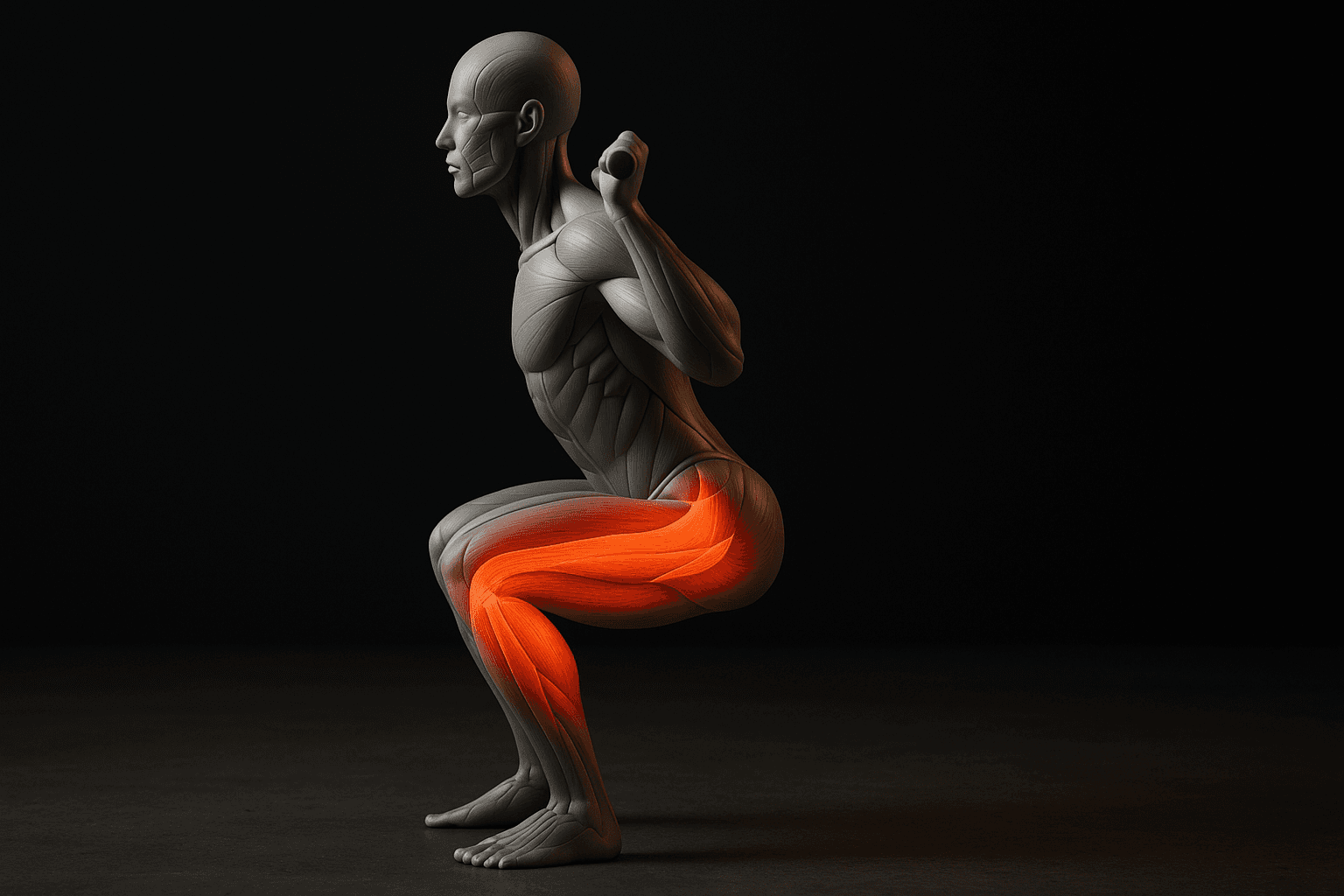
A wall sit is an isometric knee- and hip-flexion hold that primarily loads the quadriceps and to a lesser degree the glutes and hamstrings. It emphasizes muscular endurance and joint-specific tolerance at a fixed knee angle, requires little balance, and keeps spinal load low because the back is supported.
Which at-home alternatives require minimal equipment and what do they keep or lose versus the wall sit?
Below are 5 practical options. For each I note what it preserves from the wall sit, what it adds or loses, and when to pick it.
- Goblet squat hold (dumbbell or kettlebell)
- What it preserves: Isometric quad tension and knee-angle stress when held at the midway position (about 90° knee flexion). Time-under-tension remains similar.
- What it adds: Easy progressive loading by increasing weight; upright torso demands core stability; more posterior chain involvement than a wall sit.
- What it loses: Back support and pure isolation of quads; balance/stability requirement increases.
- When to pick it: Use when you want a straightforward way to increase load beyond bodyweight and train standing posture.
- Stationary lunge or split‑stance hold (bodyweight or dumbbell)
- What it preserves: Isometric/quasi-isometric quad and hip endurance, but unilaterally; similar knee-angle stress on one leg.
- What it adds: Single-leg loading improves balance, addresses side-to-side asymmetries, and increases glute/hamstring demand.
- What it loses: Symmetric bilateral isolation of the quads; if you need pure bilateral quad endurance, it’s a different stimulus.
- When to pick it: When addressing imbalances or when you want stronger unilateral control and functional strength.
- Bulgarian split-squat (slow eccentrics or isometric hold; bodyweight or dumbbell)
- What it preserves: Can replicate the knee angle and hold duration if you pause at the bottom; high time-under-tension for quads.
- What it adds: Larger concentric/eccentric component, greater hip mobility challenge, and more potential for heavy loading with dumbbells.
- What it loses: The pure static, supported nature of a wall sit; more technical and balance-dependent.
- When to pick it: When you want to progress from endurance to strength and hypertrophy while still using limited equipment.
- Banded squat hold or band-resisted wall sit substitute
- What it preserves: Constant tension similar to a wall sit; you can choose a band that keeps compressive force across the knee and hips.
- What it adds: Variable resistance through the range; easy to adjust intensity by using different bands or anchoring points.
- What it loses: Exact knee-angle specificity unless you pair the band with a fixed hold position.
- When to pick it: When you only have bands and want continuous tension with linear progression via band strength.
- Tempo (3–5s eccentrics) bodyweight squats or pausing at bottom
- What it preserves: Time-under-tension and metabolic demand; pausing at 90° matches wall-sit joint angle.
- What it adds: Eccentric loading that stimulates strength and hypertrophy pathways more than pure isometrics.
- What it loses: The static-only endurance-specific stimulus is diluted by movement unless many long pauses are used.
- When to pick it: When you want to develop both endurance and concentric/eccentric strength without added equipment.
How should I program these replacements? How many sets, reps, and frequency?
- Frequency: Train legs 2–3 times per week for most goals (strength, hypertrophy, or endurance). This matches broad strength and hypertrophy consensus.
- For endurance/isometric goals: perform multiple holds each session. Start with total time per leg or position around 60–180 seconds distributed across 3–6 sets; progress by increasing single-hold duration or total volume week-to-week.
- For strength/hypertrophy: use 2–4 sets of 6–12 reps with heavier load (goblet or dumbbells). For time-effective hypertrophy you can also use 8–20 rep ranges or slow tempo sets.
- Progressive overload: increase hold time, add load, increase reps, or reduce rest. Track numbers each session and only change one variable at a time.
- Deloads: include a lighter week after several weeks of progressive loading (commonly every 4–8 weeks, depending on fatigue and overall program).
Quick comparison: what do these alternatives emphasize compared to a wall sit?
| Exercise | Quad isometric stress | Progressive external load | Unilateral demand | Balance/mobility | Good replacement when... |
|---|---|---|---|---|---|
| Wall sit (baseline) | High | Low | Low | Low | You need joint-specific isometric endurance with back support |
| Goblet squat hold | High | High | Moderate | Moderate | You want load progression and upright posture work |
| Stationary lunge hold | Moderate | Moderate | High | Moderate–High | You need unilateral control and asymmetry work |
| Bulgarian split-squat | Moderate–High | High | High | High | You want to shift to strength/hypertrophy while using minimal equipment |
| Banded squat hold | Moderate | Moderate (via band) | Low–Moderate | Low | You only have bands and want continuous tension |
| Tempo/paused squats | Moderate | Low–Moderate | Moderate | Moderate | You want to combine endurance with concentric/eccentric strength |
When is a gym worth the trip instead of home alternatives?
Go to a gym when your goals require heavy bilateral loading (near-max barbell squats, heavy Bulgarian split-squats with barbells), specialized rehab protocols requiring precise external loads, or when you need machines that offload balance and isolate a joint in ways you can’t safely replicate. For general endurance, conditioning, hypertrophy up to moderate loads, home alternatives suffice.
Safety note
Stop any exercise immediately if you feel sharp joint pain. Use conservative progression for load and duration. If you have pre-existing knee, hip, or back issues, consult a qualified health or rehabilitation professional before doing isometrics or heavy unilateral work. This article is educational, not diagnostic.
Limitations: what apps and articles cannot do for you
No app or article can watch your movement and correct subtle form issues in real time. They cannot replace a qualified clinician for injury diagnosis or a trained coach for detailed technique correction. A plan only works if you consistently do the work; consistency outweighs platform choice. Use feedback from a coach or clinician when pain, asymmetry, or stalled progress appears.
Trackable metrics (sets, hold times, loads) are helpful—apps like RepBro can log them—but they don’t replace eyes-on coaching.
Summary If your goal is quad endurance and joint-specific tolerance, choose isometric holds (goblet hold, banded hold, long paused lunges). If you want to progress toward strength/hypertrophy, use goblet holds, Bulgarian split-squats, and slow-tempo reps with progressive load. Train legs 2–3 times per week, track load/time, and deload periodically. Return to a gym when you need heavier, more controlled external loading or formal rehab oversight.
Frequently asked questions
- Can I replace wall sits with other exercises at home and still train my quads?
- Yes. Several isometric and slow-tempo alternatives (e.g., goblet squat hold, split‑stance holds, banded squat holds) maintain quad time‑under‑tension and knee angle stress. Pick holds or slow reps that match the original duration and progress by increasing load, time, or reps.
- How often should I do these wall sit alternatives for strength or endurance?
- Train the legs 2–3 times per week. For endurance-style isometrics use longer holds (30–90+ seconds) and multiple sets; for strength/hypertrophy use heavier loading with 6–12 reps or 8–20 second isometric holds. Progress gradually and include a deload when performance drops.
- When are home swaps not enough and I should go to a gym?
- If you need maximal strength (near‑max barbell squats), very heavy unilateral loading, or specific rehab protocols requiring controlled external loads, a gym is preferable. Home alternatives handle endurance, general strength, and hypertrophy up to moderate loads.