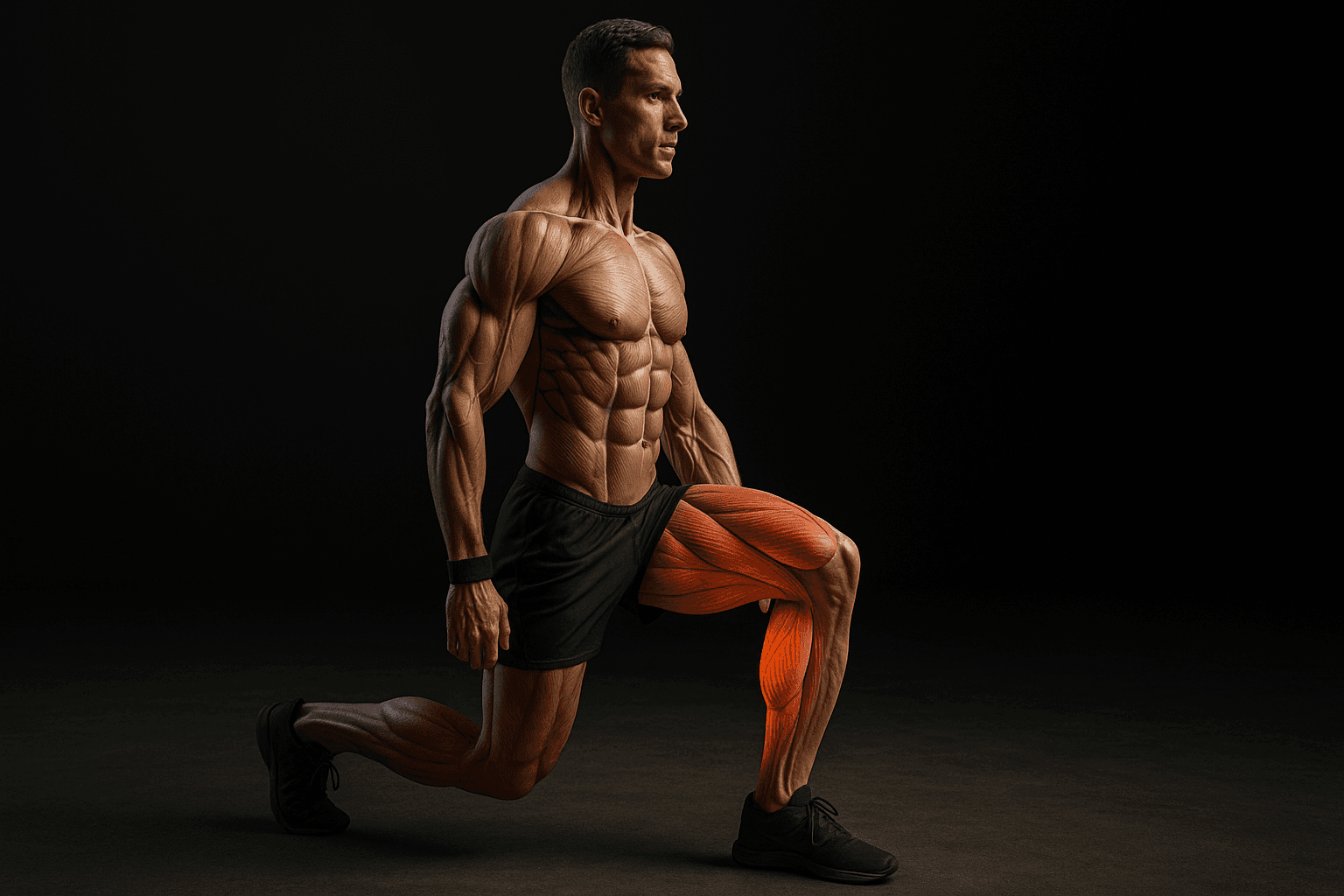
Walking Lunge Alternatives at Home (Minimal Equipment)
Five bodyweight, dumbbell, and band substitutes for walking lunges at home — what each keeps and loses compared to walking lunges, and when to return to the gym.
Photo by RepBro.
Walking lunges can be approximated at home using reverse lunges, Bulgarian split squats, stationary split squats, step-ups, or band-resisted alternating lunges. Each preserves unilateral loading and single-leg strength but trades off some stride mechanics, horizontal momentum, or balance specificity. Pick the substitute based on available load, balance needs, and training goal.
What practical at-home alternatives replicate walking lunges?
- Reverse lunge (bodyweight or dumbbell)
- Bulgarian split squat (rear-foot elevated, bodyweight or dumbbell)
- Stationary split squat (static lunge)
- Step-up (onto a stable chair, box, or bench) with dumbbells or bodyweight
- Band-resisted alternating lunge (loop or anchored band)
Each option only needs minimal equipment: a pair of dumbbells a loop band, or a sturdy elevated surface.
How does each alternative preserve and lose what walking lunges train?
| Exercise | Equipment | Preserves vs walking lunge | Loses vs walking lunge | When to pick it |
|---|---|---|---|---|
| Reverse lunge | Bodyweight/dumbbells | Good eccentric control of lead leg, less forward momentum; quad and glute loading | Less continuous forward step pattern and gait transfer | If you have limited space and want safer knee tracking |
| Bulgarian split squat | Bodyweight/dumbbells | High single-leg tension, vertical loading, large glute/quad stimulus | Reduced balance challenge of forward stepping; different hip angle increases hip extension demand | When you want maximal single-leg load with little space |
| Stationary split squat | Bodyweight/dumbbells | Good for balanced unilateral strength and technique work | No alternating gait; less transverse stability demand | For technical work and tempo control |
| Step-up | Bodyweight/dumbbells | Preserves concentric hip-drive and vertical force; low knee shear | Less eccentric lengthening and step-to-step balance challenge | When you want to overload with heavier dumbbells safely |
| Band-resisted alternating lunge | Loop or anchored band | Keeps alternating pattern, resistance curve can mimic forward step | Limited absolute load compared to barbells; band path differs from gravity | If you want walking pattern and limited equipment |
Which training qualities does a walking lunge emphasize and how do substitutes match them?
Walking lunges emphasize unilateral leg strength, eccentric control, hip extension, and dynamic balance across a forward step. Substitutes preserve unilateral strength and hip extension to varying degrees. Bulgarian split squats and step-ups allow higher absolute load per leg (useful for strength/hypertrophy); reverse and banded alternating lunges maintain more of the stepping pattern and balance demand.
How should I program these substitutes for strength or hypertrophy?
- Frequency: target the leg muscles 2–3 times per week, aligning with common resistance training recommendations for muscle growth and strength gains.
- Volume & load:
- Strength focus: 3–6 sets of 3–8 reps with heavier external load or harder progression (e.g., unilateral loaded step-ups, weighted Bulgarian split squats). Ensure long rest between sets.
- Hypertrophy focus: 3–4 sets of 6–20 reps per exercise, using tempos that include a controlled eccentric (1–3 s) and moderate rest. Adjust reps based on load availability.
- Progression options: add load (dumbbells, heavier band), increase sets/reps, change tempo (slow eccentrics), reduce stability (elevated platform or single-leg variations), or increase range of motion.
Keep a simple log and increase one variable at a time. If you track sets and reps, apps like RepBro can help you monitor progressive overload.
When is an at-home swap adequate versus when should I go back to the gym?
Choose a home alternative when: you lack gym access, need to maintain or modestly increase unilateral strength, or want a safe option with limited equipment. Consider the gym when you need: very high absolute loads (barbells/loaded barbells), long walking space for repeated walking lunges, or sport-specific transfer requiring true gait mechanics under load. If progress stalls for multiple weeks despite systematic overload and adequate recovery, gym access may provide the extra loading options you need.
What safety advice should I follow?
Stop any exercise that causes sharp or unusual pain. Prioritize controlled movement and knee tracking over depth. Use appropriate footwear and a stable surface for step-ups or Bulgarian split squats. If you have pre-existing conditions or recent injuries, consult a qualified health or fitness professional before progressing. This article does not diagnose or treat injuries.
What can't an app or AI coaching do for my lunge work?
- See or correct your movement patterns in real time — a human coach or in-person assessment is needed for nuanced form fixes.
- Replace individualized medical or rehabilitation care — injuries and post-op plans require licensed professionals.
- Guarantee results — adherence and progressive overload determine outcomes more than app choice.
Limitations
- No app or written guide can watch your form, feel your joint comfort, or perform a full medical screen. If exercises cause persistent pain or you’re rehabbing an injury, seek a qualified clinician.
- A plan only works if you do the work: consistency, recovery, nutrition, and progressive overload are the real drivers of adaptation.
Safety reminder
If you experience sharp pain, numbness, or signs of acute injury, stop and consult a qualified professional. Follow conservative progression and prioritize movement quality over load.
Acknowledgement
These alternatives are intended to help you maintain and progress unilateral leg strength at home with minimal equipment. Choose the substitute that matches your goal (balance/stability, strength, or hypertrophy) and use gradual overload to continue improving.
Frequently asked questions
- Can I replace walking lunges with at-home alternatives?
- Yes. Several at-home options (reverse lunges, Bulgarian split squats, stationary split squats, step-ups, band-resisted alternating lunges) can reproduce most loading, unilateral strength stimulus, and hypertrophy. They differ in balance demand, hip-drive mechanics, and carryover to gait, so choice depends on your goals and available load.
- How should I progress these at-home lunge alternatives?
- Progress by increasing load (dumbbells or band tension), adding reps or sets, changing tempo, or reducing stability (e.g., elevated surface). For hypertrophy use moderate reps with 2–4 sets; for strength use lower reps with heavier load. Track progression and aim for gradual overload every 1–3 weeks.
- When should I stop using substitutes and go back to the gym?
- If you need heavy bilateral loading, true walking-pattern carryover, or access to long bands/loaded barbells for higher absolute strength, return to the gym. Also consider a gym if your progress stalls despite systematic overload and adequate recovery at home.