Trap Bar Deadlift Alternatives at Home (Minimal Equipment)
Four practical at-home substitutes for the trap bar deadlift using bodyweight, dumbbells, or bands — what each keeps, what it loses, and when to visit a gym.
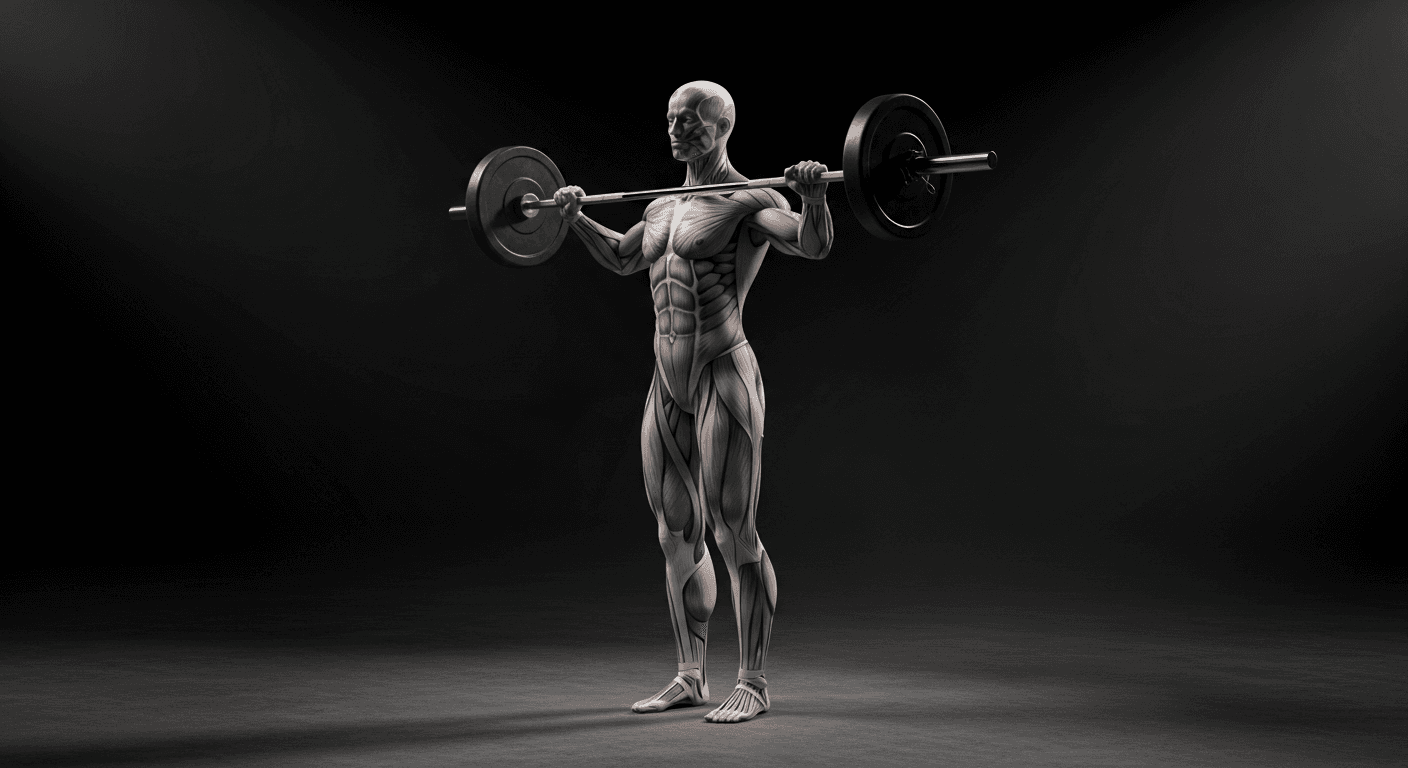
Photo by RepBro.
If you don't have a trap bar, you can safely substitute with heavy dumbbell deadlifts, Romanian deadlifts, suitcase deadlifts, band-resisted deadlifts, and single-leg RDLs. Each preserves hip-dominant loading and posterior-chain stimulus but differs in load ceiling, stability demands, and carryover to heavy strength.
What are practical trap bar deadlift alternatives with minimal equipment?
Here are four to five options that require only dumbbells, resistance bands, or bodyweight:
- Dumbbell double-deadlift (two dumbbells or one heavy hex/DB held centrally)
- Romanian deadlift (RDL) with dumbbells
- Suitcase deadlift / farmer-hold deadlift with dumbbells
- Band-resisted deadlift (bands anchored under feet or to a low anchor)
- Single-leg RDL (bodyweight or holding a dumbbell)
Each is described below with what it preserves and what it loses versus the trap bar.
How does each substitute compare to the trap bar deadlift?
| Exercise | Equipment | What it preserves | What it loses | When this swap is adequate | When go to a gym instead |
|---|---|---|---|---|---|
| Dumbbell double-deadlift (two DBs or single heavy DB) | Dumbbells | Vertical load path, hip extension, low back and quads involvement | Absolute load ceiling, near-max triple strength specificity | Building strength and size, progressing to moderate-heavy loads | When you need very heavy triples or max testing (>what your DBs permit) |
| Dumbbell RDL | Dumbbells | Hip hinge, hamstring/glute emphasis, technical carryover | Quadriceps drive and starting power from the floor if using light load | Improving posterior chain strength, hypertrophy, technique work | For very heavy, low-rep strength blocks needing barbell/trap bar |
| Suitcase deadlift | Dumbbells | Unilateral core demand, sturdy carryover to real-world lifts | Symmetrical loading and pure vertical center-of-mass position | Train unilateral strength and anti-rotation core | If you require symmetrical max strength testing |
| Band-resisted deadlift | Bands | Variable resistance, safe joint-friendly loading, hip extension | Less absolute top-end load and different force curve than barbell | Work capacity, technique, and progressive overload with limited gear | When needing consistent heavy concentric overload or barbell-specific carryover |
| Single-leg RDL (DB or BW) | Dumbbell or bodyweight | Unilateral strength, balance, hamstring/glute focus | Heavy bilateral loading and maximal strength | Mobility/imbalances, hypertrophy, unilateral control | For max bilateral strength development |
How should I program these alternatives for strength, size, and carryover?
- Frequency: Train the posterior chain movement 2–3 times per week for most lifters. Evidence supports multiple weekly exposures for strength and hypertrophy.
- Strength-focused sessions: Use heavier sets in the lower-rep range (e.g., sets of 3–6) when load permits; increase sets rather than reps to manage fatigue.
- Hypertrophy-focused sessions: Use 3–4 sets of 6–12 reps with controlled tempo and full range-of-motion.
- Progression: Increase load, reps, or sets weekly in small, planned increments. If equipment limits load, increase time under tension, slow eccentrics, or add band tension.
- Deloads: Schedule a lower-intensity week every 3–8 weeks depending on training volume, fatigue, and experience.
These programming points align with general sports-science guidance: multiple weekly exposures and progressive overload are key; manipulate intensity and volume based on goals.
Which substitute should I pick for my goal?
- Strength: Dumbbell double-deadlifts and heavy RDLs. If your dumbbells are heavy enough, prioritize lower-rep, higher-load sets. If not, use bands or tempo to increase difficulty.
- Hypertrophy: RDLs, single-leg RDLs, and controlled band deadlifts with higher reps and tempo.
- Athletic carryover and core anti-rotation: Suitcase deadlifts and single-leg variations.
- Rehab/progression from injury: Light band deadlifts and RDLs, focusing on pain-free range and tempo. Always coordinate with a clinician.
When is it time to go to a gym instead of using at-home swaps?
Go back to a gym when any of these apply:
- You need to train very heavy triples or maximal 1-rep attempts for strength progression and your home weights are insufficient.
- You need a trap bar or barbell for sport-specific transfer or testing (powerlifting-style load positions).
- Your progress stalls despite methodical progressive overload and you suspect the load ceiling is the limiter.
- You require professional coaching with hands-on cues or equipment not reasonably replicated at home.
What safety steps and common-sense rules should I follow?
Stop any set immediately if you feel sharp or unusual pain. Maintain neutral spine and a hip-hinge pattern for all deadlift variants. Use proper foot placement, bracing, and controlled eccentrics. Consult a qualified professional for persistent pain or when returning from injury. No content here diagnoses or guarantees injury prevention.
What are the limitations of apps and remote guidance?
No app or AI can see your live form, feel fatigue, or replace a qualified coach for hands-on correction. They also can't diagnose medical conditions. A plan only works if you show up; consistency outweighs app choice. For rehabilitation or complex movement errors, seek in-person assessment.
If you track sets and progressive overload with a phone app, one option to record sessions is RepBro, which makes logging simple and portable.
Limitations: This guide summarizes exercise substitutions and general programming. It is not a medical or rehabilitation prescription. For painful conditions, recent surgery, or complex movement dysfunction, consult a licensed healthcare professional or qualified strength coach.
Safety reminder: Stop on sharp pain; if unsure about an exercise, get an in-person assessment. Follow progressive overload and planned deloads to manage fatigue and recovery.
Frequently asked questions
- Can I effectively replace trap bar deadlifts at home?
- Yes—temporarily. With dumbbells, bands or bodyweight you can preserve hip-dominant movement, posterior chain stimulus, and progressive overload up to a point. For maximal loading, peak strength testing, or heavy triple work you likely need gym equipment like a trap bar or barbell.
- Which at-home exercise most closely mimics the trap bar deadlift?
- A heavy dumbbell or two-dumbbell Romanian/hex-style deadlift most closely matches trap bar mechanics because it keeps the load close to the body and encourages a more upright torso than the conventional barbell deadlift, while still loading hip extension and the quads to some degree.
- How often should I train these alternatives for strength gains?
- Train the posterior-chain movement 2–3 times per week with a mix of heavy (>~4 reps) and moderate-volume (6–12 reps) sessions. Use progressive overload, planned deloads, and monitor recovery; adjust frequency if performance or recovery suffers.