Seated Cable Row: Proper Form, Step by Step
Definitive seated cable row form guide: setup, execution cues, breathing, tempo, common mistakes and fixes. Safety-first tips for pain and progress.
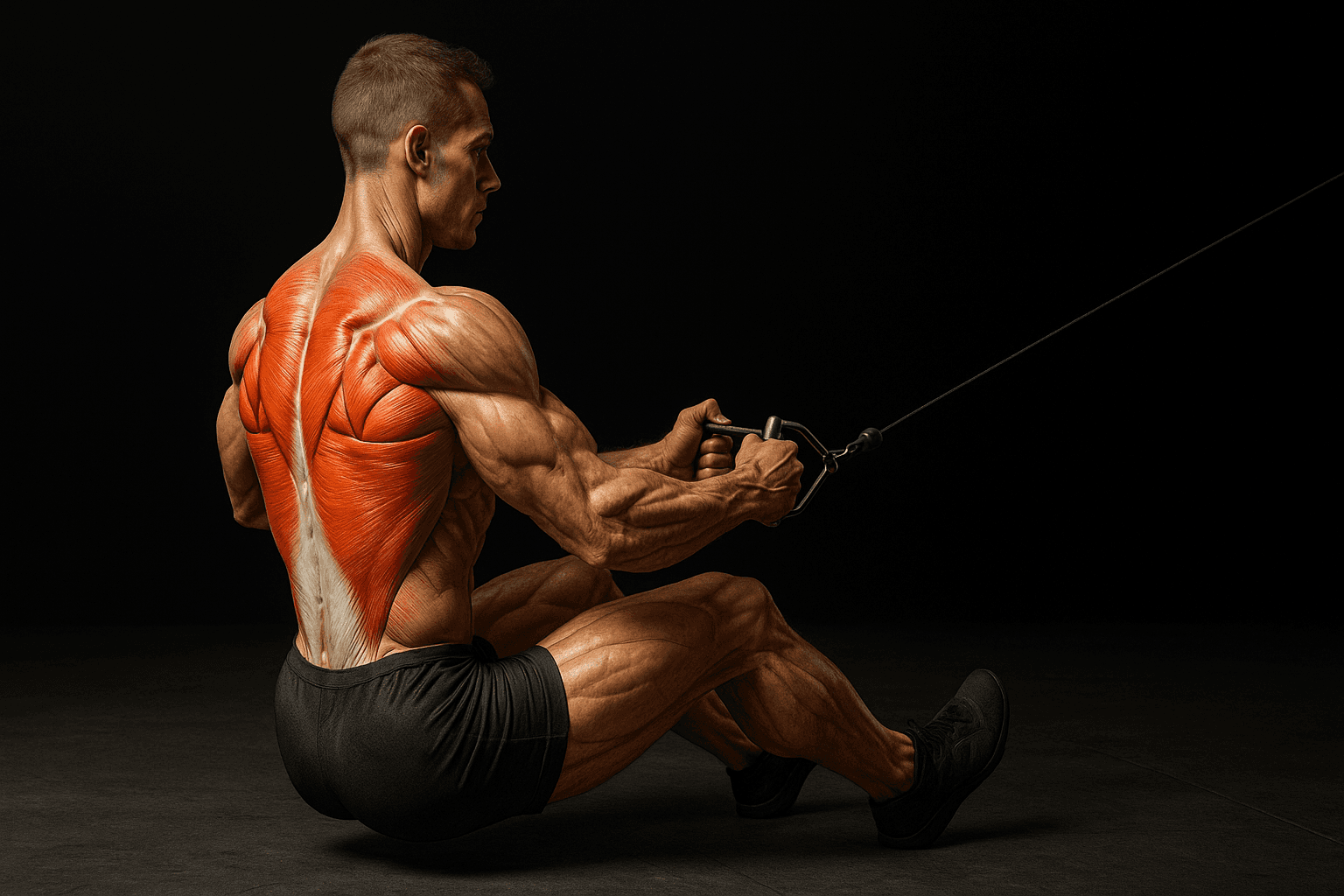
Photo by RepBro.
The shortest answer: proper seated cable row form is a controlled horizontal pull from a stable upright torso, initiating the movement by retracting the shoulder blades, pulling the handle to the lower ribs while keeping the chest up, and returning under control—exhale on the pull, inhale on the return. Use a weight you can move for clean reps with a tempo of roughly 2-1-2.
How do I set the machine up before I pull?
- Choose the handle: close neutral grip (V-bar) or straight bar are most common. Use a wide grip for more rear-delt emphasis.
- Seat and chest pad: set the seat so that your feet are flat on the footplate and legs are slightly bent (10–20°). If there is a chest pad, position it so you can reach the full row without hitting the pad prematurely.
- Handle height: the pulley should be at the lowest position or aligned with your feet so the cable runs horizontal when you sit upright.
- Weight selection: pick a load you can control for your target rep range—start light and add weight once you can do 2 extra reps for 2 consecutive workouts.
How do I sit and brace for a safe pull?
- Sit tall with a neutral spine: maintain the natural curves of your lower back—no rounding or excessive arching.
- Scapula set: shrug your shoulders up and then pull them back and down into a slightly packed position before the first rep. This shortens the distance you need to retract on the pull and protects the shoulder joint.
- Chest and head: keep your chest up and a neutral head/neck line—eyes forward or slightly down.
- Grip and arms: take the handle with a firm grip; elbows start extended but not locked.
What is the step-by-step execution?
- Setup: sit, brace the core, set scapula as above. Count “Start.”
- Initiate: pull the elbows back toward your hips by squeezing the shoulder blades together—think "elbows to the hips," not "hands to the chest." (1–2 second focus.)
- Finish: stop when the handle contacts the lower ribs or just below the sternum; hold 1 second and squeeze the mid-back. Avoid flaring the ribs or leaning back more than 10–15°.
- Return: extend the arms forward slowly and under control, letting the shoulder blades protract to the start position. Do not collapse the torso.
- Breathing: exhale during the concentric pull, inhale during the eccentric return.
- Tempo: aim for a 2-1-2 tempo—2 seconds to pull, 1 second hold/squeeze, 2 seconds to return.
What cues help maintain good technique?
- "Chest up, eyes forward."
- "Elbows to hips, not out." (limits shoulder flare)
- "Squeeze your shoulder blades together."
- "Keep a neutral spine; no bum-shoving back-and-forth." Use a light touch with the lower body—feet provide a base but legs shouldn’t drive the movement.
What are common mistakes and how do I fix them?
Mistake: Rounding the lower back.
- Fix: Reduce weight, sit taller, brace core, and use a shorter range of motion until you can maintain neutral spine for all reps.
Mistake: Leaning back excessively and turning it into a row-row-swing.
- Fix: Limit torso lean to 10–15°. Use a slower tempo and focus on scapular retraction and elbow travel rather than body momentum.
Mistake: Pulling with the arms and shrugging the shoulders.
- Fix: Start each rep by pulling the shoulder blades together; cue "elbows drive back" and imagine trying to pinch a penny between your shoulder blades.
Mistake: Letting the shoulders roll forward on the return.
- Fix: Control the eccentric phase and allow the scapulae to protract under control; don’t drop the chest.
Mistake: Using too heavy a weight (cheating with momentum).
- Fix: Drop 10–30% of the weight and focus on 8–12 strict reps with the 2-1-2 tempo.
How should I progress and program the seated cable row?
- Reps/sets: For hypertrophy, use 3–4 sets of 8–12 reps. For strength, 3–5 sets of 4–6 reps.
- Load progression: add 1–2.5–5 kg (2–5 lb) when you can do 2 more reps than your goal for two workouts in a row.
- Frequency: 1–3 times per week depending on volume split. Combine with vertical pulls (pulldowns/chin-ups) for balanced back development. For comparing movements and building plans, see RepBro and read comparisons at https://www.repbro.app/vs.
What are the safety notes?
- Stop immediately if you feel sharp or shooting pain; consult a qualified health professional.
- If you have unresolved shoulder, neck, or lower-back issues, seek professional guidance before loading this exercise. This article does not diagnose conditions.
Short FAQ
Q: Should I use a V-bar or straight bar? A: Use a V-bar (neutral grip) for more lat and middle-trap emphasis with less shoulder strain; choose a straight bar for a slightly wider upper-back cueing. Pick the one that feels stable and pain-free.
Q: Can I row standing? A: Standing rows are a different pattern (more posterior chain and core involvement). Use the seated cable row to prioritize horizontal pull strength and mid-back control.
Q: What if I can’t feel my back working? A: Reduce the weight and slow the tempo. Focus on scapular retraction and elbow travel rather than arm bending.
One-sentence takeaway: The seated cable row works best when you prioritize a stable upright torso, initiate with scapular retraction, pull elbows to the lower ribs on a controlled 2-1-2 tempo, and stop if you feel sharp pain.
Frequently asked questions
- How many reps and sets should I do for the seated cable row?
- For strength, use 3–5 sets of 4–6 reps with heavier loads; for size and general back development, 3–4 sets of 8–12 reps. Choose a weight you can control with strict form for the target rep range.
- Should my knees be locked during the seated cable row?
- No. Keep a soft bend in the knees (about 10–20 degrees) to avoid hyperextension and to provide a stable base. Knees should not move actively during the pull.
- Where should I feel the seated cable row?
- You should feel the work primarily across the mid-back (rhomboids, middle trapezius) and the latissimus dorsi, plus the rear delts. Stop and consult a professional if you feel sharp pain or nerve-like symptoms.