Seal Row: Which Muscles It Trains and Practical Alternatives
Clear overview of which muscles the seal row trains, how to program it, and practical alternatives when equipment or injury changes your choices.
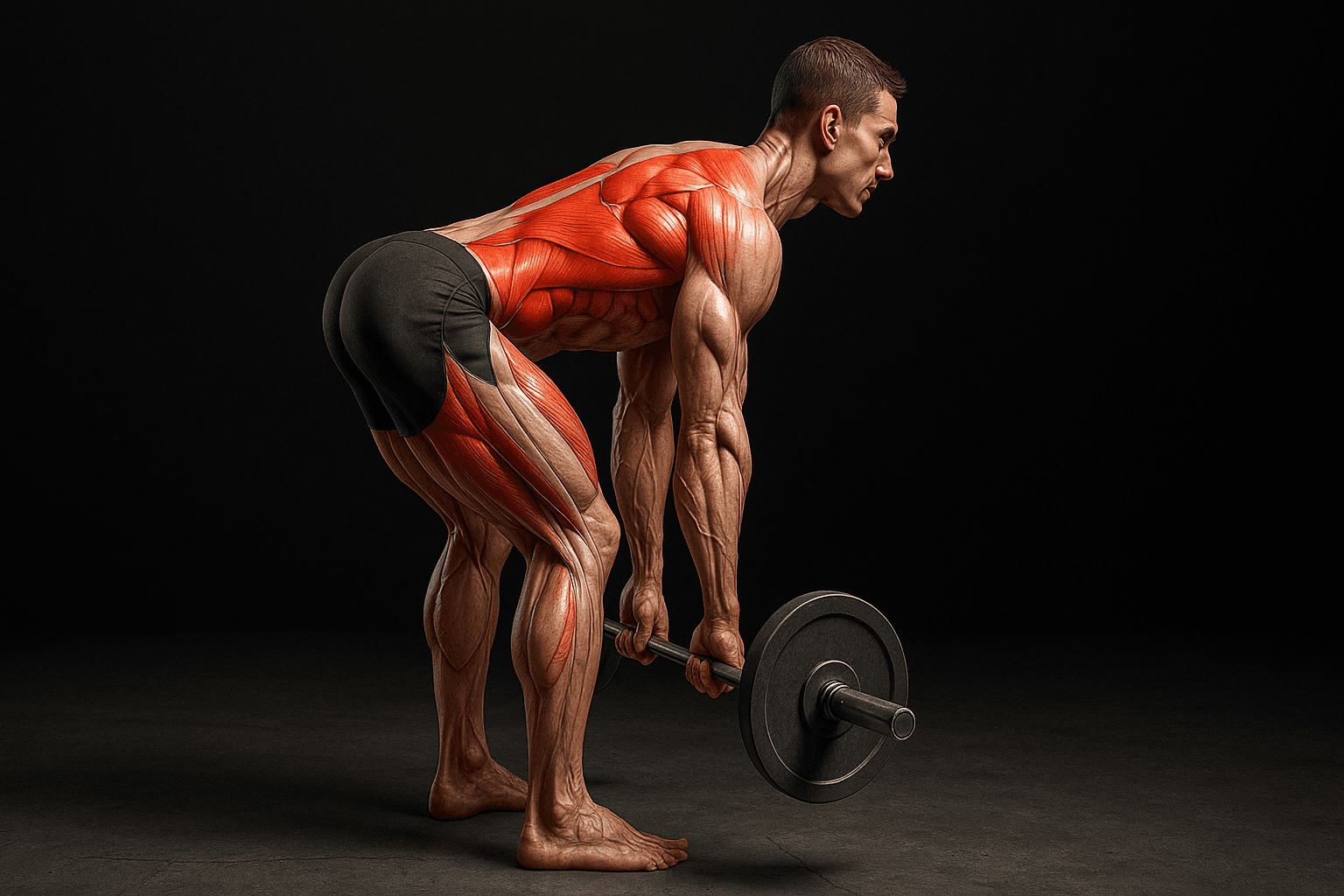
Photo by RepBro.
The seal row works the middle back—rhomboids and middle traps—and the lats as primary movers, with posterior delts, biceps, and forearms as important secondary muscles. Lying on a bench removes lower-back work, making it a horizontal-pull that isolates scapular retraction and elbow flexion.
What muscles does the seal row train and how is the loading distributed?
Primary: rhomboids and middle trapezius (scapular retraction) and latissimus dorsi (arm extension/adduction).
Secondary: posterior deltoids, teres major, biceps brachii, brachialis and forearm extensors/grip muscles. Because your chest rests on the bench, the lumbar erectors are largely taken out of the picture; that makes the seal row more of a mid-back isolation pull than conventional bent-over rows.
Practical takeaways: the seal row emphasizes horizontal pulling and scapular control. If your goal is to hit the mid-thoracic area with minimal lower-back stress, it’s an efficient choice.
How should I program seal rows into a routine?
Frequency: 1–3 sessions per week depending on total weekly back volume and recovery. Evidence-based practice for hypertrophy supports distributing work over multiple sessions rather than cramming all volume into one workout.
Weekly volume: Aim to include seal rows as part of your 10–20 weekly sets for the back muscles depending on experience and recovery. Beginners need fewer sets; intermediate and advanced lifters may need more volume to progress.
Sets and reps: Use 3–6 sets of 3–6 reps for strength-focused cycles, 3–5 sets of 6–12 reps for hypertrophy emphasis, and higher reps (12–20) if you're targeting metabolic conditioning or endurance. Rest 2–3 minutes for heavy sets and 60–120 seconds for hypertrophy work.
Progression: prioritize progressive overload by increasing load, then reps, then sets, or by improving technique and time under tension. Track load and reps each session; tools like RepBro can help log progress.
Deloading: schedule a lighter week or reduce volume when performance stalls, fatigue accumulates, or other recovery markers worsen. Individual timing varies—every few weeks to a few months depending on stress and workload.
How do I perform the seal row with safe, effective form?
Setup: place a flat bench high enough that you can lie chest-down with hips supported and feet on the floor. Use a barbell or dumbbells beneath the bench. Grip width and elbow path should allow the handle to travel to your lower ribs.
Execution cues: initiate each rep with a scapular retraction (pull shoulder blades together) then drive the elbow toward your hip. Pause briefly at the top for full contraction, control the eccentric back to the start. Keep the neck neutral and avoid letting the shoulders round forward between reps.
Common errors: using torso momentum (less relevant on the seal row but still possible), pulling with the biceps instead of initiating with the scapulae, letting the chest lift off the bench, or shortening range of motion.
Safety note: stop on sharp pain and consult a qualified healthcare or movement professional if pain persists. This article does not diagnose injuries or guarantee prevention.
What are solid alternatives to the seal row and when should I pick each?
Below are four practical alternatives and the contexts where they fit best.
-
Bent-over barbell row
- When to pick: You want higher loading potential and more carryover to full-body strength movements. Choose this if your lower back is healthy and you’re training strength or mass.
- Equipment: barbell and plates. Requires good hip hinge and bracing.
- Watch for: lumbar stress and form breakdown.
-
Chest-supported dumbbell row
- When to pick: Lower-back issues or you want unilateral work without spinal loading. Also useful to remove momentum and emphasize strict contraction.
- Equipment: incline bench and dumbbells.
- Watch for: bench angle and scapular motion—ensure full retraction.
-
Single-arm dumbbell row (one-arm bench-supported)
- When to pick: unilateral imbalances, sport-specific asymmetry, or to overload one side safely. Good for building a stronger mind-muscle connection and fixing left/right differences.
- Equipment: flat bench and dumbbell.
- Watch for: torso rotation—keep hips square.
-
Seated cable row
- When to pick: desire for constant tension, easy microloading, or limited floor/bench space. Good for higher-rep work and varied grips.
- Equipment: cable machine and appropriate attachment.
- Watch for: leaning back too far turns it into more of a posterior chain pull.
How does the seal row compare to other horizontal pulls at a glance?
| Movement | Primary focus | Lower-back involvement | Loading ease | When to choose |
|---|---|---|---|---|
| Seal row | Mid-back (scapular retraction) + lats | Minimal | Moderate (barbell/dumbbell) | Isolate mid-back with low lumbar stress |
| Bent-over row | Lats and overall back strength | High | High | Strength and mass with full posterior chain engagement |
| Chest-supported DB row | Mid-back and unilateral strength | Minimal | Moderate | Lower-back issues; strict contractions |
| Seated cable row | Mid-back and lats with constant tension | Low-moderate | High (easy increments) | High-rep work and consistent tension |
When should I avoid or postpone seal rows?
Avoid or modify if you have acute shoulder pain, rotator cuff irritation during horizontal pulls, or if you cannot set up the bench safely. Substitute with chest-supported or cable rows until a clinician or coach clears you.
Limitations
No app, article, or AI can replace an in-person movement assessment. Apps can help you log sets and volume but cannot see or correct your form in real time. If you have an injury, persistent pain, or complex rehabilitation needs, consult a qualified healthcare or strength-and-conditioning professional. A program only works if you train consistently and adjust based on recovery.
Consistent, gradually progressive training is what changes muscle and strength—exercise selection is a tool to fit that process, not a shortcut.
Frequently asked questions
- What muscles does the seal row primarily target?
- The seal row primarily targets the mid-back—rhomboids and middle trapezius—and the latissimus dorsi, with substantial involvement of the posterior deltoids, biceps, and forearms. Because you lie on a bench, it minimizes lower-back contribution compared with bent-over rows.
- How often should I do seal rows for growth or strength?
- Program seal rows 1–3 times per week depending on total back volume. For hypertrophy aim for part of a 10–20 weekly set range for back muscles; for strength use lower rep ranges (3–6) with longer rests and heavier loads, and progress load or reps over time.
- Which alternative should I pick if I have lower-back pain?
- Choose a chest-supported or seal-style dumbbell row that removes spinal loading. Chest-supported dumbbell rows or machine-supported rows let you train horizontal pulling force without taxing the lumbar spine while still targeting mid-back musculature.