Romanian Deadlift: Muscles Worked and Best Alternatives
Which muscles the Romanian deadlift trains, where it fits in a program, and 4 practical alternatives—when to pick each for equipment, injuries, or plateaus.
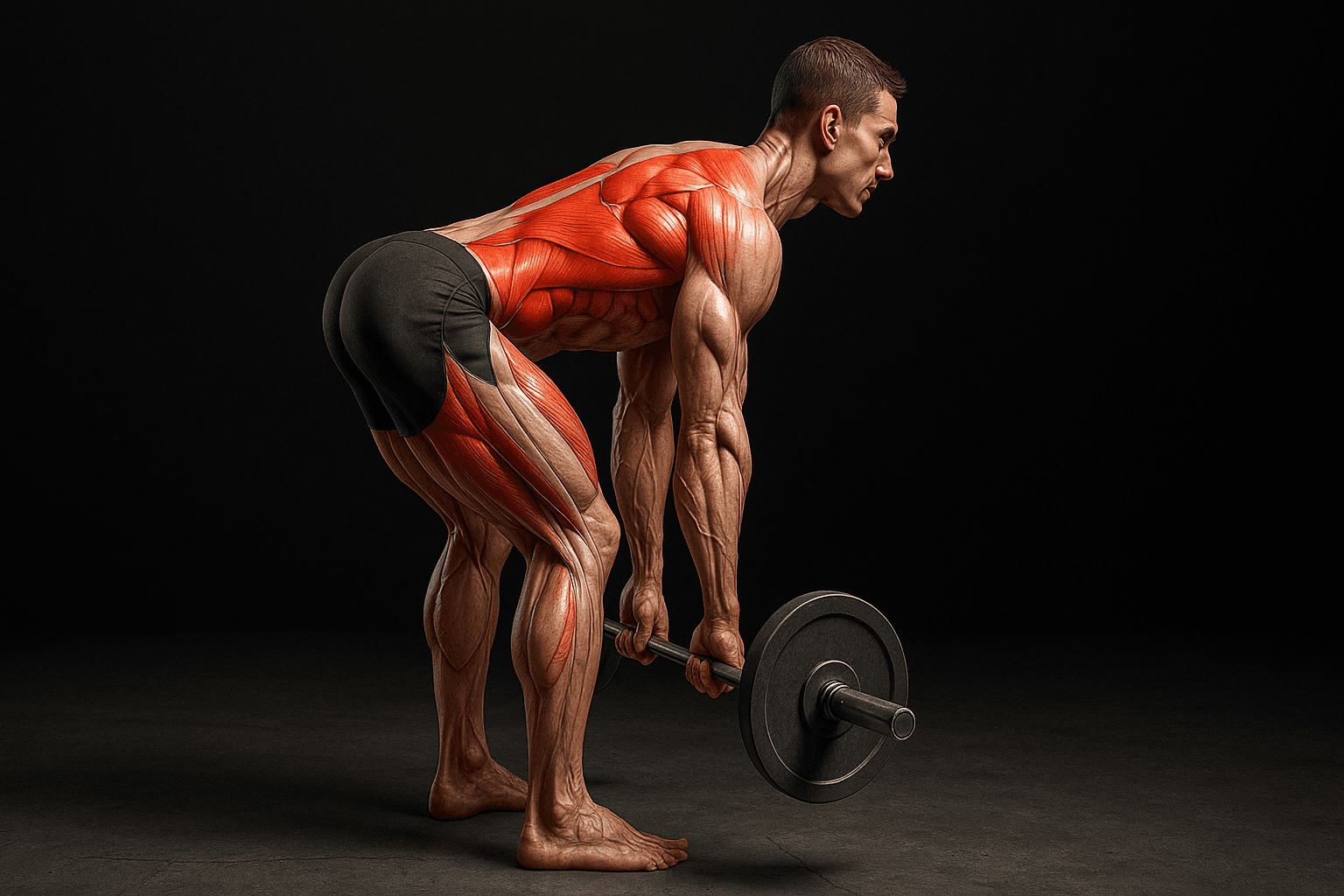
Photo by RepBro.
First paragraph answer The Romanian deadlift (RDL) chiefly trains the hamstrings and gluteus maximus as primary movers, with the spinal erectors and adductors as the main secondary muscles and grip, traps and core acting as tertiary contributors. In short: RDL = posterior-chain emphasis via a hip hinge.
What exactly does the Romanian deadlift work?
Primary muscles
- Hamstrings (biceps femoris, semitendinosus, semimembranosus): the RDL loads these eccentrically as you lower, then concentrically as you extend the hips.
- Gluteus maximus: the drive back up is a hip-extension action that heavily recruits the glutes.
Secondary muscles
- Spinal erectors (erector spinae): resist trunk flexion and stabilize the spine under load.
- Adductors (mainly adductor magnus): assist hip extension and stabilize the femur.
Tertiary/support muscles
- Core (bracing for intra-abdominal pressure), grip and forearms (holding the bar), upper traps/lats (scapular stability).
How the demand changes with variations
- Narrower stance and deeper hinge shift more toward hamstrings.
- A more upright torso (small hinge) reduces hamstring stretch and shifts load toward glutes and erectors.
How should I program the RDL in a routine?
Where it fits
- Use RDLs as a primary posterior-chain movement on lower-body or pull days.
- Place them after a general warm-up and activation work (5–10 minutes), and either before or after heavy compound lifts depending on goals:
- Strength focus: perform RDLs before accessory work but after heavy compound warm-ups; examples: heavy squats first, then RDLs as an accessory, or RDLs as the main posterior-chain lift if the goal is hip-hinge strength.
- Hypertrophy/volume focus: RDLs can be a main movement with 3–4 sets of 6–12, followed by isolations (hamstring curls, glute bridges).
Frequency and dosage
- Frequency: 1–2 times per week for most lifters.
- Strength template: 3–5 sets of 3–6 reps with heavier loads and longer rests (2–4 minutes).
- Hypertrophy template: 3–4 sets of 6–12 reps with 60–90 seconds rest.
- Tempo: 2–3 seconds controlled descent, 0–1 second pause near mid-shin, 1–2 seconds drive up.
Progression
- Increase load by 2.5–5% when you can complete all prescribed reps with good form, or add 1–2 reps per set week-to-week.
What is proper RDL form? (short cues and safety)
- Hinge at the hips: push hips back while keeping a neutral spine.
- Maintain a slight knee bend — not locked, not a full squat.
- Bar close to the body: keep the barbell tracking near mid-shin on the descent.
- Don't round the lower back; stop and reduce weight if rounding appears.
- Drive the hips forward to return to standing instead of pulling with the lower back. Safety note: stop if you feel sharp or radiating pain, and consult a qualified professional for ongoing pain. This is general guidance, not a diagnosis.
What are good alternatives to the Romanian deadlift and when to pick each?
- Hip thrust (barbell or loaded from floor)
- Why: Exceptional for concentric glute strength and hypertrophy. Less shear on the lower back than RDLs.
- When to pick it: If your main goal is glute development, if you have mild lower-back sensitivity, or when you need a heavier, safer hip-extension option. Works with minimal hamstring stretch, so it's less ideal if you specifically want eccentric hamstring loading.
- Equipment: Barbell, bench, or hip-thrust platform. Works well at home with a bench and dumbbell.
- Single-leg Romanian deadlift (dumbbell or kettlebell)
- Why: Adds balance and unilateral strength, good for asymmetry and core stability.
- When to pick it: If you have access only to light equipment, want to address unilateral imbalances, or are stuck on barbell RDL plateaus caused by weak stabilizers. Also useful for return-to-sport rehab phases with professional guidance.
- Equipment: 1 dumbbell or kettlebell; can be done bodyweight progression.
- Trap-bar deadlift (hex bar)
- Why: Keeps a more upright torso and often reduces shear on the lower back compared with a straight-bar RDL; allows heavier loading while still engaging hamstrings and glutes.
- When to pick it: If you want heavy posterior-chain loading but have lower-back discomfort with straight-bar RDLs, or if you lack confidence with a barbell. Also a practical option for strength carryover to other lifts.
- Equipment: Trap bar; commonly available in gyms.
- Good morning (barbell)
- Why: Strong hip-hinge builder that targets erectors and glutes under loaded flexion.
- When to pick it: If spinal erectors are a limiting factor or you need targeted posterior-chain spine strength. Not recommended if you have acute low-back issues or poor hip hinge mechanics. Keep weights conservative and focus on technique.
- Equipment: Barbell; consider a safety squat bar for comfort.
How to choose among them
- Equipment-limited: single-leg RDLs or kettlebell/dumbbell RDLs.
- Low-back sensitivity: hip thrusts or trap-bar deadlifts.
- Plateau on concentric lockout: hip thrusts or trap-bar deadlifts to overload hip extension.
- Hamstring-lengthening stimulus needed: straight-bar RDL or single-leg RDL for greater eccentric stretch.
How do I manage common issues like plateaus or pain?
- Plateau: change variables—add volume (one extra set), increase eccentric tempo (3–4s), switch to a unilateral variant, or substitute trap-bar to load more safely.
- Minor soreness: prioritize recovery (sleep, nutrition, light mobility).
- Ongoing or sharp pain: stop the exercise and seek assessment from a qualified clinician.
Internal links If you track lifts or want to compare programming options, check the RepBro app here: https://apps.apple.com/us/app/gym-workout-coach-repbro/id6763749305 and see lift comparisons at https://www.repbro.app/vs.
One-sentence takeaway The Romanian deadlift is a high-value hip-hinge that primarily trains hamstrings and glutes—use it 1–2 times weekly for posterior-chain strength and pick one of the alternatives above when equipment, pain, or plateaus demand a different tool.
Frequently asked questions
- Are Romanian deadlifts mainly for glutes or hamstrings?
- RDLs primarily target the hamstrings and glutes. They emphasize the hip hinge, so hamstrings and gluteus maximus take most of the load while spinal erectors and adductors act as strong secondary contributors.
- How often should I do Romanian deadlifts?
- 1–2 times per week is optimal for most lifters. Use heavier RDL sessions (3–5 sets of 4–6) for strength or moderate-volume sessions (3–4 sets of 6–12) for hypertrophy.
- Can I replace RDLs if I lack a barbell?
- Yes. Single-leg RDLs, kettlebell/dumbbell RDLs, and hip thrusts are effective barbell-free alternatives—pick based on goals, balance needs, and available load.