Rear Delt Fly Alternatives at Home (Minimal Equipment)
Four practical at-home substitutes for the bent-over rear-delt fly using bodyweight, dumbbells, or bands, with what each preserves, loses, and when to choose a gym.
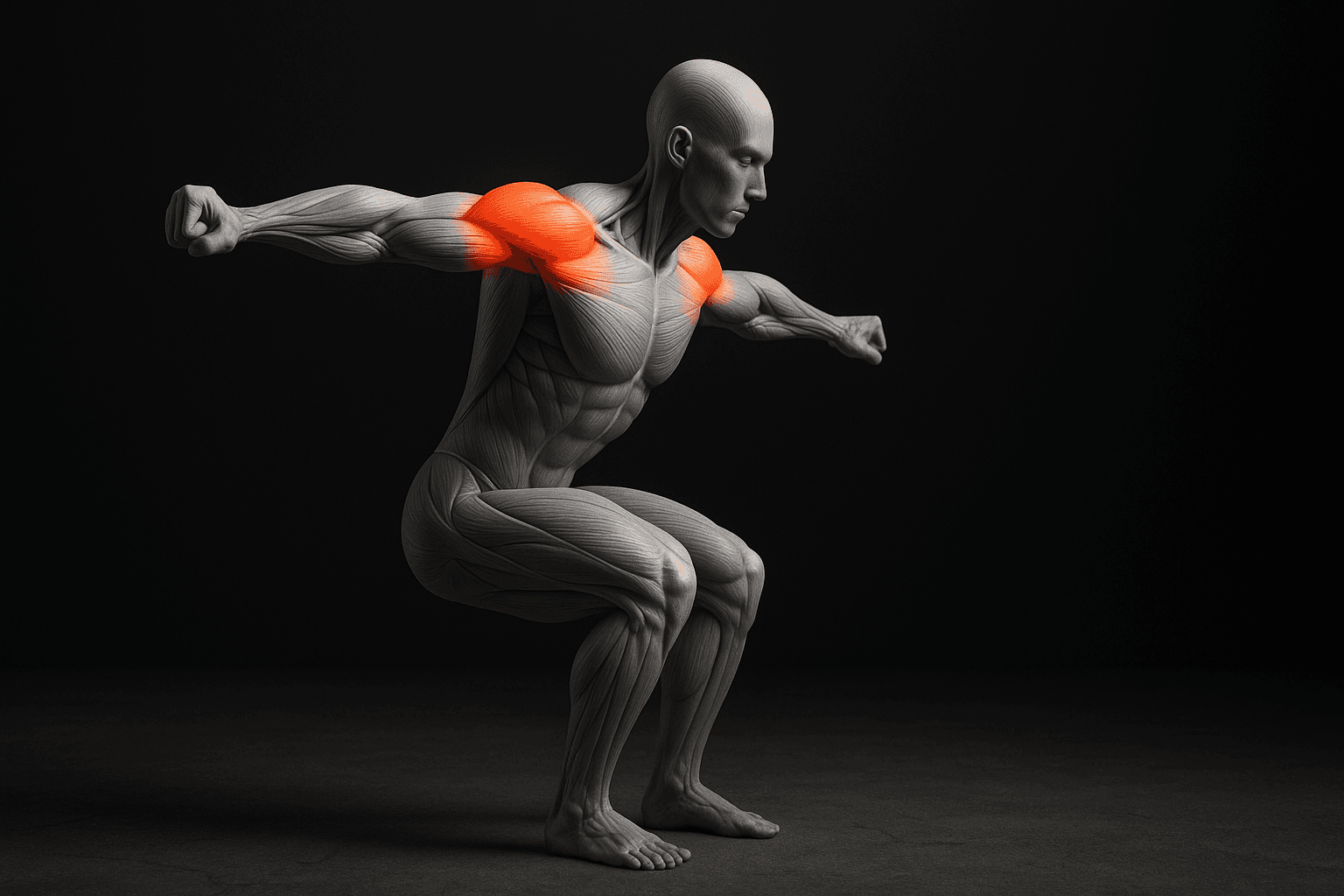
Photo by RepBro.
You can replicate most of the bent-over rear-delt fly’s stimulus at home with bands, dumbbells, or bodyweight. Choose exercises that preserve horizontal shoulder abduction and external rotation, and program 8–15 quality weekly sets split across 2–3 sessions while progressively increasing difficulty.
What simple at-home rear-delt alternatives actually work?
Here are four practical options that require little equipment and scale by load or difficulty.
- Bent-over one-arm dumbbell rear delt fly
- Equipment: single dumbbell (or kettlebell) or two if you have them.
- How: Hinge at the hips with a flat back, support the torso with the opposite hand on a bench or knee, abduct the humerus horizontally with a slight external rotation, pause at peak contraction.
- Reps/sets: 8–15 reps, 3–4 sets.
- Incline-prone dumbbell rear delt raise (chest-supported)
- Equipment: adjustable bench set to ~30–45° incline and light–moderate dumbbells.
- How: Lie chest-down, let arms hang, raise dumbbells in a T or slightly higher arc. Keeps momentum low and isolates rear delts.
- Reps/sets: 8–15 reps, 3–4 sets.
- Band pull-apart (horizontal band pull) / face-pull with band
- Equipment: loop or long resistance band anchored at chest/high head height.
- How: Pull band apart to shoulder level focusing on scapular retraction and external rotation. For face-pulls, pull to face with elbows high to bias rear delts and external rotators.
- Reps/sets: 12–25 reps, 3–5 sets.
- Prone T/Y/I (floor or low incline) — bodyweight
- Equipment: none or light dumbbells (0.5–3 kg/1–5 lb) if you want more load.
- How: Lie face-down and lift arms into T, Y, and I shapes with controlled tempo. Emphasizes scapular control and posterior delts through different vectors.
- Reps/sets: 8–20 reps each pattern, 2–4 sets.
How do these alternatives compare to the standard bent-over rear-delt fly?
| Exercise | Equipment | Preserves (vs bent-over fly) | Loses | Best use-case |
|---|---|---|---|---|
| Bent-over one-arm DB fly | Dumbbell | Similar shoulder horizontal abduction, unilateral focus, easy progressive overload | Slightly less trunk support if unsupported | Closest gym-like substitute at home |
| Incline-prone DB raise | Dumbbells + bench | Pure rear-delt isolation, limits cheating | Less postural/core demand | Use when you need strict form and control |
| Band pull-apart / face-pull | Bands | Continuous tension, external rotation emphasis | Harder to quantify load, different resistance curve | Great warm-up / high-rep finishers |
| Prone T/Y/I | Bodyweight (optional light DB) | Scapular mechanics, varied vector training | Limited heavy overload | Rehab, motor control, and accessory work |
What does each substitute preserve and lose compared with the original?
- Preservation: All four preserve the key actions of the posterior deltoid — horizontal abduction and external rotation — when performed with proper cueing.
- Losses:
- Maximum absolute loading: bodyweight and light-band options make heavy absolute loads difficult compared with heavy dumbbells or machines.
- Load quantification: bands and bodyweight are harder to track precisely, which matters for strict progressive overload.
- Resistance curve differences: bands increase tension at end-range; dumbbells give constant or gravity-dependent loading.
When is an at-home swap adequate, and when should I go to a gym?
- Adequate at home: If your goal is balanced shoulder development, posture correction, injury resilience, and incremental strength, the above exercises will suffice. Rotator cuff and posterior deltoid response to moderate-heavy, high-quality sets is achievable with bands and dumbbells.
- Time for the gym: If you need maximal hypertrophy and are using very heavy loading as part of a staged progressive program, or you require precise load progression (e.g., adding 1–2.5 kg/2–5 lb increments beyond what you own), a gym with heavier dumbbells, cables, or dedicated rear-delt machines will be useful.
How should I program these exercises (sets, reps, progression, and rest)?
- Frequency: 2–3 sessions per week for rear delts.
- Weekly volume: Aim for roughly 8–15 quality sets per week for the posterior delts, split across sessions. Adjust up or down based on recovery and pressing volume.
- Reps: 8–15 for dumbbell variants; 12–25 for band and bodyweight variations where load is lighter.
- Progression: Increase reps up to upper range, then increase load (heavier band or dumbbell). Track perceived effort or RPE and add small load increments when you can exceed target reps by 1–2 across sets.
- Rest: 60–120 seconds between sets depending on load and goal.
- Deload: Consider a lighter week (reduce volume/load ~30–50%) every 4–8 weeks or when signs of systemic fatigue appear.
What safety steps should I follow?
- Stop any movement that causes sharp or unusual joint pain.
- Use controlled tempo and avoid excessive shrugging or lumbar rounding.
- Warm up the thoracic spine and rotator cuff before loading (band pull-aparts, light external rotations).
- If you have a current shoulder injury or pain, consult a qualified medical or rehabilitation professional before loading the joint.
What limitations should I know about apps and AI coaching?
- No app or AI can see or correct your live movement with the nuance of an experienced coach; video review by a qualified professional is preferable for form faults.
- Apps cannot diagnose injuries or prescribe medical rehab — see a licensed clinician for persistent pain or structural problems.
- Any program only works if you follow it consistently; coaching tools assist but do not replace adherence and progressive overload.
Summary: With a handful of dumbbells, a resistance band, and consistent programming (2–3x/week, ~8–15 sets/week), you can reliably develop the rear delts at home. Use prone chest-supported variations for strict isolation, single-arm bent-over flies for unilateral overload, bands for high-rep finishing and motor control, and floor T/Y/I patterns for scapular mechanics. If you need very high absolute loads or precise incremental loading, the gym offers additional options.
Safety reminder: This article is informational, not a diagnosis. Stop on sharp pain and consult a qualified professional for injuries.
Frequently asked questions
- Can I build rear delts at home without machines?
- Yes. You can target the posterior deltoid effectively at home with dumbbells, bands, and bodyweight moves. Use progressive overload (more reps, tighter bands, heavier dumbbells) and 8–15 quality sets per week across 2–3 sessions for visible progress.
- How often should I train rear delts?
- Train rear delts 2–3 times per week, splitting 8–15 total weekly sets across those sessions. Allow 48–72 hours recovery between focused sessions; adjust volume if you handle heavy pressing work in the same week.
- Are band exercises as effective as dumbbells for rear delts?
- Bands can be very effective when they provide consistent tension and allow progressive challenge. They preserve movement pattern and time under tension, but they make exact load tracking harder than dumbbells and may change resistance curve.