Pull-up: Proper Form, Step by Step
Definitive, safety-first guide to pull-up proper form: setup, execution cues, breathing, tempo, common mistakes and fixes. Stop on sharp pain.
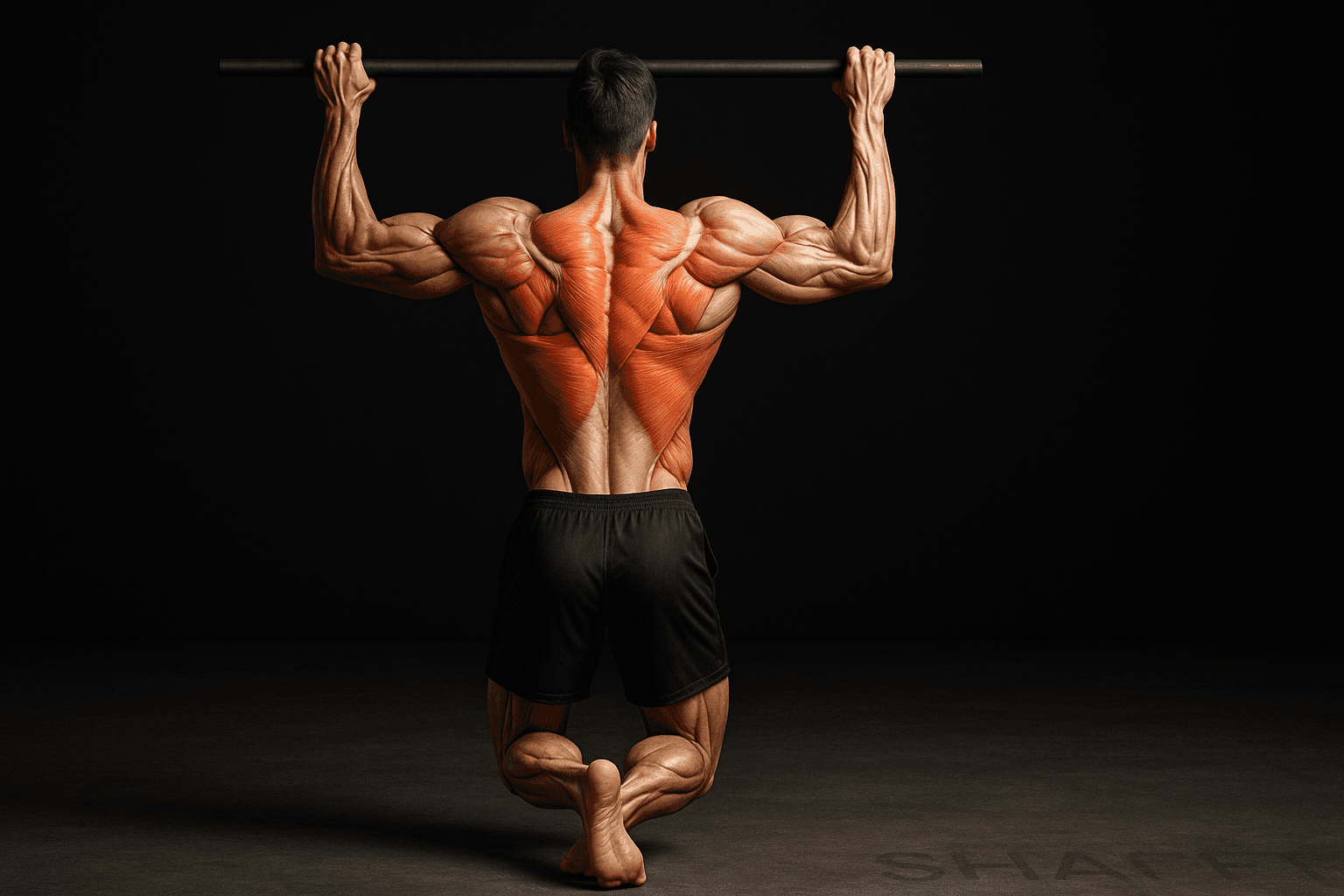
Photo by RepBro.
Proper form for the pull-up is: start from a full (but active) dead hang, retract the scapula to engage the lats, pull your elbows down and back until your chin clears the bar (or the bar touches upper chest), then lower under control back to a full hang. Keep the torso tall, core braced, and avoid swinging — those are the core markers of a clean, effective pull-up.
What is the correct setup before you pull?
- Bar height: high enough so your feet don’t touch the ground when you hang but low enough to step down safely after a rep.
- Grip: overhand (pronated) grip, roughly shoulder-width to 10–20 cm (4–8 in) wider than shoulder width for most lifters.
- Hand placement: thumbs either wrapped around the bar or in a false grip if you’re experienced — wrap the thumb for safety and control.
- Body position: slight hollow/tall posture — chest up, ribs down, pelvis neutral. You can cross your feet or bend your knees to keep your legs compact; avoid exaggerated kicking or swinging.
- Scapula: start with an active hang — not a limp, passive hang. Think of "shoulders down and back" (scapular retraction and slight depression) to tension the lats before the pull.
How do I perform the pull-up step by step?
- Grip the bar and take an active hang: shoulders engaged, lats on, elbows straight but not locked out painfully. Feet can be together with a slight knee bend.
- Cue the scapular pull: initiate a small downward-and-back squeeze of the shoulder blades (about 1–2 cm) to set the lats. This is the start of every rep — don’t pull with your arms first.
- Drive the elbows down to your ribs: imagine pulling your elbows into your back pockets. Keep the chest up and lead with your sternum toward the bar.
- Finish the concentric when your chin clears the bar or the bar contacts your upper chest. Avoid craning the neck — bring the chest to the bar, not the chin over the bar.
- Lower under control: resist gravity on the way down. Aim to return to the active hang with shoulders engaged (not a dead, slouched hang). Control the descent for 2–5 seconds depending on your training goal.
- Reset if needed: if fatigue causes form breakdown, briefly re-establish the scapular position before the next rep.
How should I breathe, and what tempo should I use?
- Breathing: exhale on the concentric (as you pull up) and inhale on the eccentric (as you lower). Avoid breath-holding for multiple reps; a brief Valsalva is acceptable for heavy, single efforts if you’re experienced and cleared to do so.
- Tempo recommendations (choose based on goal):
- Strength: 1s up, 0s top pause, 3–5s down. 3–6 reps per set.
- Hypertrophy/control: 1–2s up, 0–1s top, 2–3s down. 6–12 reps per set.
- Beginners/negatives: 0s up (use a step or jump to get to top), 5–8s slow eccentric, 1–3 reps per set.
What are common mistakes and how do I fix them?
- Mistake: Starting from a passive hang (shoulders shrugged). Fix: Begin each rep with a scapular pull — set the shoulders down and back.
- Mistake: Pulling with the arms only and letting the chest drop. Fix: "Lead with the chest" cue; think of driving the sternum to the bar and pulling elbows to the hips.
- Mistake: Kipping or excessive swinging during strict work. Fix: Brace the core, keep legs slightly forward, and shorten the movement tempo. Record yourself or use a mirror to check for body swing.
- Mistake: Partial reps — not reaching full hang or not getting chin over the bar. Fix: Use a rack or step to reach the top, and fully lower between reps. If you lack strength, perform band-assisted reps or negatives.
- Mistake: Excessively wide grip causing shoulder discomfort. Fix: Narrow the grip toward shoulder-width and focus on range of motion.
- Mistake: Holding breath or straining through sets. Fix: Breathe out on the pull, breathe in on the descent; keep tempo consistent.
How do I progress or regress the pull-up?
- Regressions (build baseline strength): band-assisted pull-ups, machine-assisted pull-ups, inverted/horizontal rows, negatives (5–8s eccentric), and isometric holds at different joint angles.
- Progressions: add weight (dip belt or weighted vest) in 1–2.5 kg increments, increase time under tension (slower eccentrics), or increase set volume. Track progress and avoid adding more than 5–10% load jumps.
Is the pull-up safe for my shoulders?
Pull-ups are safe for most people when performed with a controlled, full range of motion and proper shoulder/scapular control. Stop immediately if you feel sharp or unusual pain and consult a qualified professional — neither this article nor any guide can diagnose or treat injuries. If you have a history of shoulder surgery or persistent pain, get clearance from a clinician before loading the joint.
What training frequency is appropriate?
Train pull-ups 2–3 times per week for most intermediate trainees. For beginners, 1–2 focused sessions per week with accessory back work (rows, rear delt work) is sufficient. Ensure at least 48 hours of recovery between heavy pull-up sessions.
Short FAQ
- Q: How many pull-ups should I do per set? A: Based on goal—strength: 3–6 reps; hypertrophy: 6–12 reps; endurance: 12+ reps with good form.
- Q: Should my thumbs wrap around the bar? A: Yes — wrapping the thumb around the bar increases safety and grip security for most people.
- Q: Can I use momentum/kipping? A: Only if you’re specifically training kipping pull-ups (crossfit-style) and have the skill; for strict strength or hypertrophy training, avoid kipping.
Want to track and progress pull-ups in a structured way? Check out RepBro for logging and progression templates.
Safety note: stop on sharp joint pain, consult a qualified professional for persistent pain, and never use this guide as a diagnosis.
One-sentence takeaway: Master the active hang and scapular-first pull, control the descent, and progress gradually — that’s how you build safe, repeatable pull-ups.
Frequently asked questions
- How wide should my grip be for a standard pull-up?
- Use a grip about shoulder-width to 10–20 cm (4–8 in) wider than shoulder width. Too wide reduces range of motion and stresses the shoulders; too narrow shifts emphasis to the biceps.
- How many pull-ups should a beginner aim for?
- Start with ability-based goals: 3–5 unassisted reps is a useful short-term target. If you can't do a single rep yet, build strength with assisted pull-ups, band-assisted negatives (5–8s eccentric), and horizontal rows.
- Should I pause at the top of the pull-up?
- A brief 0–1 second pause to show control is fine. For strength work, pause briefly or perform a controlled eccentric (3–5s) on the way down. Avoid bouncing at the top.