Preacher Curl Alternatives at Home (Minimal Equipment)
Four practical at-home substitutes for the preacher curl using dumbbells, bands, or bodyweight, what each preserves and loses, programming tips, safety, and when to return to a gym.
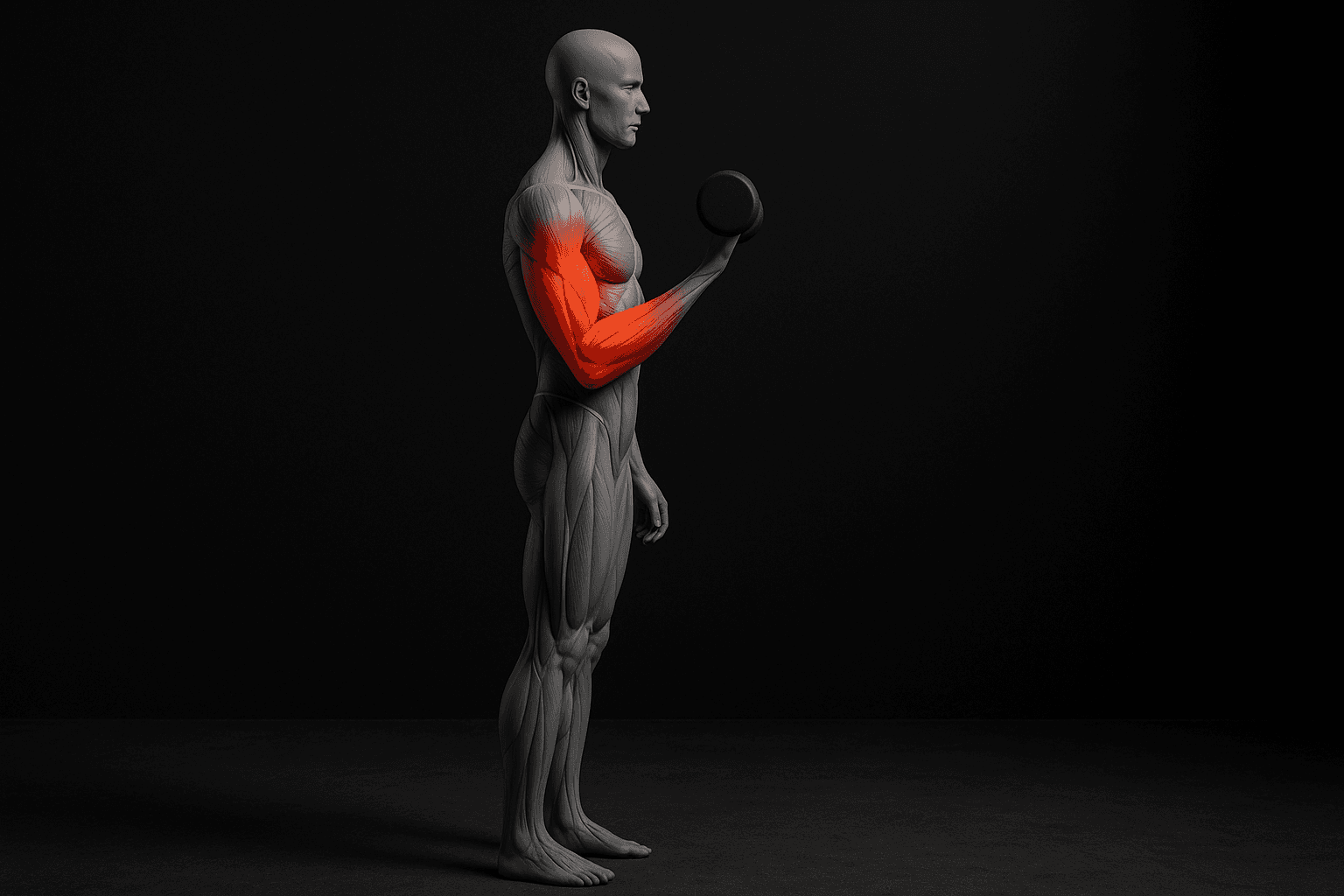
Photo by RepBro.
Yes — you can substitute preacher curls at home and keep most of the biceps-loading stimulus. The following four options (dumbbell incline curls, standing concentration curls, band preacher-style curls, and reverse table/edge curls) use minimal equipment and preserve range-of-motion and tension if programmed correctly.
What does the preacher curl actually emphasize that I should try to preserve?
Preacher curls fix the upper arm so the elbow can’t drift backward, reducing shoulder involvement and forcing the biceps to work through the mid-to-late concentric range. They de-emphasize momentum and isolate the short and long heads depending on grip. Key features to preserve: a stable elbow, a consistent elbow angle, and controlled eccentric and concentric phases.
Which at-home exercises replicate those features with minimal gear?
- Dumbbell Incline Curl
- How: Sit on an incline (30–45°) and let your arms hang straight down; curl with strict form. Use palms-up (supinated) grip.
- What it preserves: long starting stretch, reduced shoulder involvement, long eccentric tension similar to preacher bench’s fixed-arm emphasis.
- What it loses: preacher bench’s fixed elbow position; some elbow drift is possible unless you brace.
- Standing Concentration Curl
- How: Sit with your elbow braced against your inner thigh or lean over a bench edge; curl slowly, focusing on the peak contraction.
- What it preserves: strict isolation at the top of the movement and a stable elbow; good for peak contraction and long head activation.
- What it loses: consistent mid-range tension across the full ROM compared with preacher setup.
- Band “Preacher” Curl (Wrapped Around a Post)
- How: Anchor a band low behind you, kneel or sit, and press your upper arm against your thigh or a small pad to mimic preacher bracing; curl against band tension.
- What it preserves: continuous tension, easy to adjust resistance curve, and good elbow stability if you brace properly.
- What it loses: absolute maximal loading compared to heavy gym machines; band tension increases at the top, altering the strength curve compared with free weights.
- Reverse Table/Edge Curl (Bodyweight-Assisted)
- How: Sit at a table or bed edge, place the back of the upper arm on the edge, hold a dumbbell or heavy bag under the hand, and curl with elbow anchored to the edge.
- What it preserves: very strict elbow bracing for isolation and a controlled ROM.
- What it loses: limited loading progression unless you progressively add weight or increase time under tension.
How do these substitutes compare in one glance?
| Exercise | Preserves (isolation, ROM, tension) | What it loses | When the swap is adequate |
|---|---|---|---|
| Dumbbell Incline Curl | Stretched start, reduced shoulder help | Perfect elbow fixation | When you have dumbbells and need a strong eccentric bias |
| Concentration Curl | Peak contraction, elbow stability | Mid-range continuous tension | Good for finishing sets and strict isolation |
| Band Preacher-style Curl | Continuous tension, adjustable resistance | Maximal absolute load, slightly different strength curve | When no heavy weights available; progressive with thicker bands |
| Table/Edge Curl | Fixed elbow brace, strict form | Load ceiling unless adding weight | When you want strict isolation with very little gear |
How should I program these alternatives for progress?
- Frequency: Train biceps 2–3 times per week as part of an upper-body split or full-body routine. This aligns with consensus recommending multiple weekly exposures for a muscle group.
- Intensity and sets: Use a mixture of rep ranges (6–12 for moderate-heavy work and 12–20 for higher volume/time-under-tension). Perform 3–5 sets per exercise depending on overall weekly volume and recovery.
- Progression: Progress load, reps, or add sets over time. If weights/bands are limited, increase tempo control (slower eccentrics), add pauses, or increase set density.
- Variation: Rotate between the alternatives every 4–8 weeks to target slightly different portions of the biceps and avoid stagnation.
Which alternative should I pick first?
Choose the option that matches your equipment and the stimulus you’re missing. If you miss the long eccentric stretch: do incline dumbbell curls. If you miss the strict elbow lock and peak contraction: do concentration or table/edge curls. If you need continuous tension and variable load without heavy plates: use bands.
When should I go back to a gym for the real preacher curl?
Return when your home setup prevents progressive overload (you can’t increase resistance safely), when the fixed-seat bench is required for pain-free positioning, or when your training phase specifically calls for machine isolation under heavy single-joint loading. For most recreational lifters, well-programmed home alternatives suffice for months or longer.
Safety note
Stop any exercise that causes sharp or unusual pain. Maintain controlled tempo and avoid jerking motions. If you have a history of elbow or shoulder pathology, consult a qualified professional before loading single-joint movements. This article doesn’t diagnose or treat injuries.
Limitations: what apps and AI coaching cannot do for your curls
- No app or AI can watch your form in real time or feel pain for you. Video feedback or in-person coaching is required for precise technical correction.
- Apps can’t replace a clinician for rehab or modify exercises safely after an injury. Seek a qualified physical therapist for persistent pain.
- A program only works when you follow it consistently; tools help tracking and progression but do not substitute for adherence or recovery.
If you track sets, reps, and progression on your phone, a simple tracker or generalist app like RepBro can help maintain progressive overload and session logs.
Bottom line: with a couple of dumbbells, a band, or clever bracing against a chair or table edge, you can recreate most of the preacher curl’s isolation stimulus. Progress requires consistent overload and careful positioning; when your equipment or pain limits load progression or form, a gym visit or professional input is the appropriate next step.
Frequently asked questions
- Can I build biceps at home without a preacher bench?
- Yes. You can build biceps at home with consistent progressive overload using dumbbells, bands, or bodyweight variations. Preacher curls emphasize isolation; substitutes can replicate that stimulus enough for growth if you manage load, full range of motion, and enough volume across 2–3 weekly sessions.
- How often should I train biceps at home?
- Train biceps 2–3 times per week, distributing volume across the sessions. Use 6–20 repetition ranges depending on load and goals, and progress load, reps, or sets over time. Allow at least 48 hours of recovery between focused biceps sessions when they’re high-intensity.
- When is it worth going back to a gym just for preacher curls?
- Return to a gym if you need the preacher bench for strict isolation (for example, when elbow position or seat bracing matters), when your home load is capped and you can’t progress further, or when your program requires heavy, single-joint loading that your equipment can’t safely provide.