The Most Common Plank Mistakes (and How to Fix Them)
Fix the most common plank mistakes: sagging hips, butt too high, neck strain, shoulder collapse, hand/elbow errors, breath-holding and over-timing with clear fixes and safety tips.
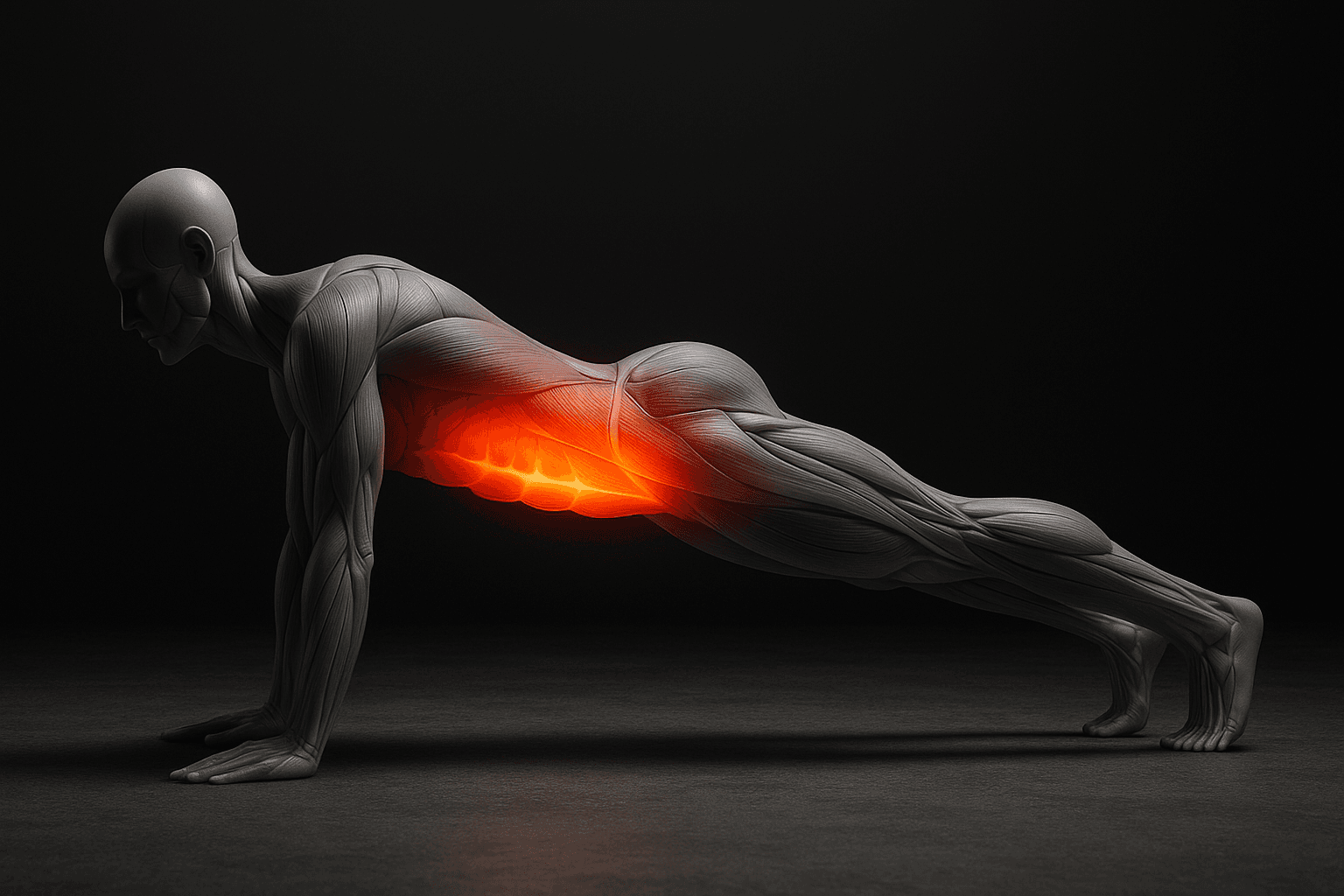
Photo by RepBro.
Plank mistakes are usually form faults: hips that sag or rise, shoulders collapsed forward, neck craned, holding your breath, wrong elbow/hand placement, or simply planking too long until form breaks. Fix those and you’ll stop wasting time and reduce injury risk.
Why are my hips sagging (too low)?
- Why it happens: Weak or unengaged glutes and deep core + trying to hold the position when you’re tired. People often let the pelvis drop to rest on passive tissues.
- What it costs: Increased lumbar extension increases low-back compression and reduces abdominal activation. That costs both safety (more ache) and effectiveness (less core stimulus).
- One concrete fix: Brace and posteriorly tilt the pelvis. Draw your belly button toward your spine and squeeze your glutes until your body forms a straight line from head to heels. If you can’t hold that, drop to a knee plank and do 3 sets of 30–45 seconds, or perform 3 sets of 8–12 glute bridges before planks.
Why are my hips too high (butt in the air)?
- Why it happens: People instinctively raise the hips to make the hold easier—they shift load from the core to the hips and legs.
- What it costs: High hips reduce core demand, turning the plank into a poor isometric squat. You lose abdominal stimulus and the carryover to stability tasks.
- One concrete fix: Lower the hips until the ears, shoulders, hips and heels align. Use a mirror or phone set at hip height, or place a dowel or broom along your spine to feel alignment. Start with 3 sets of 20–40 seconds with this cue.
Why is my neck/head out of position?
- Why it happens: Looking up to check form, letting the head drop, or tensing the neck. Many people crane the neck forward or tuck the chin too much.
- What it costs: Neck strain, headaches, and an inefficient transfer of force through the trunk.
- One concrete fix: Neutral neck—look at a spot ~30–60 cm (1–2 ft) in front of your hands so the neck is a continuation of the spine. Practice short 20–30 second holds focusing only on head position to build the habit.
Why are my shoulders collapsing or shrugged?
- Why it happens: Poor scapular control, pushing too far forward with the elbows/hands, or trying to compensate for fatigue.
- What it costs: Increased risk of shoulder impingement and much less work for the anterior core; shoulders take the load instead of distributing it.
- One concrete fix: Stack the shoulders over the elbows (or hands), push the ground away to create tension through the lats, and pull your shoulder blades lightly down and together without pinching. Cue: push the floor away for 2–3 seconds every 10 seconds during a hold.
Why is my hand/elbow placement wrong?
- Why it happens: Elbows too far forward, hands too wide, or uneven placement from poor setup.
- What it costs: Forward elbows increase shoulder torque and make the plank more of a shoulder exercise; wide hands reduce stability and change the muscle emphasis.
- One concrete fix: Place elbows directly under shoulders for forearm planks, or under shoulders for high planks with hands beneath shoulders. Mark a spot on the mat until it becomes automatic. For balance, check that weight is evenly distributed between left and right sides.
Why am I holding my breath or bracing incorrectly?
- Why it happens: People either hold their breath or brace so hard they raise intra-abdominal pressure incorrectly, making the hold feel ‘‘tighter’’ but less controlled.
- What it costs: Dizziness, less muscular endurance, and poor stabilization patterns that don’t translate well to dynamic lifts.
- One concrete fix: Breathe steady—inhale for 2–3 seconds, exhale for 2–3 seconds, keeping the ribs down and core braced. Practice breathing while holding 20–30 second planks: count your breaths to ensure a steady pattern.
Why am I staying in the plank too long?
- Why it happens: Belief that longer is always better, or training by time rather than by quality.
- What it costs: Reinforcement of broken patterns, wasted training time, and possible overuse fatigue.
- One concrete fix: Train the plank like a skill. Use sets that maintain perfect form—3–5 sets of quality holds. If form breaks, stop the set. Track progress by increasing total time across sets with perfect form by ~10% per week.
When should I stop or get help?
Stop immediately on sharp pain or unusual numbness. If you have persistent low-back or shoulder pain during planks, consult a qualified physiotherapist or strength coach—this article doesn’t diagnose. If you’re programming planks into a plan, logging form and progress in an app can help; consider RepBro to track repetitions, sets and notes.
Safety note: Stop on sharp pain, seek professional advice for persistent pain, and never force an exercise when technique fails.
One-sentence takeaway: Correct small technique errors—hips, shoulders, neck, breathing and setup—and you’ll get safer, more effective planks without doing longer holds that reinforce bad patterns.
Frequently asked questions
- How long should I hold a plank?
- Prioritize quality over time: start with 3 sets of 20–40 seconds with perfect form and progress by adding 5–10 seconds per week once you hold clean form for all sets.
- Are planks enough to build a strong core?
- Planks train the anti-extension and anti-rotation muscles effectively but should be combined with kettlebell carries, anti-rotation holds, and loaded movements for a complete core program.
- How often can I practice planks?
- Practice 3–5 times per week; treat them like a skill—short, frequent practice with good form beats one long session with breakdown.