Leg Extension Alternatives at Home (Minimal Equipment)
Practical at-home leg extension substitutes using bodyweight, dumbbells, and bands. What each option preserves or loses compared to the machine, programming tips, and when to use a gym.
Photo by RepBro.
Yes. Several home options—banded knee extensions, seated band/dumbbell quad squeezes, Bulgarian split-squats, and Nordic negatives—can give meaningful quad stimulus. They differ in isolation and load control compared with a machine; pick the option that matches your goals and available equipment.
What does a leg extension actually train and why would I replace it at home?
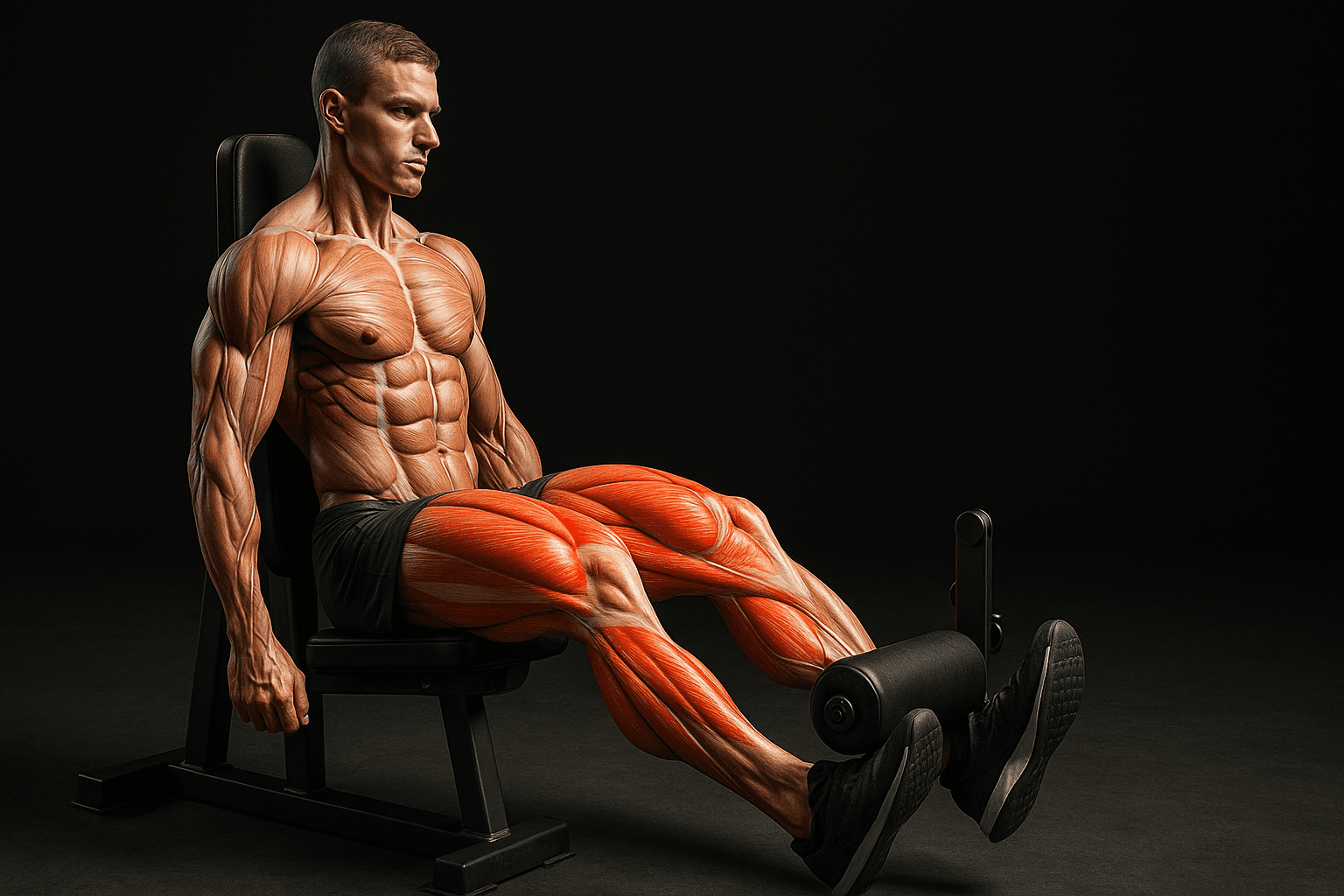
The seated leg extension is a single-joint exercise that primarily loads the knee extensors (quadriceps) through near-full knee extension. It provides a consistent external resistance and isolates the quads by minimizing hip involvement and balance demands. At home you may replace it because machines are uncommon, or because you want to combine convenience with adequate stimulus.
Which minimal-equipment exercises mimic the muscle action of the leg extension?
Below are 4–5 practical substitutes grouped by equipment type, with what each preserves and what it loses compared to the machine.
- Seated band knee extension (band anchored at foot): Preserve: knee-dominant action and ability to control range-of-motion. Lose: maximum load precision, change in moment arm vs machine.
- Seated dumbbell toe-press (dumbbell between feet or strapped): Preserve: single-leg focus and heavy local loading if you can secure weight. Lose: comfort and exact range control; limited maximal load for some lifters.
- Slow eccentric Bulgarian split-squat (bodyweight or dumbbells): Preserve: high quad activation at the lower half of the movement, greater overall loading options. Lose: more hip and balance demand; less pure knee-extension isolation.
- Nordic (Nordic hamstring-style but front-loaded) or reverse Nordic: Preserve: lengthened quadriceps eccentric challenge and high quad tension. Lose: difficulty and different joint torque profile from seated extension; requires strong control.
- Terminal-knee-extension (TKE) with band from standing: Preserve: knee-extension emphasis with consistent band tension. Lose: usually lower peak load than a machine and more hip involvement than seated machine.
How do these alternatives compare directly to the leg extension machine?
| Exercise | Preserves from leg extension | Loses vs leg extension |
|---|---|---|
| Seated band knee extension | Knee-dominant motion, ROM control | Exact load increments, stable moment arm |
| Seated dumbbell toe-press | Single-leg loadability | Comfort/stability, high incremental load for some |
| Bulgarian split-squat (slow) | High quad activation, overload potential | Hip involvement, balance demands, less isolation |
| Reverse Nordic / eccentric-focused work | High quad eccentric tension | Different torque curve, more knee discomfort for some |
| Standing TKE with band | Knee-extension emphasis, easy progression | Lower absolute load, less isolation than machine |
When is a swap adequate and when should I seek a gym machine?
A home alternative is adequate when your goal is general quad hypertrophy, strength within bodyweight or modest external load limits, or long-term maintenance. Most trainees can reach sensible progressive overload with bands, dumbbells, and tempo variations.
Consider returning to a gym leg extension machine if:
- You need precise, high single-joint loading for rehab protocols prescribed by a clinician.
- You’re targeting very high local volume for hypertrophy and require exact incremental loading.
- You need to isolate the quads with minimal hip or balance demands (e.g., some post-op phases).
How should I program these alternatives (sets, reps, progression)?
Follow common resistance-training principles: train quads 2–3 times per week, use multiple sets per exercise, and apply progressive overload. For hypertrophy, aim for moderate repetitions with an intensity that makes the final reps challenging; for strength, use heavier loads and lower reps. Practical progression methods at home include:
- Increase band tension or use thicker bands.
- Add reps or sets when current work becomes easy.
- Slow the eccentric portion to increase time under tension.
- Reduce assistance (e.g., for Nordic) gradually.
Examples (adjust to fitness level):
- Seated band knee extension: 3–4 sets of 8–15 reps. Increase tension or reps over weeks.
- Bulgarian split-squat: 3–4 sets of 6–12 reps per leg for loaded versions; pause at the bottom for more quad emphasis.
- Reverse Nordic or eccentric-focused: 3 sets of controlled 5–8 reps or added eccentric-only reps.
Do not train to failure every set; manage volume so you recover between sessions. Deload periodically when progress stalls or overall fatigue accumulates.
What form and safety cues should I use?
- Keep movements controlled; avoid jerky motions.
- For knee-dominant work, focus on actively extending the knee rather than driving the hip.
- Stop on sharp pain; mild soreness is normal but sharp or joint pain is not. Consult a qualified professional for persistent pain.
- Use a supported seat or back if balance or low-back strain becomes an issue.
Safety note: This article does not diagnose injuries or give medical advice. If you have prior knee surgery, unstable joints, or pain during these movements, consult a qualified clinician before continuing.
What can't an app or AI fully provide for this work?
Apps and AI can help you log sets, suggest progressions, and remind you to train. They cannot watch and correct your form in real time, perform a physical assessment, or replace hands-on guidance from a coach or therapist. A plan only works if you do the work consistently, and an in-person professional is needed for injury diagnosis or rehabilitation.
Limitations
- This guide summarizes practical exercise choices and programming principles but is not individualized medical advice. If you have a history of knee pathology or surgical repair, follow your clinician’s protocol.
- No app or article can see your movement quality; in-person assessment remains the standard for complex issues. Tracking tools (for example, apps such as RepBro) can help you monitor load progression, but they do not replace coaching.
If you want a short starter routine using only bands and one dumbbell, say so and I’ll provide a 4-week progressive template you can do at home.
Frequently asked questions
- Can I train my quads at home without a leg extension machine?
- Yes. Several home options—banded knee extensions, seated band/dumbbell quad squeezes, Bulgarian split-squats, and Nordic negatives—can give meaningful quad stimulus. They differ in isolation and load control compared with a machine; pick the option that matches your goals and available equipment.
- How often should I train quads if I'm using home alternatives?
- Train quads 2–3 times per week, aiming for multiple hard sets per session. Use progressive overload (more reps, sets, slower tempo, or greater band tension/dumbbell load). Adjust volume based on recovery and overall program—follow standard resistance-training guidelines rather than daily maximal work.
- When should I return to a gym leg extension machine?
- Consider the machine if you need precise single-joint isolation for rehab, very high single-leg load with minimal stabilizer demand, or strict top-end hypertrophy work you can’t match at home. Otherwise, well-structured home alternatives are adequate for strength and hypertrophy for most lifters.