Landmine Press: Proper Form, Step by Step
Practical, evidence-aware guide to landmine press form: setup, step-by-step cues, breathing, tempo, programming ranges, common mistakes, and a short FAQ.
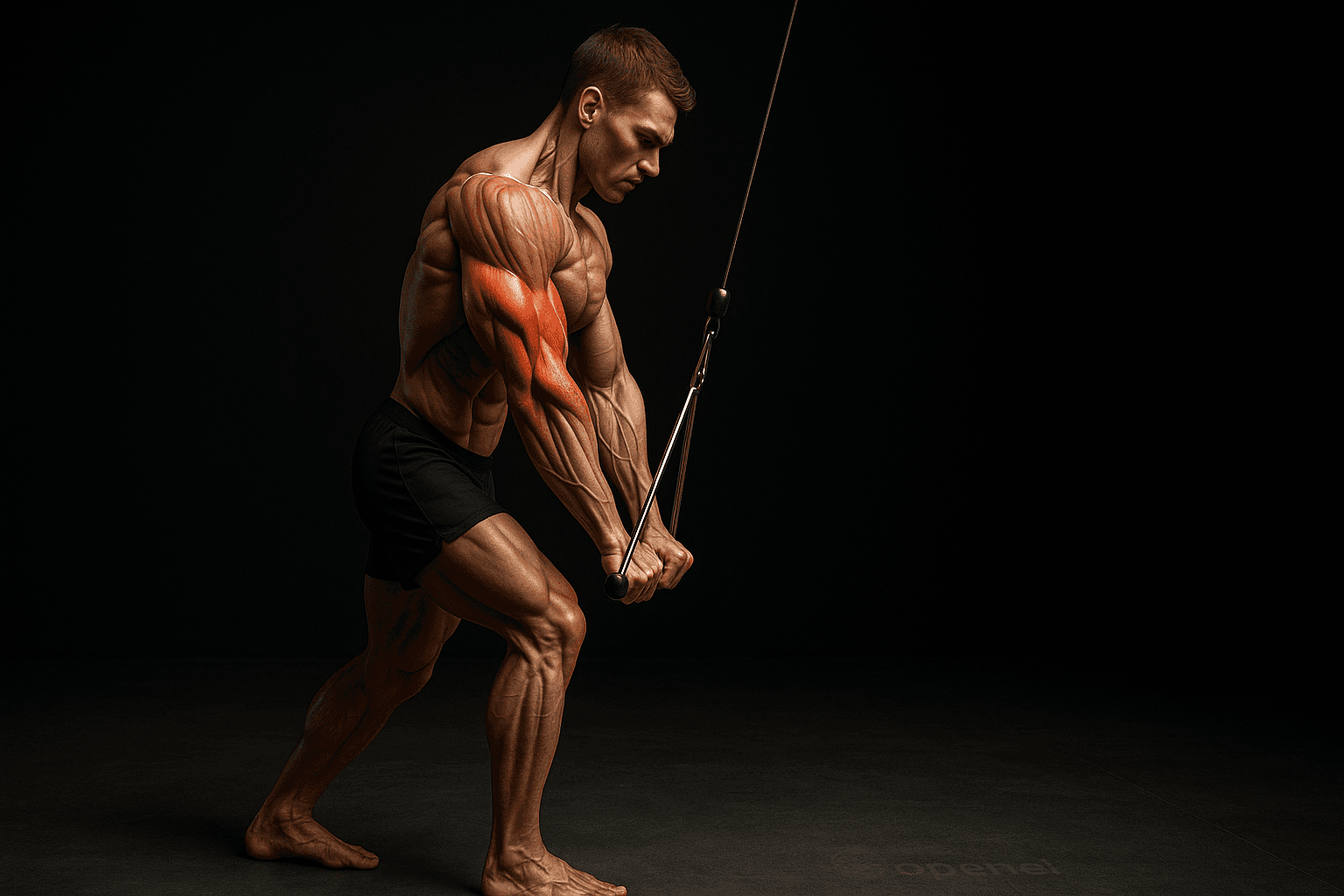
Photo by RepBro.
The landmine press is a barbell press with the bar anchored at one end; proper form uses a staggered stance, firm core brace, and an arcing press path. Press deliberately, control the descent, avoid excessive torso rotation, and stop if you feel sharp pain.
What is the landmine press and why would I do it?
The landmine press is a pressing variation where the barbell is anchored at one end (landmine or corner) and pressed from a shoulder-height start. It reduces shoulder impingement risk compared with a strict overhead barbell press for many lifters, offers a natural arcing path, and is useful for unilateral strength, anti-rotation control, and transitional phases of overhead training.
How do I set up the bar, anchor, and my stance?
- Anchor: Use a commercial landmine attachment or wedge the bar securely in a corner; confirm the sleeve won’t lift.
- Bar height: The bar should pivot freely with the sleeve fully seated.
- Load: Start light. Single-arm work begins with an empty or lightly loaded barbell sleeve.
- Stance options:
- Staggered (split) stance: lead foot forward 20–40 cm (8–16 in) for stability.
- Neutral standing: feet hip-width for a more athletic position.
- Hand position: For single-arm, use a neutral or slight underhand grip with wrist stacked under the elbow.
What are the step-by-step mechanics to perform the single-arm landmine press?
- Setup: Stand with the bar in the landmine, hold the end at shoulder height with elbow tucked slightly forward, wrist neutral. Feet in staggered stance, shoulders relaxed and scapula set.
- Brace: Take a diaphragmatic breath and brace your trunk like preparing for a punch (create intra-abdominal pressure). Eyes fixed on a point ahead.
- Drive: Press the bar up and slightly away following the natural arc. Your arm will travel forward and up toward an overhead/diagonal finish. Do not thrust your ribcage forward.
- Lockout: End with the elbow nearly extended but not hyperextended; shoulder should feel stacked over the ribcage. Maintain tension in the lats and core.
- Return: Lower the bar under control to the starting position (eccentric control), inhale, brace, and repeat.
For two-handed landmine press, the same cues apply; hold the bar with both hands at chest or shoulder level and press along the same arc.
How should I breathe and control tempo?
- Breathing: Inhale and brace before the press (intra-abdominal pressure), exhale during or just after the concentric portion. For heavier sets, use a full breath-brace-exhale pattern. Avoid shallow chest breathing.
- Tempo templates:
- Strength focus: 1–2s concentric, explosive; 2–3s eccentric.
- Hypertrophy/control: 1s concentric, 2–3s eccentric, small pause at bottom. Keep control on the eccentric; don’t let the bar drop quickly. Tempo choice should match your goal and recovery capacity.
How many sets, reps, and how should I progress?
- Frequency: 1–3 times per week depending on volume and goals.
- Reps and sets: Use standard resistance training ranges—strength-oriented lower reps (3–6), hypertrophy moderate reps (6–12), endurance higher reps (12–20). Typical set ranges are 2–5 per session depending on overall program load.
- Progression: When you can complete the upper end of your rep range with good form on all sets, increase load by a small increment or add a set. Track load, reps, and perceived exertion.
These are consensus-style guidelines used by coaches and sport scientists; individual needs vary.
How does the landmine press compare with the overhead barbell and dumbbell presses?
| Feature | Landmine press | Standing barbell overhead press | Dumbbell overhead press |
|---|---|---|---|
| Joint path | Arcing, natural | Vertical, fixed plane | Vertical but allows rotation |
| Shoulder stress | Often lower impingement risk | Higher ROM and load potential | High ROM, unilateral work |
| Core demand | Anti-rotation emphasis | Anti-flexion and stability | Greater unilateral core challenge |
| Use case | Rehab, unilateral control, transition | Max strength, competition-style | Hypertrophy, stability training |
What are common mistakes and how do I fix them?
- Excessive torso rotation: Fix by shortening range, using lighter weight, and cueing a strong brace; practice with pauses.
- Elbow flaring (too wide): Bring the elbow a bit more forward so the forearm stacks under the bar.
- Letting the bar swing with momentum: Slow the eccentric and start each rep from a static position.
- Overarching the lower back: Tuck the ribs, brace the core, and hinge slightly at the hips if needed.
- Using too much neck/upper-trapezius activation: Keep the neck neutral and think of the triceps doing the push.
Is the landmine press safe and who should avoid it?
Safety note: Stop if you feel sharp or unusual pain and consult a qualified health professional. The landmine press is generally safe when load and range are appropriate, but people with acute shoulder pain or recent shoulder surgery should get clearance and individualized guidance.
What short cues help most lifters immediately improve form?
- 'Brace, then press' (breathe and brace first).
- 'Elbow under the bar' (improves stacking).
- 'Control down' (emphasize eccentric).
- 'Lead with the thumb' (guides the arcing path).
What can't apps and AI coaching do for my landmine press?
- See and correct your real-time movement with the nuance of a human coach.
- Diagnose injuries or provide individualized medical rehab plans.
- Guarantee adherence; a plan only works if you show up and recover.
If you want straightforward logging of sets, reps, and progressive overload for landmine presses, tools like RepBro can help track progress, but they are not a substitute for hands-on coaching.
Limitations: what this guide does not do
- This article cannot replace an in-person assessment for pain, mobility deficits, or technique correction.
- It does not provide individualized rehabilitation protocols.
- It assumes access to basic gym equipment and general fitness; personalized programming requires an assessment of goals, history, and current capacity.
Safety reminder: this guidance is educational. If you experience persistent pain with the landmine press, stop and consult a qualified clinician or coach before continuing.
Frequently asked questions
- Can I do the landmine press with both hands or single-arm?
- Both variations are valid. The single-arm landmine press increases anti-rotation demand and unilateral strength; the two‑hand press is useful for learning the path and adding load. Use single-arm for stability work and two‑hand for moderate loads and beginners.
- How often should I train the landmine press?
- Train the landmine press 1–3 times per week depending on goals. For technical practice and hypertrophy aim for 2 sessions/week; for supplemental strength 1–2 sessions is common. Monitor recovery and adjust frequency before increasing volume.
- Does the landmine press build shoulder stability and reduce injury risk?
- The landmine press trains pressing strength and anti-rotation control; it can improve shoulder function as part of a balanced program. It is not a guarantee against injury. If you have pain or prior shoulder issues consult a qualified health professional before progressing.