Hollow Body Hold Alternatives at Home (Minimal Equipment)
Practical at-home substitutes for the hollow body hold using bodyweight, dumbbells, or bands. What each alternative preserves/loses, programming advice, and when to use the gym.
Photo by RepBro.
Use dead bugs, tucked hollow holds, band-resisted planks, weighted hollow/dead-bug variations, and L‑sit progressions to replicate the hollow hold at home. Each preserves anterior core anti‑extension to varying degrees. Train them 2–3 times per week, increase hold time or load, and only seek gym options when you need heavier axial loading.
What does the hollow body hold train and why would I replace it?
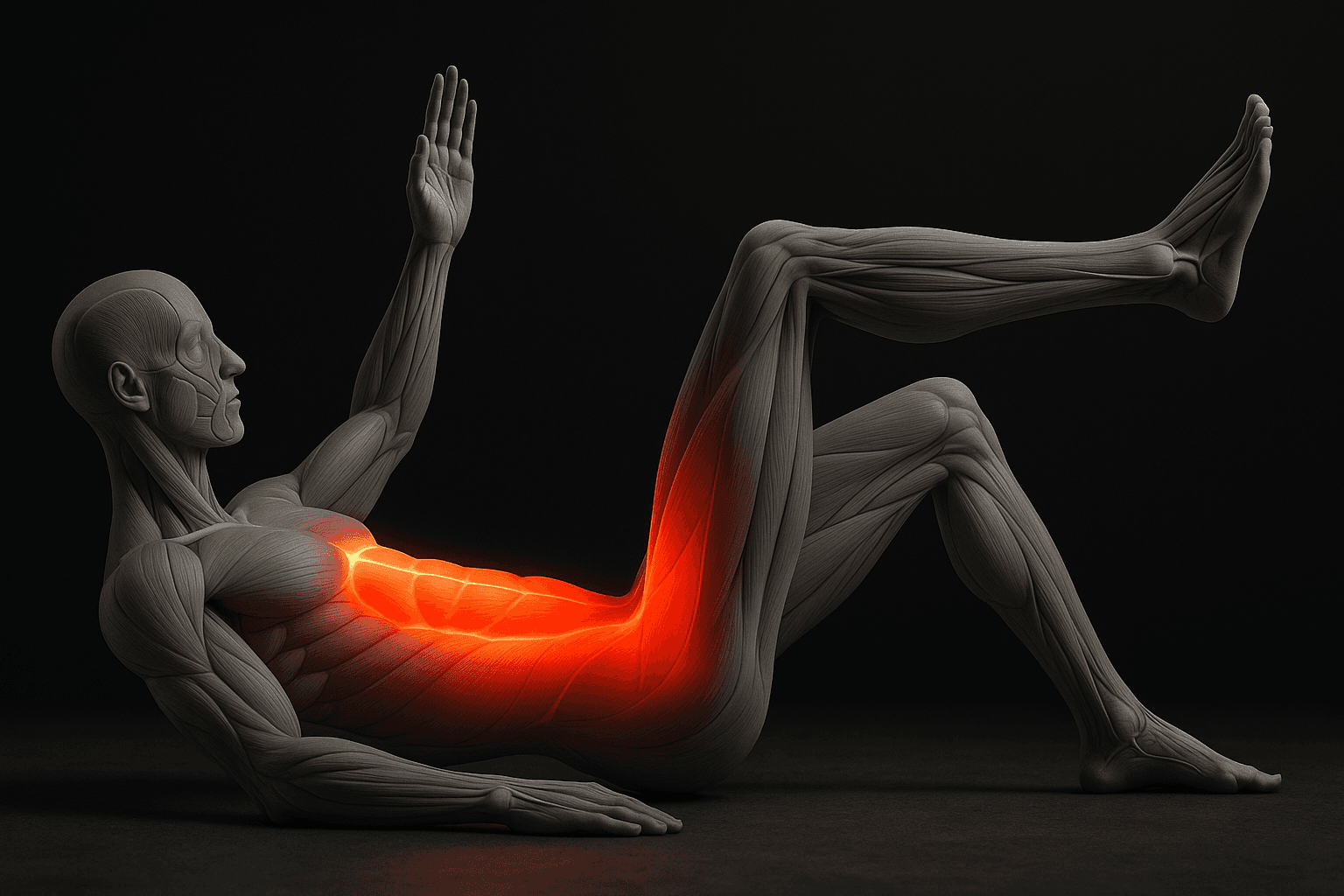
The hollow body hold is an isometric anterior‑core drill teaching posterior pelvic tilt, flattened ribcage, and whole‑body tension (glutes and quads engaged). It’s excellent for anti‑extension strength—resisting the spine’s tendency to arch under load. You might replace it at home because: limited equipment, lower‑back sensitivity to full leg extension, or a need for easier progressions that keep training stimulus.
Which at‑home alternatives actually preserve the hollow’s key demands?
Below are 5 practical substitutions with minimal equipment. For each I list what it preserves, what it sacrifices, and when it’s an adequate swap.
- Dead Bug (bodyweight)
- How: Lie on your back, posterior pelvic tilt, opposite arm and leg lower slowly while keeping pelvis stable.
- Preserves: Anti‑extension control, coordination between limbs and core.
- Loses: The whole‑body tension seen in a full hollow (less quad/glute engagement).
- When adequate: If you lack hamstring/hip flexibility or can’t tolerate legs extended; good early rehab/progression.
- Progression: Increase range/speed control, add a light dumbbell in the hand or band around feet.
- Tucked Hollow Hold (bodyweight)
- How: Same hollow posture but knees tucked toward chest to reduce lever arm.
- Preserves: Posterior pelvic tilt and rib‑down position, easier to maintain for beginners.
- Loses: Maximal anti‑extension demand from long lever (straight legs).
- When adequate: Use as gateway for beginners, or during sessions focused on volume of quality holds.
- Progression: Move to one leg extended, then full hollow.
- Band‑Resisted Plank (band + bodyweight)
- How: Standard forearm or high plank with a resistance band pulling you into extension; resist the band’s pull.
- Preserves: Anti‑extension under external perturbation and whole‑body tension.
- Loses: Exact hollow shape (pelvis tilt and rib position differ), but trains anti‑extension in a functional context.
- When adequate: Good when legs/hips tolerate axial load and you want carryover to pressing/press stability.
- Progression: Use stronger band, change leverage (elevate feet), or add unilateral arm/leg movements.
- Dumbbell Hollow/Weighted Dead‑Bug (dumbbell)
- How: Hold a light dumbbell overhead while performing an abbreviated hollow or controlled dead‑bug lowers.
- Preserves: Anterior chain anti‑extension under axial load; increases demand on shoulder‑stability if overhead.
- Loses: Pure hollow position can be compromised if shoulder mobility is limited.
- When adequate: If you need progressive overload beyond bodyweight and have safe shoulder positioning.
- Progression: Increase dumbbell load or switch to heavier single‑arm variations with strict form.
- Floor L‑Sit Progressions (bodyweight, chair or parallettes optional)
- How: Start with tuck L‑sit on the floor or between chairs, make legs longer over time.
- Preserves: Intense anterior core tension and hip‑flexor strength under isometric load.
- Loses: The hollow’s posterior pelvic tilt emphasis can be different—L‑sits often show stronger hip flexor bias.
- When adequate: Good to develop short‑range anti‑extension and carryover to gymnastics/calisthenics patterns.
- Progression: Increase leg straightness/time, move to parallettes or rings for harder leverage.
How should I program these alternatives?
Training frequency: 2–3 sessions per week for targeted anterior core work, integrated into full‑body sessions. Sets and reps: begin with 2–3 sets of 10–30 seconds for isometric holds or 6–12 controlled reps for dynamic versions; progress toward 3–5 sets of 30–60 seconds or more challenging variations. Prioritize technique: keep ribs down, posterior pelvic tilt, and breathing controlled. If soreness or fatigue reduces form quality, reduce time or intensity (deload).
Comparison table: what each alternative offers
| Exercise | Equipment | Preserves anti‑extension? | Whole‑body tension | Ease to scale | Good for beginners? |
|---|---|---|---|---|---|
| Dead bug | None | Yes | Moderate | High | Yes |
| Tucked hollow | None | Yes (reduced) | Moderate | Very high | Yes |
| Band‑resisted plank | Band | Yes (functional) | High | Medium | Yes |
| Dumbbell hollow | Dumbbell | Yes (increased load) | High | Medium | No (needs control) |
| L‑sit | Chair/parallettes | Partly (hip flexor bias) | High | Medium | Progression required |
When is an at‑home swap NOT adequate and the gym or coach is warranted?
Consider moving to gym or supervised coaching when: you need systematic heavy axial loading (barbell anti‑extension with ab wheel or loaded carries), you plateau despite progressive overload, your technique breaks down under modest load, or you experience persistent pain. A coach or physical therapist can assess motor patterns and prescribe regressions or targeted corrective work.
Safety note: stop any drill immediately if you feel sharp or radiating pain. If you have a history of spinal pathology, recent surgery or persistent symptoms, consult a qualified health professional before progressing. This article does not diagnose or provide medical advice.
What can’t an app or AI coaching do for my hollow training?
No app or AI can watch your movement in real time, palpate for tenderness, or make hands‑on corrections. Remote programs may give useful progressions and logging, but they can’t fully replace a qualified coach’s live feedback for form correction, nor can they perform clinical assessment for injury or rehabilitation. Also remember: a plan only works if you follow it consistently.
Limitations
- This guide focuses on common, evidence‑aligned progressions and programming norms; it does not substitute for personalized assessment.
- Apps and AI can help with reminders and tracking but cannot see or correct your form.
- If you have pain, recent injury, or complicated medical history, seek a qualified professional for diagnosis and rehabilitation.
- Consistency, load progression, and recovery are the primary drivers of improvement—no tool guarantees results without adherence.
If you want to track progress and program variations easily, select a simple tracker that records hold times, band strengths, and load so you can objectively increase stimulus over weeks. Controlled, progressive overload and attention to position will give the best transfer from these home options to athletic or gym tasks.
Frequently asked questions
- Can I replace the hollow body hold with at-home alternatives?
- Yes. Dead bugs, tucked hollow holds, band-resisted planks, weighted hollow/dead-bug variants, and L‑sit progressions each preserve the hollow’s anti‑extension demand to varying degrees. Pick the one that matches your current control, hip‑flexor comfort, and equipment; progressively increase hold time or load to maintain stimulus.
- How often and how long should I practice these hollow alternatives?
- Train core isometrically 2–3 times per week. Start with 2–3 sets of 10–30 seconds for holds (or 6–12 controlled reps for dynamic drills) and progress toward 3–5 sets of 30–60 seconds or harder progressions. Prioritize quality of position over maximal time on day one.
- When should I go to a gym for hollow progressions?
- Consider the gym when you need heavier axial or rotational loading that you cannot safely produce at home (e.g., heavy loaded anti‑extension with a barbell), or when ring/L‑sit work requires equipment. Also go for supervised coaching if pain, compensation, or technical stalling occurs.