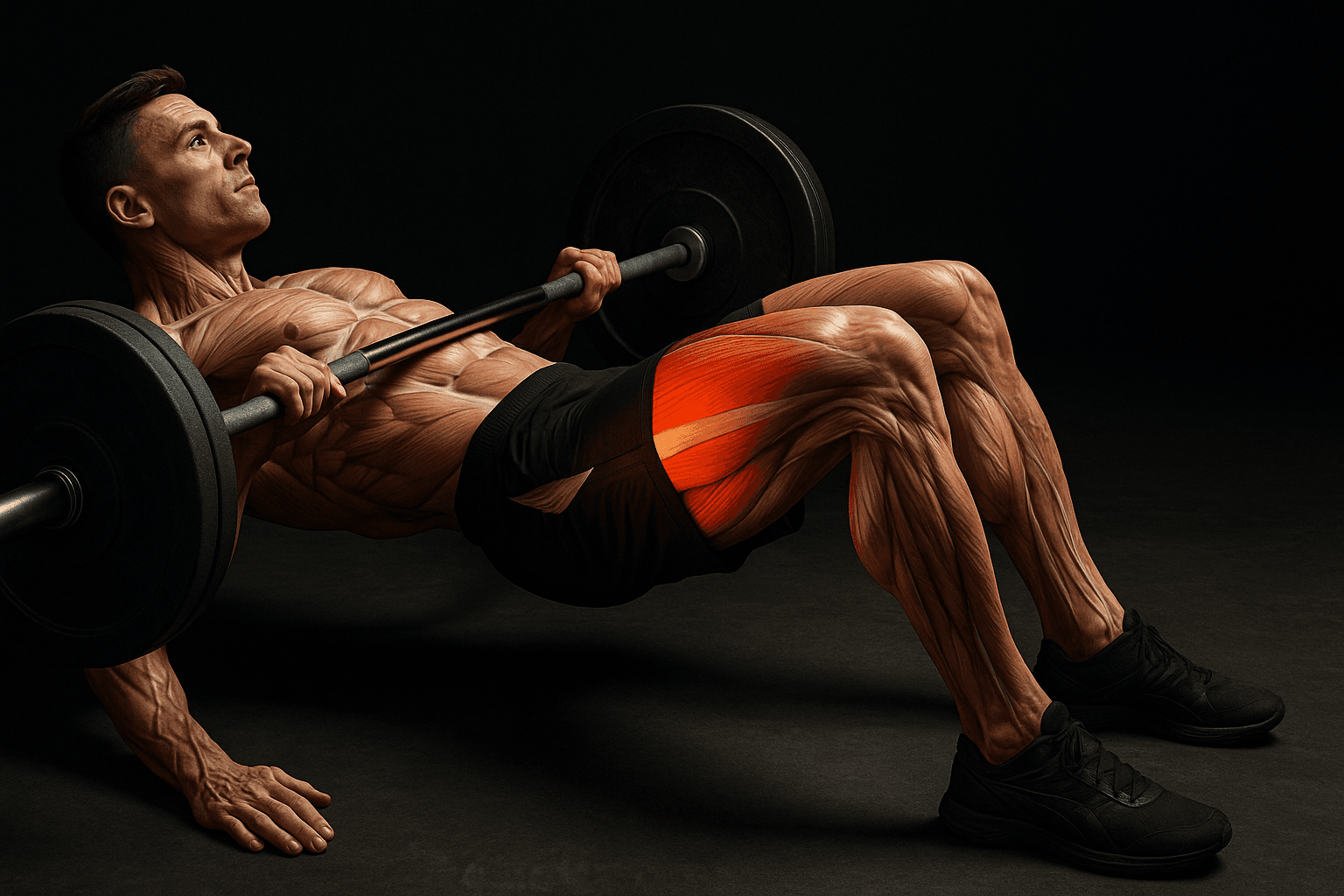
Hip Thrust Alternatives at Home (Minimal Equipment)
Practical at-home substitutes for the barbell hip thrust using bodyweight, dumbbells, or bands — what each keeps, what it loses, and when to return to the gym.
Photo by RepBro.
Banded bridges, single-leg elevated hip thrusts, dumbbell Romanian deadlifts, Bulgarian split squats, and high-rep bodyweight bridges each recreate key parts of the hip-thrust stimulus at home. Some preserve horizontal hip extension; others shift load to a hinge or vertical force. Use them for weeks or months — return to heavy gym loading when you need higher absolute resistance.
What are simple hip-thrust substitutes I can do at home with minimal kit?
- Banded Hip Bridge / Banded Hip Thrust
- Equipment: medium–heavy loop band (or long band) and a bench/couch or floor.
- What it preserves: horizontal hip-extension pattern and peak contraction at lockout; variable resistance helps challenge the top range-of-motion.
- What it loses: absolute external load compared with a loaded barbell — bands top out sooner.
- When it’s adequate: for hypertrophy phases, activation work, and off-weeks when a barbell isn’t available.
- Progression: increase band tension, add pause at top, increase sets/reps, or add a dumbbell on hips.
- Single-Leg Elevated Hip Thrust / Glute Bridge
- Equipment: bench/couch and optionally a dumbbell.
- What it preserves: similar hip-extension mechanics and high glute activation; adds unilateral load and core demand.
- What it loses: total absolute bilateral load; balance limits may reduce load compared with heavy bilateral thrusts.
- When it’s adequate: when you want per-leg overload, correct left-right imbalances, or don’t have heavy weights.
- Progression: increase reps, tempo, add weight (dumbbell/plate), or move to a shorter stance to increase demand.
- Dumbbell Romanian Deadlift (RDL)
- Equipment: pair of dumbbells or single dumbbell.
- What it preserves: hip-hinge pattern and eccentric control of the posterior chain — effective for hamstrings and glute strength via hip extension under load.
- What it loses: less emphasis on peak hip-extension lockout and horizontal load on glutes compared with thrusts.
- When it’s adequate: when you’re prioritising posterior-chain strength, hamstring development, or heavier absolute load at home (dumbbells allow heavier loading than bands alone).
- Progression: heavier dumbbells, slower eccentrics, or more sets.
- Bulgarian Split Squat (rear-foot elevated)
- Equipment: bench/couch and dumbbell(s) or bodyweight.
- What it preserves: strong unilateral loading and capacity to load each leg with significant resistance while training single-leg stability.
- What it loses: comparatively more quad emphasis and a more vertical force vector than the horizontal thrust.
- When it’s adequate: for building leg strength, unilateral hypertrophy, and carrying over to improved thrust stability.
- Progression: increase load, depth, or do deficit versions; pause at the bottom or use slower tempo.
- High-Rep Bridges / Frog Pumps (bodyweight or banded)
- Equipment: none or loop band.
- What it preserves: glute activation and metabolic/hypertrophy stimulus when higher reps are used.
- What it loses: the capacity for heavy, low‑rep strength work; less carryover to maximal strength.
- When it’s adequate: as an accessory on high-volume days, between heavy sets for extra blood flow, or during travel and deload weeks.
How do these options compare to the barbell hip thrust? (comparison table)
| Exercise | Primary stimulus preserved | Max practical progressive overload at home | Equipment | Best when... |
|---|---|---|---|---|
| Banded Hip Bridge | Horizontal hip extension and top-range tension | Moderate (band tension limits absolute load) | Loop/long band (+ bench) | You want thrust mechanics and higher rep power without a barbell |
| Single-Leg Hip Thrust | Unilateral peak hip extension | Moderate (load per leg limited by stability) | Bench/couch + dumbbell optional | Addressing imbalances and training each glute hard |
| Dumbbell RDL | Hip hinge, eccentric hamstring/glute load | High (dumbbells allow substantial load) | Dumbbells | You want posterior-chain strength but lack a barbell |
| Bulgarian Split Squat | Unilateral strength and loadability | High (dumbbells) | Bench + dumbbells | You need single-leg strength and add heavy loading at home |
| High-Rep Bridges | Glute activation and metabolic stress | Low absolute load, high-volume capacity | None or band | You need low-equipment volume or travel options |
How should I structure volume and frequency at home?
- Frequency: train glute-focused movements 2–3 times per week. Split your weekly target across sessions (e.g., two full glute days or three shorter sessions).
- Weekly sets: aim for roughly 8–20 working sets for glute-focused exercises per week, adjusted to training age and recovery. Beginners sit toward the lower end; more experienced lifters toward the higher end.
- Rep ranges: use 4–8 reps for strength when you can load heavily, 8–15 for hypertrophy, and 15–30 for banded/bodyweight work.
- Progressive overload: increase load when you can perform the top of the target rep range with good form; otherwise increase reps, sets, or reduce rest.
- Deloads: plan easier weeks every 4–12 weeks or when performance and motivation fall off.
(Note: these are consensus-style recommendations; individual recovery varies.)
When should I go back to the gym for a barbell hip thrust?
Go back to heavier gym loading if your goal is absolute maximal glute strength or you need to lift progressive, heavy bilateral loads that exceed what bands, single-leg work, or dumbbells provide. Also return when you need specialized equipment (heavy barbell, safety squat bar, calibrated plates) for strength testing or peaking.
What safety notes should I follow?
Stop any exercise that produces sharp or unusual joint pain. Prioritise technique over load: control the descent and avoid lumbar hyperextension at the top. If you have pre-existing back, hip, or knee issues, consult a qualified professional before attempting loaded unilateral work or heavy hinge patterns.
What can apps or AI coaching not do? (LIMITATIONS)
No app or AI can observe and correct your real-time movement as a coach in person can. They can’t diagnose injuries or provide a medical rehabilitation program — that requires a qualified clinician. A tracking app helps with consistency and progressive overload, but it won’t substitute for showing up and practising form. If you suspect a structural injury, seek an in-person assessment.
Safety reminder: none of this is medical advice; consult a qualified professional for persistent pain or injury.
If you want a simple way to track sets, reps, and progression for these home variations, you can log them in RepBro or any training tracker.
References and further reading: follow consensus strength-training guidelines on frequency, volume, and progressive overload; consult exercise-science summaries for EMG and force-vector differences between hip thrusts and hinge/vertical exercises.
Frequently asked questions
- Can banded hip bridges replace barbell hip thrusts?
- Banded hip bridges keep the hip-extension pattern and can progressively overload via band tension and higher reps, so they’re a good substitute short-term. They lose the same linear, heavy top-end loading a barbell provides; for maximal strength or very heavy progressive overload you’ll eventually need heavier gym loading.
- Will single-leg hip thrusts build as much glute strength as bilateral hip thrusts?
- Single-leg hip thrusts raise per-leg loading without heavy equipment and improve unilateral control and hypertrophy. They can approach the stimulus of heavy bilateral thrusts, but total absolute load per leg is often lower; heavy bilateral loading in a gym remains superior for absolute maximal strength.
- How often should I train glutes at home with these alternatives?
- Train glute-focused work 2–3 times per week. Aim for roughly 8–20 weekly working sets for the glutes, split across sessions. Use heavier loading and lower reps for strength-focused work, higher reps or banded sets for volume and metabolic stimulus.