Glute Bridge Alternatives at Home (Minimal Equipment)
Four to five at-home substitutes for the glute bridge using bodyweight, dumbbells, or bands — what each keeps, what it loses, and when to go to a gym.
Photo by RepBro.
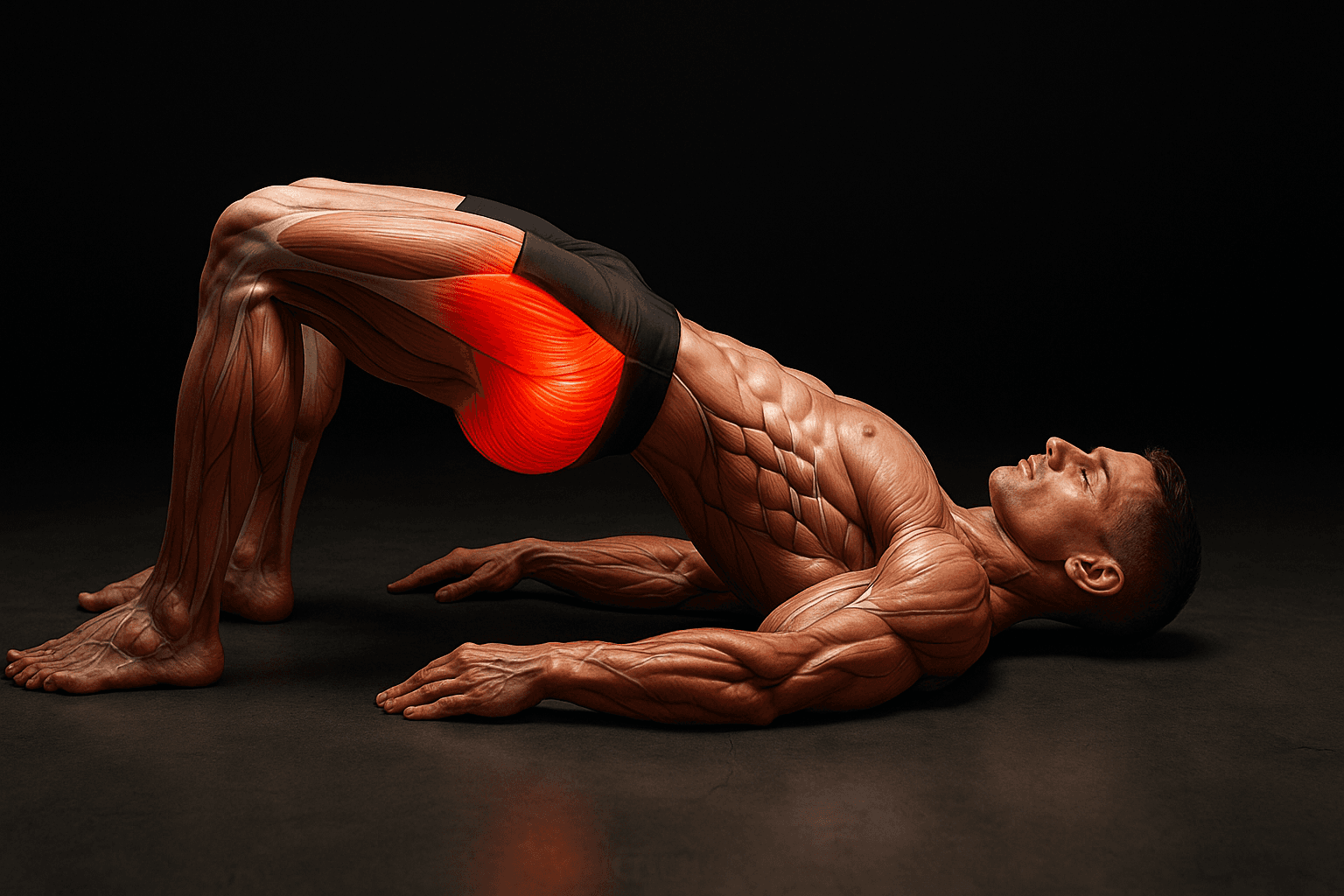
If you can’t do barbell glute bridges, use single-leg bridges, banded bridges, dumbbell hip bridges, Romanian deadlifts (RDLs) and split squats as practical home substitutes. Each preserves hip-extension stimulus but differs in loading pattern, stability demand, and how easily you can progress over time.
What exercises work as glute bridge alternatives at home?
Here are 5 practical substitutes you can do with minimal equipment.
- Single-leg glute bridge (bodyweight)
- What it is: Bridge on one leg, drive hips up while the other leg stays extended.
- Targets: Gluteus maximus, hamstrings, core anti-rotation.
- What it preserves: High hip-extension emphasis and posterior chain activation; strong end-range contraction.
- What it loses: Absolute external load compared with heavy barbell thrusts; less symmetrical loading control.
- Programming: 3–4 sets of 8–15 reps per leg or 6–10 slow reps if you want more intensity (2–3×/week). Progress by adding a dumbbell on the working hip or pausing at the top.
- Cue: Drive through the heel, squeeze the glute at the top, keep ribs down.
- Banded glute bridge (loop band around knees or hips)
- What it is: Double-leg bridge with a resistance band providing extra tension at the top (or lateral band for abduction focus).
- Targets: Glute max and med; increased tension through end range.
- What it preserves: End-range hip extension and continuous tension across the lift.
- What it loses: Max absolute load unless you have very heavy bands.
- Programming: 3–5 sets of 8–20 reps. Progress by using thicker bands, slowing the negative, or pausing at the top.
- Dumbbell glute bridge / dumbbell hip thrust (single or double)
- What it is: Dumbbell placed on hips while performing a bridge or hip thrust (back can be on a couch/bench for elevated version).
- Targets: Glute max, hamstrings, quads to a lesser extent.
- What it preserves: Similar loading pattern to barbell hip thrusts when load is sufficient; vertical load allows progressive overload.
- What it loses: Limited load compared to barbell setups once dumbbell weight is capped.
- Programming: 3–4 sets of 6–12 reps. Increase weight when you can comfortably do 12 reps.
- Romanian deadlift (single- or double-leg) with dumbbells
- What it is: Hip-hinge movement with long hamstring tension; single-leg increases glute focus and balance demand.
- Targets: Glutes, hamstrings, spinal erectors.
- What it preserves: Hip-hinge mechanics and eccentric loading of posterior chain.
- What it loses: The horizontal push and peak hip-extension emphasis of the bridge; less isometric top-range squeeze.
- Programming: 3–4 sets of 6–12 reps (heavier) or 8–15 (moderate). Use slow eccentrics to increase time under tension.
- Bulgarian split squat or reverse lunge (dumbbell)
- What it is: Single-leg loaded knee-dominant exercises performed with bodyweight or dumbbells.
- Targets: Glutes, quads, stability muscles.
- What it preserves: Unilateral loading and functional transfer to single-leg strength.
- What it loses: Direct horizontal hip extension; more knee flexion increases quadriceps involvement.
- Programming: 3–4 sets of 6–12 reps per leg. Add load when reps reach the top end.
How do these options compare at a glance?
| Exercise | Equipment | Primary emphasis | What it preserves | What it loses |
|---|---|---|---|---|
| Single-leg glute bridge | None / dumbbell optional | Hip extension, unilateral | Strong glute contraction, pelvic stability | Absolute load ceiling (bodyweight) |
| Banded bridge | Mini-band / loop band | Continuous tension, glute med activation | End-range tension, abduction cue | Max external load |
| Dumbbell hip bridge | Dumbbell | Progressive external load, hip extension | Progressive overload, heavier loading than bands | Not as heavy as barbell setups |
| Romanian deadlift | Dumbbells | Hip hinge, eccentric hamstring loading | Posterior chain eccentric stress | Less top-range glute squeeze |
| Bulgarian split squat | Dumbbells | Unilateral leg strength, stability | Unilateral strength and hip drive | More knee-dominant, less horizontal thrust |
When is an at-home swap adequate and when should I use a gym?
Use at-home alternatives when: you need a practical way to train glutes consistently, you’re building a foundation, rehabbing minor imbalances, or you don’t require near-maximal loads. These exercises support hypertrophy and strength progression for most lifters for months.
Consider the gym when: you want to pursue very high absolute strength or maximal hip-thrust loading (barbell with heavy plates), need machines for specific rehab settings, or require precise incremental loading beyond your dumbbell/band range. If progress stalls despite sensible progression (load, volume, frequency), a gym setup makes heavier loading and micro-loading easier.
How should I program these at home to make progress?
Follow established resistance-training guidelines: work glutes 2–3 times per week, 2–4 sets per exercise. For strength/hypertrophy aim for roughly 6–12 reps with loads that make the last 1–3 reps challenging. For muscular endurance, use 12–20 reps. Increase load or reps when you can complete upper-range reps with good form for all sets. Include a lighter deload week every 4–8 weeks or when performance drops.
Safety note: stop if you feel sharp joint or nerve pain and consult a qualified professional. These tips are guidance only — they do not diagnose medical conditions or guarantee injury prevention.
What safety and form cues should I follow?
- Hips: drive through heels; avoid hyperextending the lower back at the top. Keep pelvis neutral.
- Band placement: for lateral bands, place above knees to bias glute med; for hip-thrust bands, place around hips where resistance peaks at top.
- RDLs: hinge at hips with slight knee bend; maintain neutral spine and tension in hamstrings.
- Load progression: add weight only when you can control form for full sets and reps.
Track sets, reps, and load week-to-week; small, consistent increases are how strength and hypertrophy accumulate. You can use RepBro to log progressive overload and program variations if you wish.
What can apps and AI coaching not do?
Apps and AI can track workouts, suggest progressions, and remind you of volume targets, but they cannot see your form, feel your pain, or diagnose injuries. No app replaces a hands-on qualified coach or clinician for technique fixes, rehab, or medical evaluation. Plans only work if you show up — consistency and sensible recovery are the main drivers of results.
Limitations: This article summarizes practical options and established training norms. Individual needs (injury history, mobility limitations, sport priorities) require a personalized assessment. For pain that persists or for post-injury programming, consult a physiotherapist or certified strength coach.
References and further reading: Consult standard resistance training guidelines from organizations such as the American College of Sports Medicine for set/rep recommendations and progression principles.
Frequently asked questions
- Can I build glute strength without barbell hip thrusts?
- Yes. Single-leg bridges, banded bridges, dumbbell hip thrusts, Romanian deadlifts, and split-squat variations can produce meaningful glute stimulus. Progression comes from adding load, increasing reps, or manipulating tempo. Heavy barbell loading may still be needed for maximal strength goals.
- How often should I train glutes with these home exercises?
- Train glutes 2–3 times per week, using 2–4 sets per exercise. Aim for 8–12 reps for strength/hypertrophy or 12–20 for endurance work. Follow standard recovery: increase volume gradually and include lighter weeks every 4–8 weeks.
- Are bands as effective as dumbbells for glute growth?
- Bands provide continuous tension and are very useful, but they often top out at lower absolute load than dumbbells or barbells. For most lifters bands are sufficient for weeks or months; heavier dumbbells or gym equipment may be needed as you outgrow band resistance.